Artwork
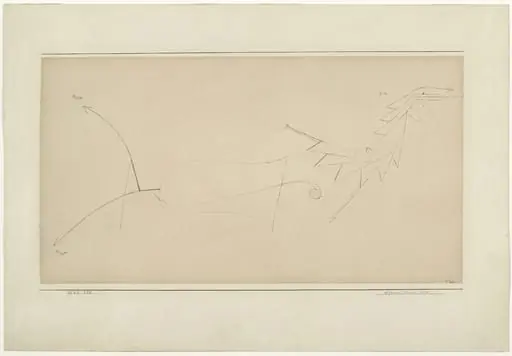
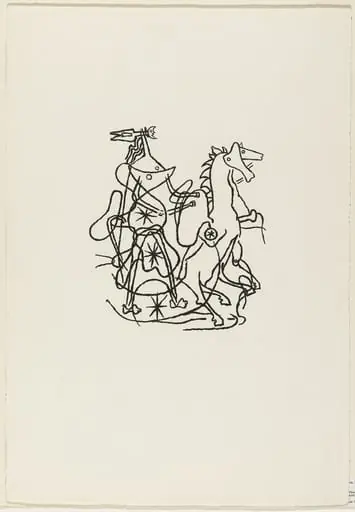
Komischer Reiter (Comic Rider)
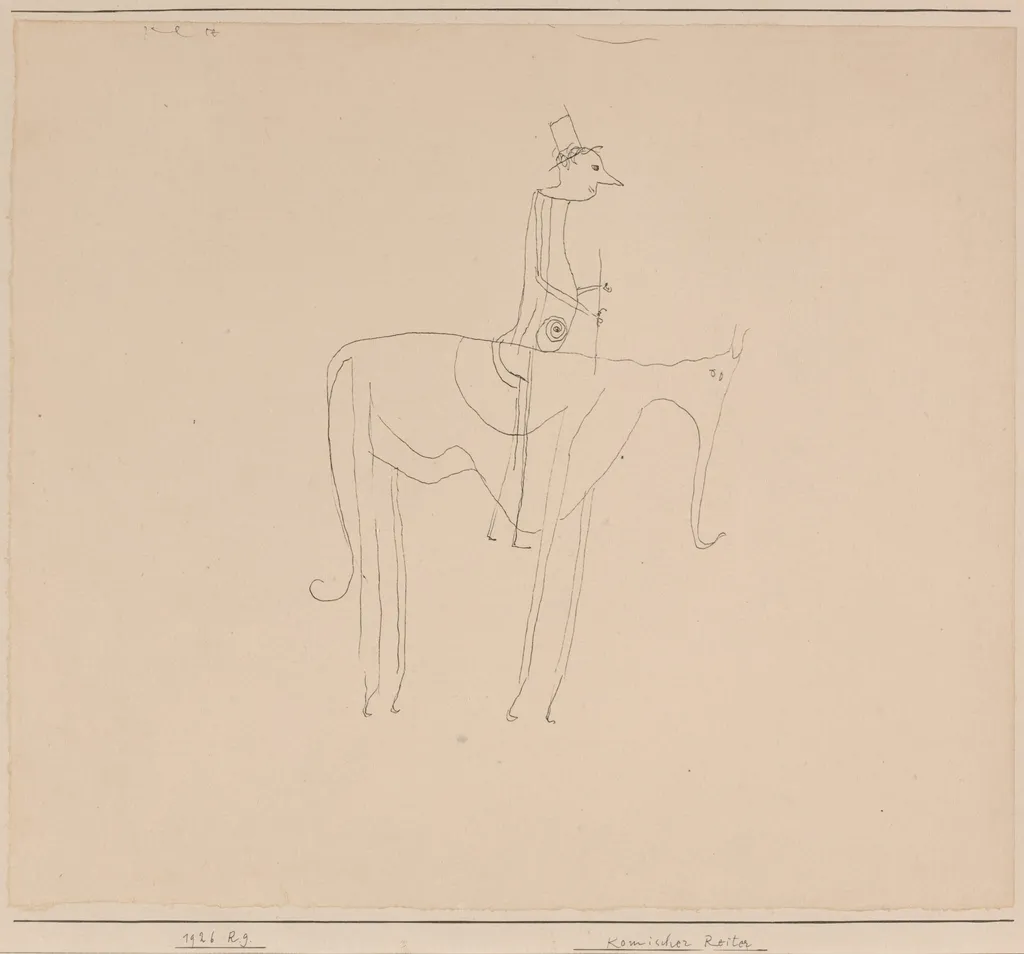
Komischer Reiter (Comic Rider) is an ink drawing by Paul Klee. It dates from 1921 and is held in the collection of the National Gallery of Art.
- Inscription
- Inscribed:lower left of mount: 1926 Rg; lower right in black ink: Komischer Reiter; upper right in black ink: Klee
About this work
Overview
The work exemplifies his interest in reducing forms to essential lines and shapes, blending spontaneity with deliberate structure.
Paul Klee produced Komischer Reiter in 1921 as a pen-and-ink drawing on laid paper, later mounted for preservation. The work exemplifies his interest in reducing forms to essential lines and shapes, blending spontaneity with deliberate structure. Though executed in monochrome, the piece carries a sense of movement and humor, characteristic of Klee’s broader exploration of visual language beyond traditional representation.
Subject & Meaning
The drawing depicts a slender, stick-like rider atop an abstract, blob-like equine form. The rider’s face, rendered with minimal dots and a faint mustache, suggests a caricatured persona rather than a realistic figure. The awkward posture and exaggerated proportions evoke a sense of whimsy and instability, possibly reflecting Klee’s engagement with the absurd and the childlike as valid modes of artistic expression.
Technique & Style
Klee employed swift, uneven ink lines to construct both rider and mount, avoiding modeling or shading. The wobbly contours and unrefined edges convey immediacy, as if the image were sketched in one continuous motion. This approach aligns with his broader practice of treating drawing as a form of visual thinking, where line becomes both structure and expression, unburdened by realism or color.
History & Provenance
Created during Klee’s tenure at the Bauhaus, the work emerged from a period of intense experimentation with form and symbolism. It was likely kept in his personal collection before entering institutional hands. The paper’s original laying and subsequent mounting reflect standard conservation practices of the time, preserving the fragile ink work while allowing for display.
Context
In early 1920s Germany, Klee was synthesizing influences from Expressionism, Cubism, and emerging Surrealist ideas. Komischer Reiter reflects this synthesis: its simplified forms echo children’s drawings and medieval illustrations, while its playful distortion resonates with contemporary avant-garde interests in the irrational and the subconscious, distancing itself from academic norms.
Legacy
The drawing stands as a quiet example of Klee’s enduring contribution to modern graphic art. Its economy of means and emotional resonance influenced later generations of illustrators and abstract artists. Rather than seeking grandeur, it affirms the expressive potential of the humble sketch, expanding the boundaries of what drawing could convey beyond representation.
Own this work as a print
Artist & collection
Artist
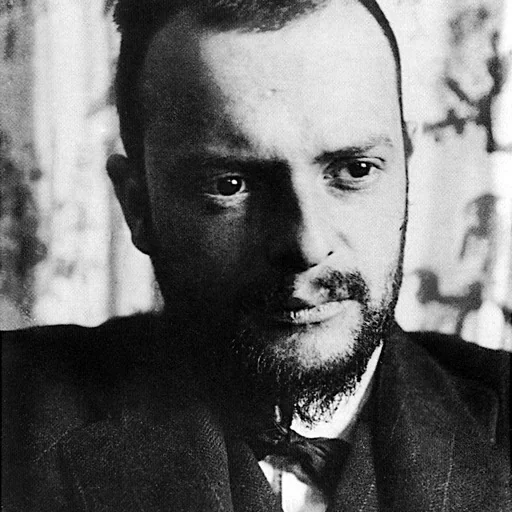
Paul Klee (German:; 18 December 1879 – 29 June 1940) was a Swiss-born German artist.