Artwork
William Tell Refusing to Honor Governor Gessler's Hat
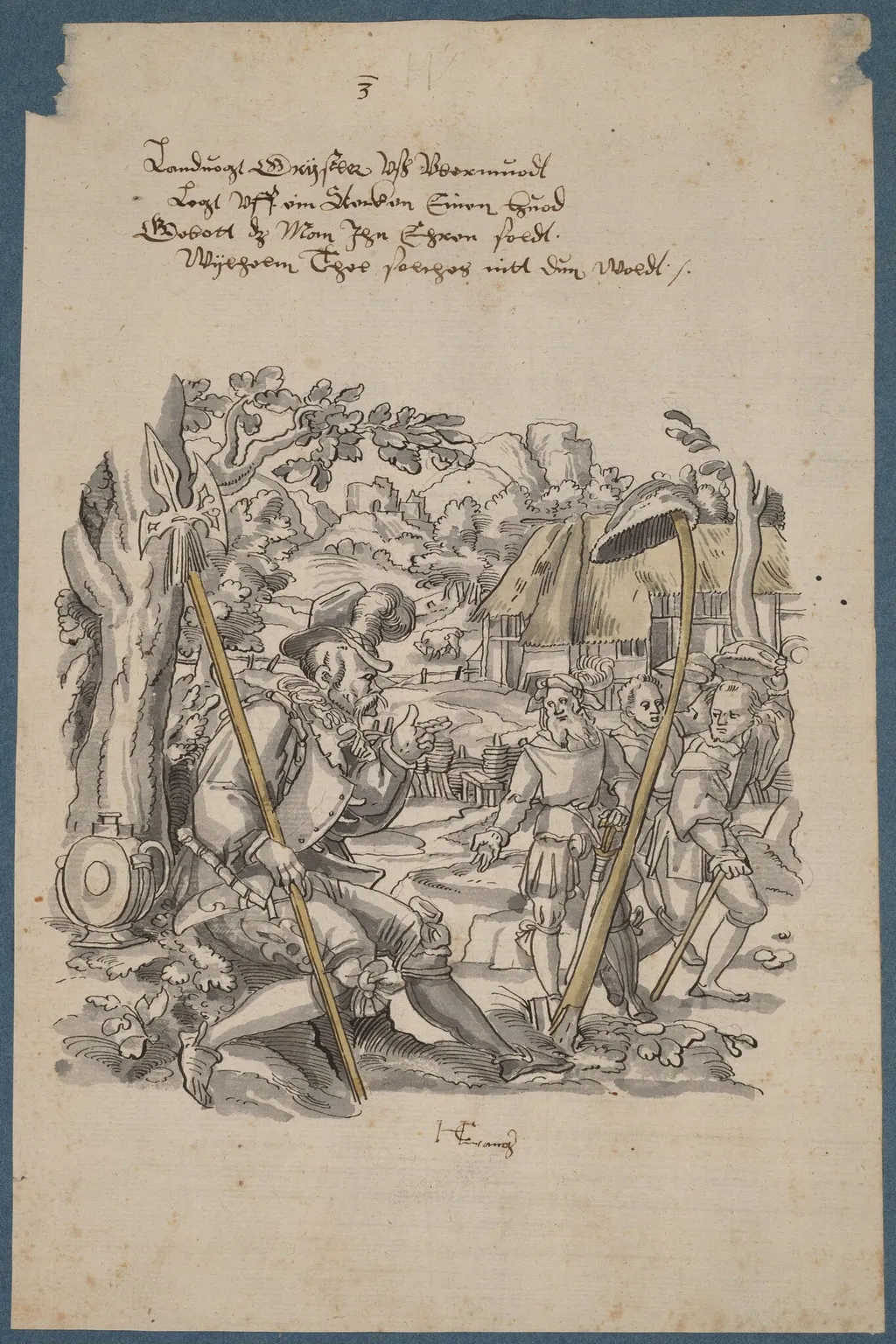
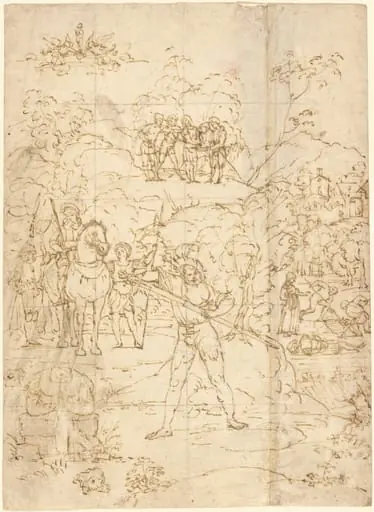
William Tell Refusing to Honor Governor Gessler's Hat is an ink drawing by the Baroque artist Hans Kaspar Lang the Elder. It dates from 1624 and is held in the collection of the National Gallery of Art.
- Inscription
- Inscribed:upper center in brown ink: 3 / [not deciphered]; lower center in brown ink: HLang
About this work
Overview
Created around 1624, this pen-and-ink drawing with grey and yellow washes on laid paper is attributed to Hans Kaspar Lang the Elder. The work depicts a moment from the William Tell legend, rendered in a compact composition that combines line work with subtle tonal washes to convey a narrative scene in a forested setting.
Subject & Meaning
The image captures a confrontation between three figures near a modest hut. One figure kneels, clutching his hat and refusing to bow to it, while another stands upright, gazing sternly at the protester. A third onlooker watches from the side.
The refusal to touch the hat symbolizes defiance against the authority of Governor Gessler, echoing the broader theme of resistance in the Swiss folk tale.
Technique & Style
Lang employs rapid, expressive lines to outline the figures and surrounding trees, while cross‑hatching creates depth in the shadows. The addition of grey and yellow washes over graphite adds atmospheric tone to the rocky ground and foliage. This combination of drawing and wash reflects early 17th‑century Northern European practices for narrative sketches.
History & Provenance
The drawing is catalogued as a work by Hans Kaspar Lang the Elder, a German artist active in the early 1600s. Its provenance traces back to private collections before entering a museum inventory in the late 20th century, where it has been documented as part of the artist’s series of illustrative studies of popular legends.
Context
The composition belongs to a period when visual artists frequently illustrated national myths to reinforce cultural identity. The William Tell story, widely circulated in German‑speaking regions, provided a moral exemplar of civic virtue. Lang’s rendering aligns with contemporary print‑culture, where such images were reproduced for pamphlets and book illustrations.
Own this work as a print
Artist & collection