Artwork
High Bridge at Night, New York City
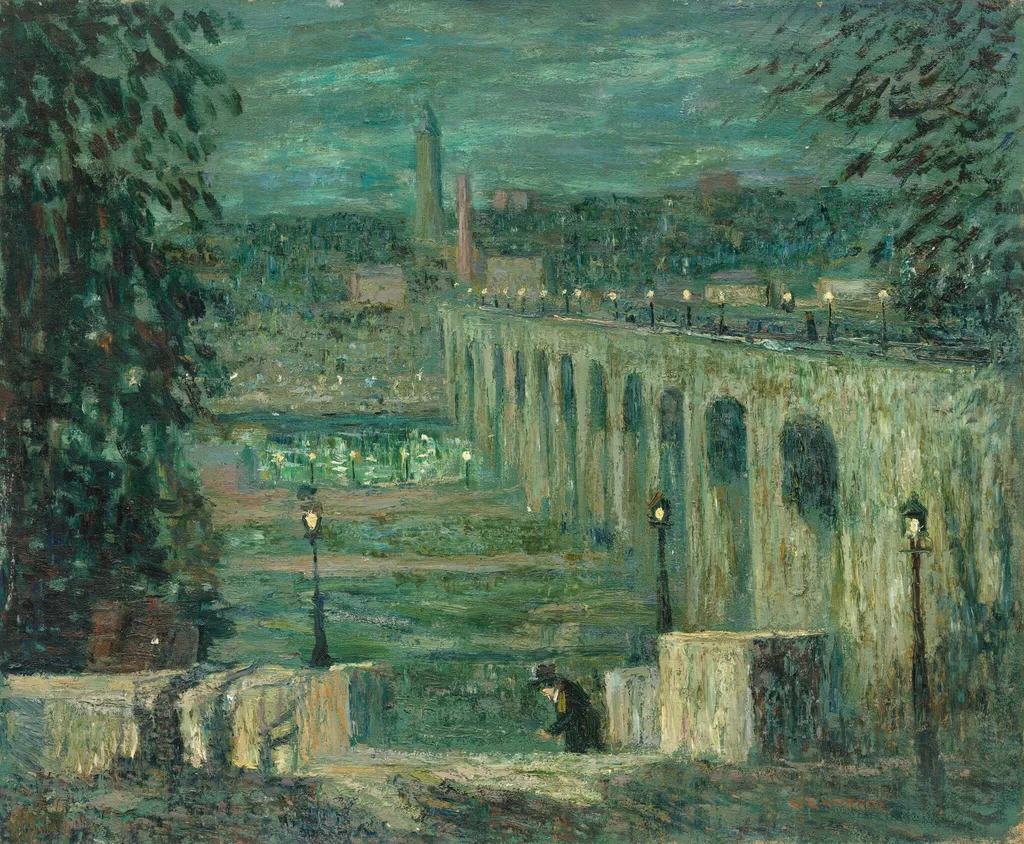
High Bridge at Night, New York City is an oil painting by the American Impressionist artist Ernest Lawson. It dates from 1915 and is held in the collection of the National Gallery of Art.
- Inscription
- Inscribed:lower right: E. Lawson.
About this work
Subject & Meaning
Its composition captures the interplay of artificial light and shadow, suggesting a contemplative view of city life after dark.
High Bridge at Night, New York City is an oil on canvas painting by Ernest Lawson created in 1915. It portrays the High Bridge in New York City illuminated after dark, using light and shadow to emphasize the structure’s architectural form within an urban nocturnal setting. The work reflects early twentieth-century American modernism’s interest in contemporary infrastructure and cityscapes, aligning with Lawson’s broader depictions of industrial and civic subjects.
The painting is held in the collection of the National Gallery of Art in Washington, D.C., having been gifted by Alice L. and Richard Schoen in 2016.
The nocturnal scene underscores themes of modernity and urban transformation, with the bridge serving as both a literal and symbolic conduit between boroughs, rendered in a style marked by loose brushwork and tonal contrast. Its composition captures the interplay of artificial light and shadow, suggesting a contemplative view of city life after dark.
The work measures 63.5 cm in height by 76.2 cm in width.
Technique & Style
The painting is executed in oil on canvas, a medium confirmed by both provenance and material specifications. It measures 63.5 centimeters in height by 76.2 centimeters in width, reflecting its large-scale composition. The work demonstrates a nocturnal urban landscape rendered with textured brushwork and muted tonal contrasts, characteristic of early 20th-century American tonalism.
Its handling emphasizes atmospheric depth and structural clarity, aligning with the formal qualities observed in Lawson's broader oeuvre.
History & Provenance
Ernest Lawson painted High Bridge at Night, New York City in 1915, depicting the Harlem River bridge illuminated after dark. The work remained in the artist's possession until it was acquired by Alice L. and Richard Schoen of Falls Church, Virginia. In 2016, the couple gifted the painting to the National Gallery of Art in Washington, D.C., where it now resides in their collection.
The canvas measures 63.5 cm by 76.2 cm. This provenance is documented in the National Gallery of Art's records and corroborated by the work's entry in the National Gallery of Art's collection database.
The painting was created as an oil on canvas work, reflecting Lawson's interest in urban landscapes and nocturnal lighting effects. Its execution dates to the early twentieth century, aligning with the artist's mature period. The work has been part of the National Gallery of Art's permanent collection since the 2016 gift, ensuring its preservation and public access as part of the institution's holdings.
High Bridge at Night, New York City is held by the National Gallery of Art in Washington, D.C. The painting entered the museum's collection in 2016 as a gift from Alice L. and Richard Schoen of Falls Church, Virginia. No prior exhibition history is documented in the available sources.
Context
Lawson's 1915 oil on canvas High Bridge at Night, New York City entered a private collection in Falls Church, Virginia before being gifted to the National Gallery of Art in 2016. The work, measuring 63.5 by 76.2 centimeters, is part of the National Gallery's holdings in Washington, D.C.. It exemplifies Lawson's impressionistic treatment of urban landscapes, situating the nocturne within his broader exploration of New York's infrastructure and atmospheric effects.
Overview
Ernest Lawson’s oil on canvas, High Bridge at Night, dates from around 1915. The nocturnal scene depicts New York’s historic High Bridge, rendered with a palette dominated by cool greens and blues. A solitary figure is seated on a low wall in the foreground, while streetlamps illuminate the bridge’s series of arches.
Artist & collection