Artwork
Bridge at Argenteuil on a Gray Day
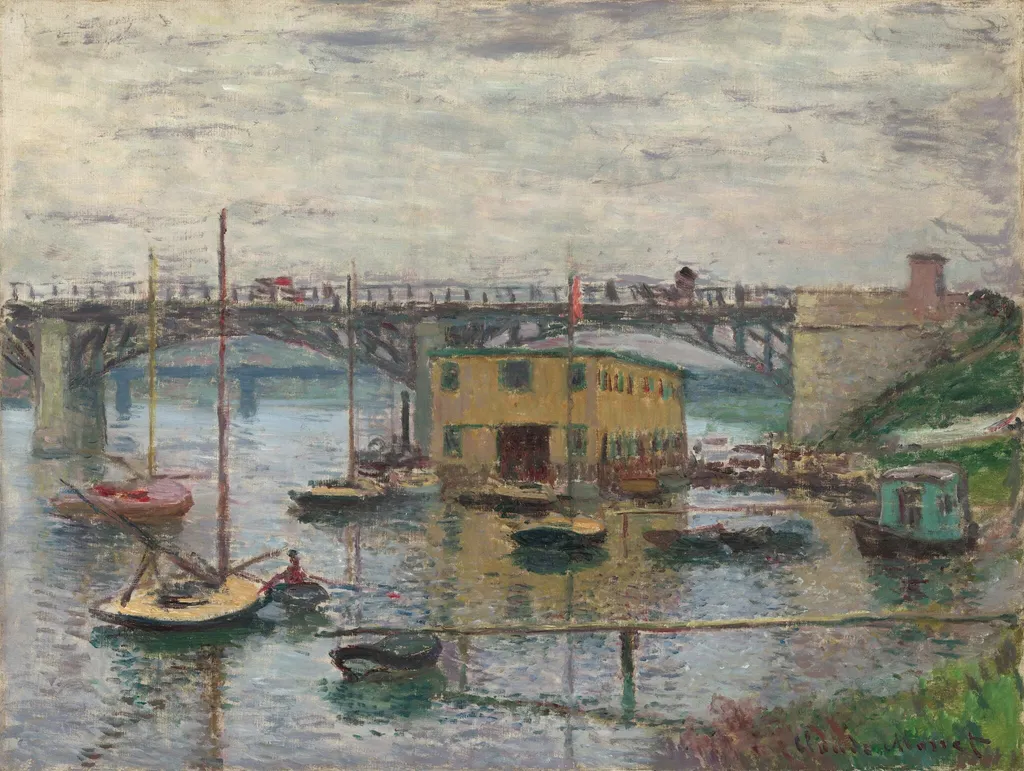
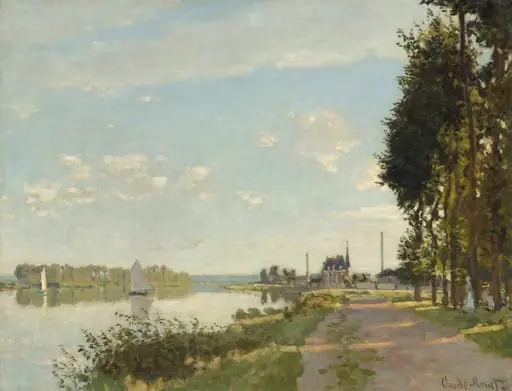
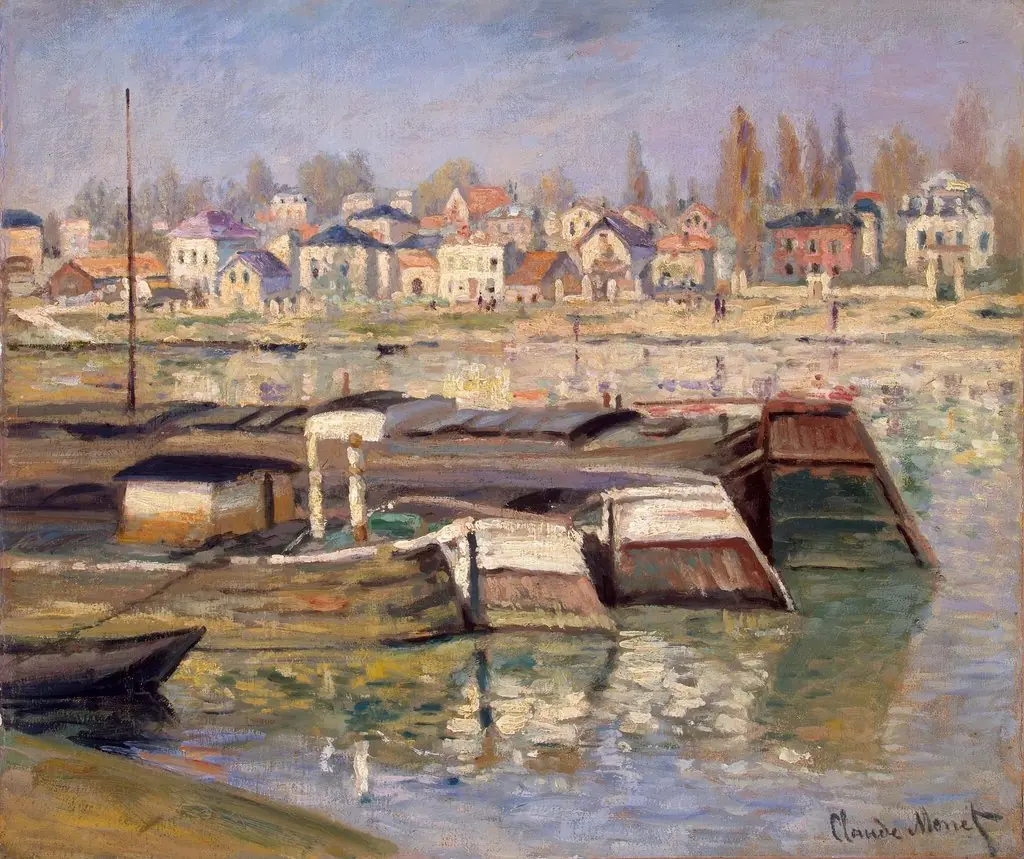
Bridge at Argenteuil on a Gray Day is an oil painting by the Impressionist artist Claude Monet. It dates from 1876 and is held in the collection of the National Gallery of Art.
- Inscription
- Inscribed:lower right: Claude Monet
About this work
Subject & Meaning
The scene centers on the railroad bridge spanning the Seine at Argenteuil, a motif that Monet treated repeatedly during his stay in the Paris suburbs in the mid‑1870s. The composition emphasizes the bridge’s iron trusses and stone piers, set against a sky of muted grays and pale blues that lends the industrial structure a quiet, almost lyrical presence. A small sailboat glides beneath the arches, anchoring the scene in everyday life and evoking the leisure activities that Argenteuil’s riverfront fostered among Parisians.
Rather than a dramatic statement on modernity, the work registers the harmonious coexistence of new infrastructure with local boating culture, rendered in the muted palette and loose brushwork characteristic of Monet’s plein‑air practice of the period.
Technique & Style
The application of oil paint to the woven support allows for the textural qualities associated with the artist's outdoor studies of the Argenteuil landscape.
Executed in 1876, this work is an oil painting on canvas measuring 61 by 80.3 centimeters. The composition features a boat as its primary subject, rendered through Monet's characteristic handling of light and atmosphere typical of the Impressionist style. The application of oil paint to the woven support allows for the textural qualities associated with the artist's outdoor studies of the Argenteuil landscape.
History & Provenance
The painting Bridge at Argenteuil on a Gray Day was created by Claude Monet in 1876 as an oil on canvas. Its earliest recorded owner was the Rosenberg gallery in Paris; on 1 March 1900 it was sold to Durand‑Ruel in New York and Paris. In 1938 the work passed to E.J. van Wisselingh of Amsterdam and then the same year to Canadian collector Henry Stevenson Southam.
Although some records suggest a possible connection to the Whitney family, later inquiries confirmed no Whitney ownership. The painting subsequently moved through the Carroll Carstairs Gallery in New York before being acquired by Ailsa Mellon Bruce on 27 June 1946. Upon her death in 1969, Bruce bequeathed the canvas to the National Gallery of Art, Washington, D.C., where it remains.
Claude Monet's Bridge at Argenteuil on a Gray Day (1876) is held in the collection of the National Gallery of Art in Washington, D.C. The work entered the museum's holdings in 1970 as a bequest from Ailsa Mellon Bruce, who had purchased it from the Carroll Carstairs Gallery in New York on June 27, 1946. Prior to this, the painting passed through the hands of Henry Stevenson Southam in Ottawa and the dealer E.J. van Wisselingh in Amsterdam. While the work was potentially lent by Southam to an exhibition at the National Gallery in Ottawa in May 1944 under the title Port d'Argenteuil, no other specific exhibition history is documented in the provided records.
Legacy
Bridge at Argenteuil on a Gray Day, painted by Claude Monet in 1876, is an oil on canvas work measuring 61 cm by 80.3 cm and depicting a boat on the Seine. The painting entered the National Gallery of Art, Washington, D.C., through the 1970 bequest of Ailsa Mellon Bruce, having previously passed through several European dealers and collectors. Its inclusion in a major public institution has ensured continued scholarly examination and public view, reinforcing Monet’s standing as a central figure in Impressionist landscape painting.
The work’s provenance, documented from Paris to New York to Amsterdam before its acquisition, illustrates the transnational circulation of Impressionist art in the early twentieth century.
Overview
Bridge at Argenteuil on a Gray Day (1876) is an oil on canvas by Claude Monet depicting the railway bridge spanning the Seine at Argenteuil. Executed during the artist's residence in this suburb, the work captures a specific atmospheric condition where overcast skies diffuse the light, rendering the scene in a restricted palette of grays, blues, and muted whites. The composition is structured by the horizontal line of the bridge, which divides the canvas between the reflective water below and the sky above.
A small boat navigates the river beneath the arches, providing a sense of scale and human presence within the industrial landscape. Monet employs his characteristic Impressionist technique, utilizing loose, rapid brushstrokes to suggest the texture of the water and the fleeting quality of the weather rather than defining precise details. This painting exemplifies Monet's focus on the effects of light and atmosphere on the modern environment, a central concern of his career during the mid-1870s.
The work reflects the shift in French art toward capturing contemporary life and the changing relationship between nature and industry, solidifying Monet's role as a leading figure in the Impressionist movement.
Context
This artwork was created during Claude Monet's period of residence in Argenteuil, a town located near Paris. While living there, the artist frequently depicted the local river landscapes, which became a significant and recurring theme in his oeuvre. These familiar settings provided Monet with ample opportunities to meticulously study and capture the subtle, ever-changing effects of light and atmosphere on everyday scenes.
Own this work as a print
Artist & collection
Artist
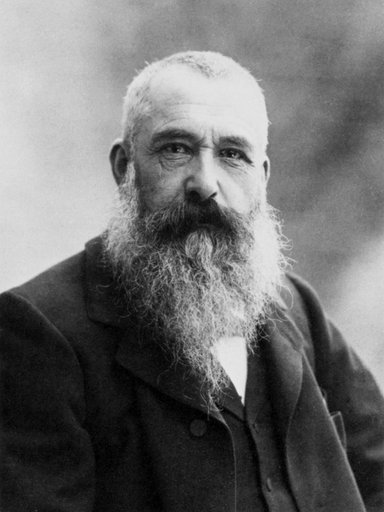
Oscar-Claude Monet was a French painter and founder of Impressionism who is seen as a key precursor to modernism, especially in his attempts to paint nature as he perceived it.