Artwork
Mercury and Pegasus
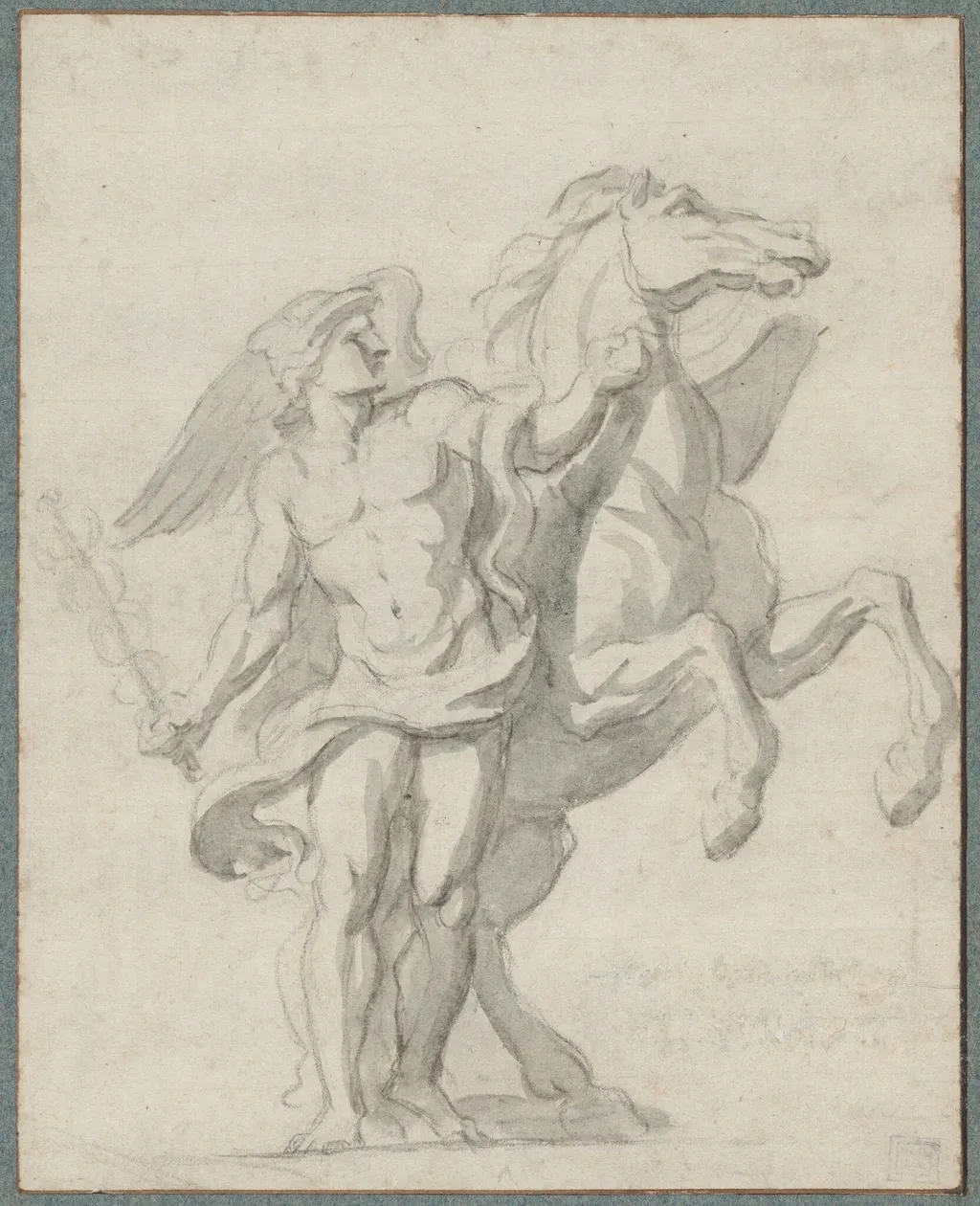
Mercury and Pegasus is a chalk drawing by the Baroque artist Charles Le Brun. It dates from 1670 and is held in the collection of the National Gallery of Art.
- Inscription
- Inscribed:by later hand in brown ink on mount: LEBRUN; by later hand, upper right verso on mount in brown ink: Paris, 28 Aout / [unidentified paraphe]; by later hand, center verso of mount in brown ink: Collect.n Alzire Humbert; by later hand, lower center verso in blue ballpoint ink: _Lebrun: Pegase et Mercure_ / De la serie des projets de [not deciphered] non executes / Dessin [not deciphered] au Louvre no. 6019 avec Pegase et un femme; by later hand, lower right verso in graphite: 990332; by later hand, lower right verso in blue ball point ink: voir / 6019 / du Louvre
- Markings
- Marked:Alzire Humbert, Paris. Alfred Norman (not in Lugt)
About this work
Overview
The work was not intended as a finished piece but as a dynamic sketch for a larger composition, likely for a decorative scheme.
Created around 1670, this drawing by Charles Le Brun is a preparatory study executed in black chalk and gray wash on laid paper, later mounted on an older support. It resides in the National Gallery of Art in Washington, D.C., and exemplifies the artist’s practice of exploring dynamic forms through rapid, expressive mark-making. The work was not intended as a finished piece but as a dynamic sketch for a larger composition, likely for a decorative scheme.
Subject & Meaning
The drawing depicts Mercury, the Roman messenger god, standing on one leg with a staff, while Pegasus, the winged horse, rears behind him. The pairing suggests a moment of divine motion, Mercury commanding or mounting the celestial steed. The imagery draws from classical mythology, symbolizing swift communication and transcendence, themes often invoked in Baroque courtly art to convey power and divine favor.
Technique & Style
Le Brun employed soft black chalk for fluid, gestural lines and applied diluted gray wash to model volume and suggest atmospheric light. There are no rigid outlines; instead, form emerges through layered shading and subtle tonal transitions. The loose, energetic strokes capture movement and weight, reflecting the artist’s focus on anatomical dynamism and kinetic energy over precise detail, a hallmark of preparatory studies in the French Baroque tradition.
History & Provenance
The drawing was likely made during Le Brun’s tenure as First Painter to Louis XIV, when he oversaw major royal decorative projects. It remained within French artistic circles before entering the collection of the National Gallery of Art in Washington, D.C., where it is preserved as part of a significant group of French academic drawings. Its survival reflects its value as a record of the artist’s working process.
Context
This work belongs to the French Baroque tradition, where large-scale decorative programs demanded extensive preparatory studies. Artists like Le Brun used quick drawings to experiment with composition, gesture, and anatomy before executing murals or ceiling paintings. The emphasis on movement and mythological themes aligned with the absolutist court’s desire to associate monarchy with classical ideals of heroism and divine order.
Legacy
Le Brun’s drawings, including this one, influenced generations of French academic artists by establishing a model for expressive, anatomically informed sketching. Though overshadowed by his finished paintings, such studies reveal the intellectual and physical rigor behind grand decorative schemes. Today, they are valued as vital documents of artistic process within the institutional framework of 17th-century French art.
Own this work as a print
Artist & collection


![Statue of Alexander and Bucephalus [recto], by Hubert Robert](https://artifactworldgallery.com/img/hubert-robert--statue-of-alexander-and-bucephalus-recto--d9a688cc8df08f18-w320.webp) Statue of Alexander and Bucephalus [recto]
Statue of Alexander and Bucephalus [recto]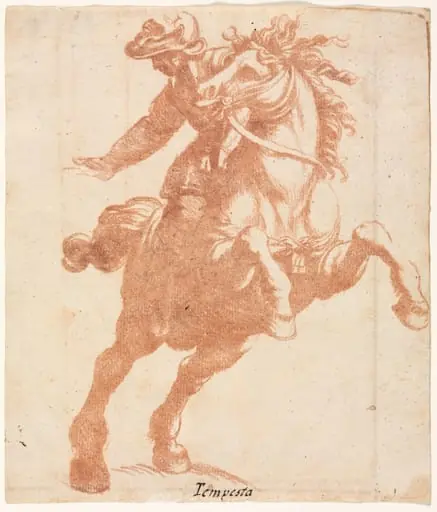 Rearing Horse and Rider
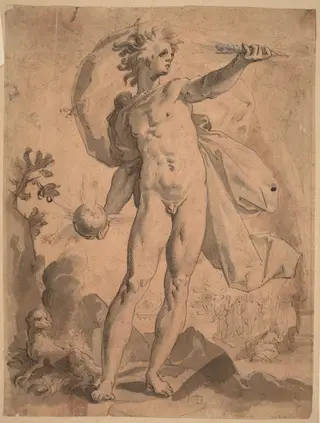 Ignis
Ignis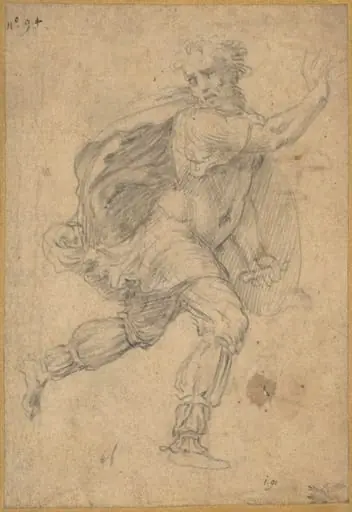 Fleeing Barbarian
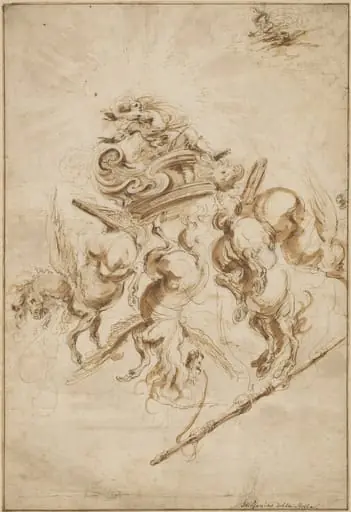 The Fall of Phaeton
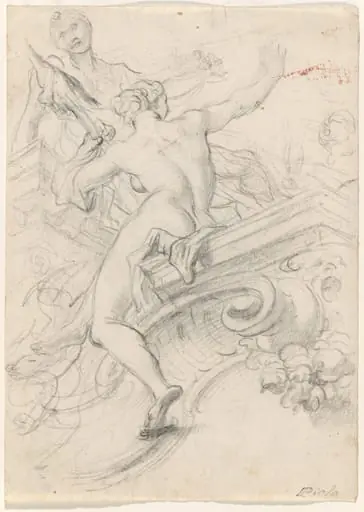 A Female Figure Seated on an Entablature, Holding a Distaff
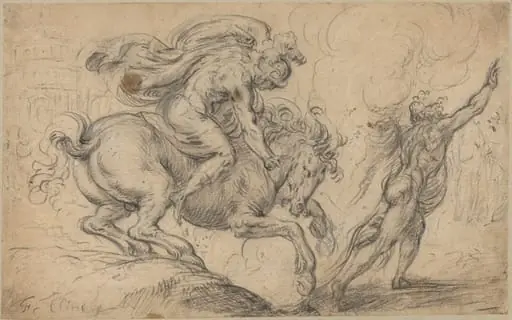 The Sacrifice of Marcus Curtius
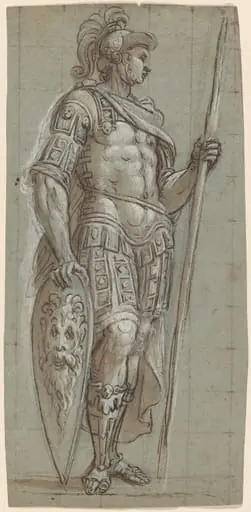 A Soldier in Ancient Roman Costume with Pike and Shield
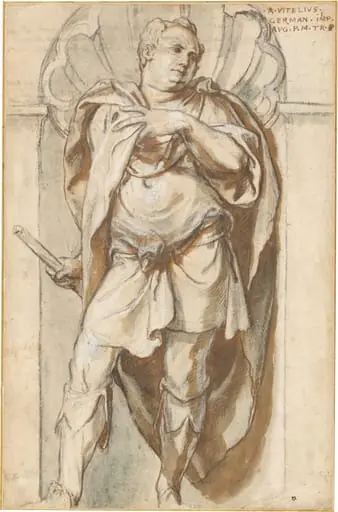 The Emperor Aulus Vitellius
![Mars and Diana [recto], by Zanguidi, called Bertoia, Jacopo](https://artifactworldgallery.com/img/zanguidi-called-bertoia-jacopo--mars-and-diana-recto--a528dea7036b44d0-w320.webp) Mars and Diana [recto]
Mars and Diana [recto]