Artwork
Ancien Bourse, Antwerp
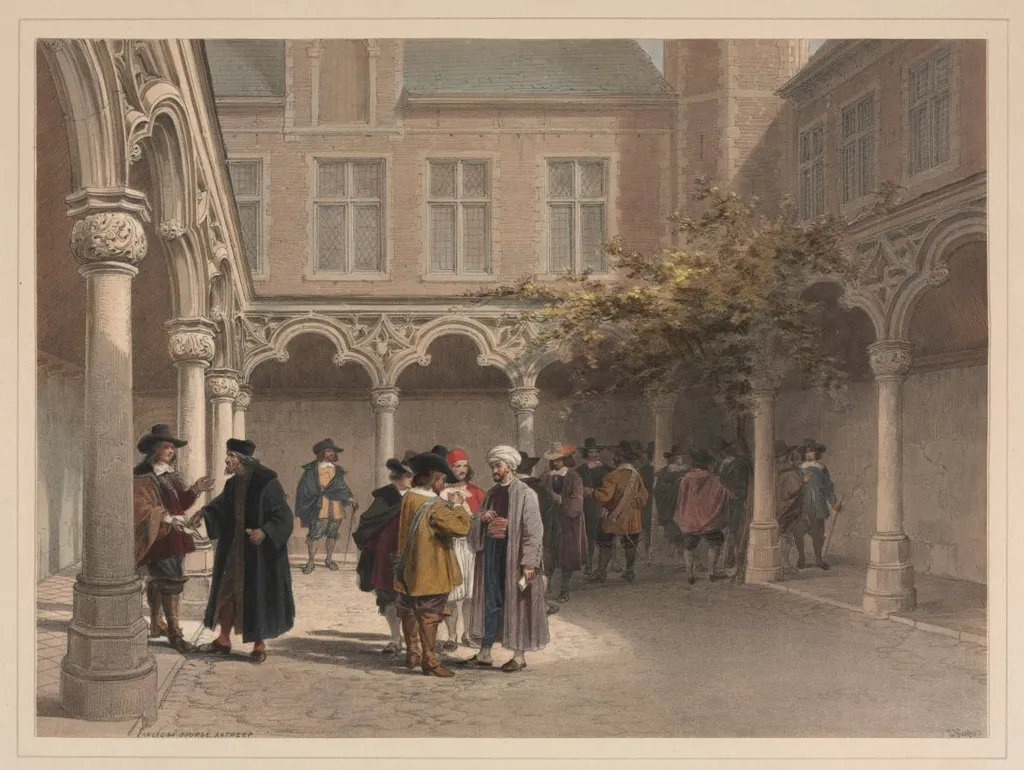
Ancien Bourse, Antwerp is a print by Louis Haghe. It dates from 1855 and is held in the collection of the Cleveland Museum of Art.
- Accession no.
- 1963.175
- Credit line
- Gift of J. Byers Hays
About this work
Overview
Trained in watercolor and early lithographic techniques, he settled in England in 1823 and later partnered in the influential firm Day & Haghe.
Louis Haghe, a British lithographer of Belgian origin, produced this lithograph around 1855, capturing the former Bourse in Antwerp. Trained in watercolor and early lithographic techniques, he settled in England in 1823 and later partnered in the influential firm Day & Haghe. The work exemplifies his precision in rendering architectural spaces and atmospheric detail, typical of mid-19th-century topographical prints.
Subject & Meaning
The scene portrays a quiet courtyard of the historic Antwerp Bourse, once a center of commercial activity. Figures in period attire, merchants, travelers, or clerks, gather in small clusters beneath arched colonnades, suggesting the lingering presence of trade even as the building’s function evolved. The inclusion of a central tree and dappled shadows introduces a sense of daily life, softening the monumentality of the structure.
Technique & Style
Haghe employed lithography to achieve fine tonal gradations and crisp architectural lines. The composition emphasizes depth through receding arcades and carefully modeled shadows cast by the tree and buildings. Textural details in stone, brick, and glass are rendered with restraint, avoiding ornamentation while preserving structural clarity. The muted palette reflects the medium’s capacity for subtle monochrome nuance.
History & Provenance
The print was made during a period of renewed interest in historic urban architecture across Europe. Haghe’s focus on Antwerp’s Bourse aligns with broader 19th-century efforts to document pre-industrial civic spaces. While its early ownership is undocumented, the work entered institutional collections by the late 19th century, including the Cleveland Museum of Art, where it remains part of a broader archive of European topographical prints.
Context
The Antwerp Bourse, completed in the 16th century, was among Europe’s earliest purpose-built commodity exchanges. By the 1850s, its commercial role had diminished, yet it retained symbolic weight as a relic of the city’s mercantile golden age. Haghe’s depiction reflects a cultural moment in which historical architecture was being visually preserved amid rapid urban modernization.
Legacy
Haghe’s lithograph contributes to a genre of 19th-century prints that sought to record architectural heritage with documentary fidelity. Though not widely exhibited today, it remains a reference for scholars studying the visual representation of European commercial spaces. Its presence in museum collections underscores its role as a quiet but enduring record of urban memory.
Artist & collection

Artist
Louis Haghe (17 March 1806 – 9 March 1885) was a lithographer and watercolourist from the Netherlands and then the United Kingdom.

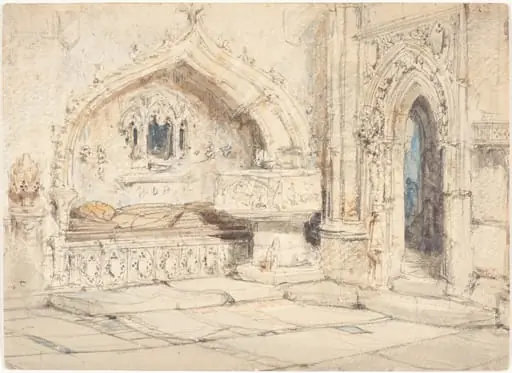 Interior of a Church with a Wall Tomb and Medieval Font
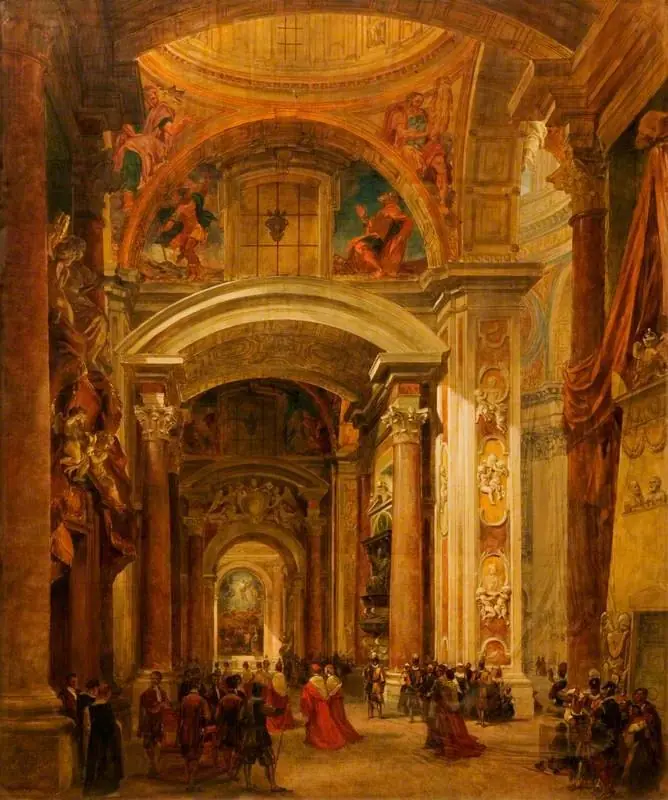 Interior of St Peter's, Rome
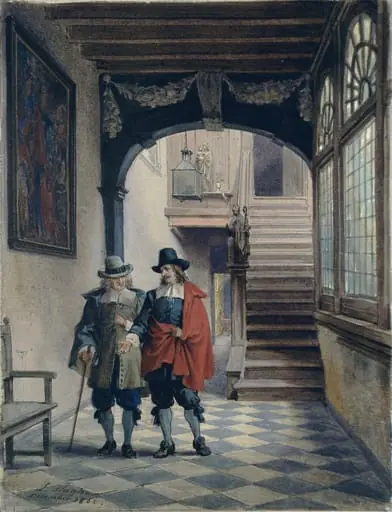 The Corridor, Brewer's Hall, Antwerp
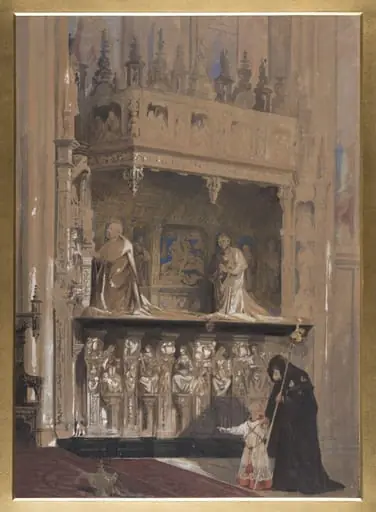 Monument of the Cardinald D'Amboise in Rouen Cathedral
 The Quay at Suez
 Egypt and Nubia, Volume II: Lateral View of the Temple called The Typhonoeum at Dendera
 Egypt and Nubia, Volume I: Thebes
 Egypt and Nubia, Volume I: Luxor