Artwork
Milsom Street in Bath
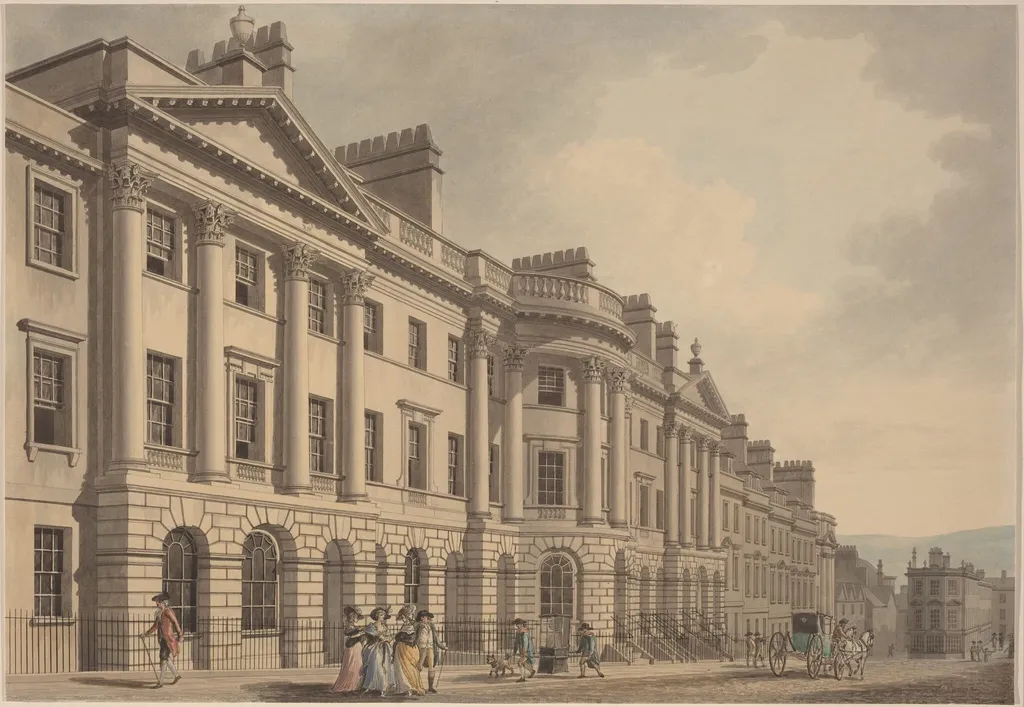
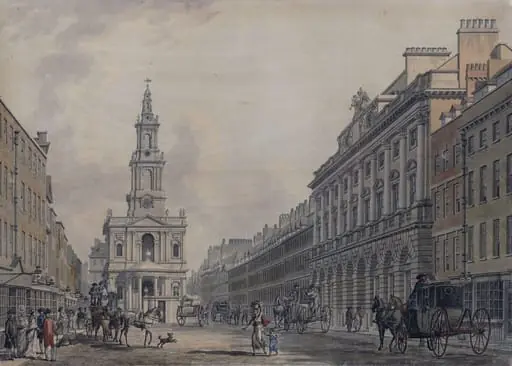
Milsom Street in Bath is an ink drawing by the Romanticist artist Thomas Malton. It dates from 1784 and is held in the collection of the National Gallery of Art.
- Inscription
- Inscribed:on a separate piece of paper, in pen and brown ink: New Bank.
About this work
Look for another Thomas Malton street view at the National Gallery of Art, Washington.
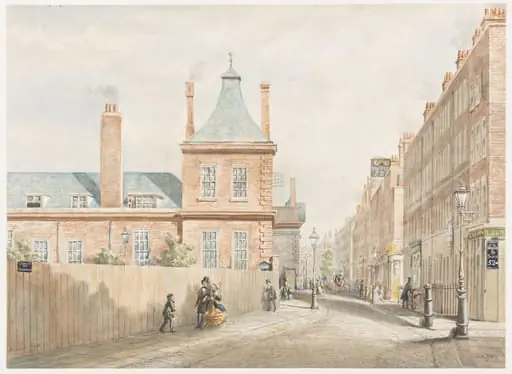
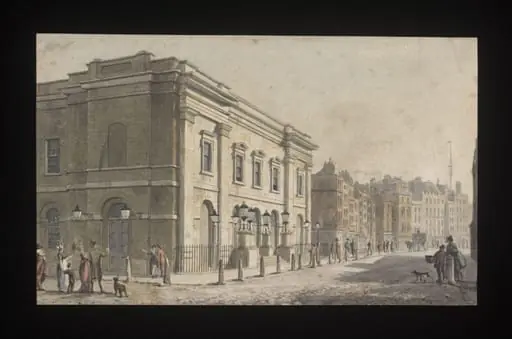
This painting shows a quiet street scene in Bath. Two-story buildings line one side. A single person walks alone near the center. The street curves gently to the left.
Thomas Malton made this in 1784. He used pen, ink, and watercolor to capture everyday buildings. The way he shades the walls makes the scene feel real and calm.
Look for another Thomas Malton street view at the National Gallery of Art, Washington.
Overview
Milsom Street in Bath is a 1784 drawing by Thomas Malton the Younger, a British topographical artist and engraver. Executed in pen and gray and black ink with gray wash and watercolor over graphite on laid paper, the work measures 33.1 by 47.8 centimeters. It is held in the collection of the National Gallery of Art in Washington, D.C., under accession number 1992.96.1, having been purchased by the institution in 1992. The drawing is a significant example of Malton's precise architectural rendering and contributes to the documentary record of Georgian Bath, one of England's most architecturally distinguished cities. It has been exhibited twice at the National Gallery of Art, in 1993 and 2006-2007, as part of exhibitions devoted to British watercolor traditions and Romantic visual culture.
Subject & Meaning
The drawing depicts Milsom Street, a grand Georgian thoroughfare in Bath, Somerset, constructed in 1762 by architect Thomas Lightholder. The composition centers on the Somersetshire Buildings, a terrace of neoclassical townhouses later designated Grade II* listed buildings, which dominate the left and center of the sheet and recede diagonally toward the distant right. The architecture is rendered with attention to its Corinthian columns, triangular pediments, crenellated rooflines, and a curved bay with balustrade. The street-level activity includes fashionable figures, a horse-drawn carriage with two horses and driver, and small groups of pedestrians, including a man in a red coat and tricorn hat with a cane, and women in long dresses. These figures animate the scene and signal the street's status as a fashionable social promenade, a quality later recognized in its literary associations with Jane Austen. The inscription on a separate piece of paper, reading 'New Bank,' suggests a specific point of interest or destination within the streetscape. The work functions as both an accurate topographical record and an evocation of urbane Georgian life.
Technique & Style
The medium is pen and gray and black ink with gray wash and watercolor over graphite on laid paper. The technique relies on precise ink or graphite linework overlaid with smooth tonal gradations of wash and subtle watercolor. The palette is restrained, consisting of muted warm tones, beige, gray, and soft brown, with subtle blue and pink in the garments, and soft gradations of gray and cream in the sky. Light falls from the left, casting soft shadows on the right faces of the building, which creates a measured sense of depth and volume. The handling demonstrates the controlled, documentary approach characteristic of Malton's work, prioritizing architectural accuracy over dramatic pictorial effect. Distant buildings and faint hills on the horizon establish atmospheric recession. The overall effect is one of clarity and order, consistent with the topographical tradition in which Malton worked.
History & Provenance
The drawing is dated 1784, a period when Malton had briefly stayed in Bath around 1780 and was producing views of urban architecture. The provenance traces from a sale at Sotheby's, London, on 12 March 1987, lot 108, to Dr. Ian Craft of London, who acquired it that year. It was subsequently sold through Hazlitt, Gooden & Fox Ltd., London, in 1992, and purchased by the National Gallery of Art the same year. The work has been exhibited twice at the National Gallery of Art: in 1993, as part of 'The Great Age of British Watercolors 1750-1880,' and from 2006 to 2007 in 'The Artist's Vision: Romantic Traditions in Great Britain.' It is not signed.
Context
Thomas Malton the Younger (1748-1804) was a specialist in topographical and architectural views who trained in his father Thomas Malton the Elder's practice and spent three years in the office of architect James Gandon. He received a premium from the Society of Arts in 1774 and won a Royal Academy gold medal in 1782 for a theatre design. From 1783 to 1789 he resided in Conduit Street, London, where he ran an evening drawing class that counted Thomas Girtin and J. M. W. Turner among its pupils. Turner later acknowledged Malton's influence by stating, 'My real master was Tom Malton.' Malton's views of London streets and buildings, drawn in Indian ink and tinted, were exhibited regularly at the Royal Academy from 1773 onward. While these works have been noted for their limited pictorial effect, their extreme accuracy in architectural detail renders them valuable as topographical records. Milsom Street in Bath belongs to this body of work, though its subject places it outside Malton's more frequent focus on London. The drawing's acquisition by the National Gallery of Art reflects the institutional recognition of British topographical drawing as a significant field within eighteenth-century art.
Legacy
Milsom Street in Bath endures as a document of Georgian urbanism, preserving the appearance of a street that has since undergone functional transformation from grand townhouses to commercial uses. The drawing's afterlife is inseparable from the broader reputation of Malton's topographical oeuvre and his pedagogical influence on the development of British watercolor painting through his pupils Turner and Girtin. The work's presence in the National Gallery of Art, and its inclusion in two major survey exhibitions of British watercolor, has secured its place in the institutional narrative of that medium's history. In contemporary contexts, the image circulates as a high-resolution digital reproduction, reflecting the continued demand for representations of Georgian architectural heritage. The street itself has acquired modern cultural recognition, being voted 'Britain's Best Fashion Street' in the 2010 Google Street View Best Streets Awards, a distinction that underscores the persistent allure of the Georgian urban aesthetic that Malton recorded.
Own this work as a print
Artist & collection