Artwork
The Harbor at Lorient
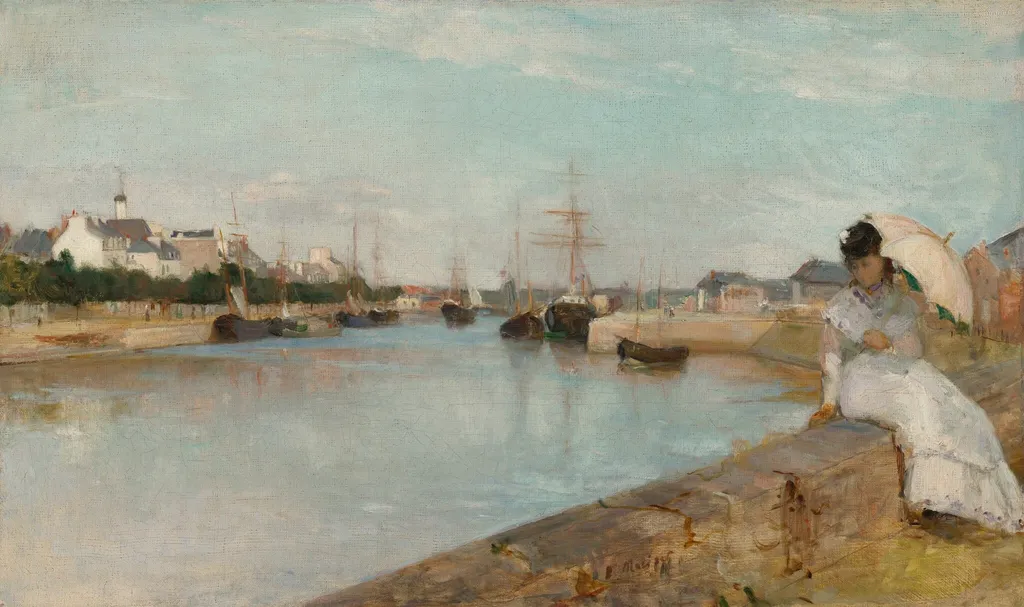
The Harbor at Lorient is an oil painting by the Impressionist artist Berthe Morisot. It dates from 1869 and is held in the collection of the National Gallery of Art.
- Inscription
- Inscribed:lower center: B Morisot
About this work
In summer 1869, Berthe Morisot joined her sister Edma in the Breton port of Lorient, where Edma's husband was stationed. From the harbor seawall she painted Edma in a white dress, parasol in hand, against a channel of anchored boats and a sky of real and reflected clouds. She gave the canvas to Édouard Manet; it now hangs in the National Gallery of Art.
Subject & Meaning
The work exemplifies Impressionist techniques of simplifying the figure in full daylight and harmonizing the figure with its surroundings.
The painting depicts the harbor at Lorient in Brittany, with Berthe Morisot's sister Edma seated on a parapet, shaded by a parasol and wearing a white dress speckled with pink and mauve. Fishing boats are moored at the quays, and the sky and sea reflect each other in muted brown and gray tones. Morisot integrates the female figure into a vaporous, silvery landscape, a recurring theme in her work that emphasizes freshness and the interaction of light and setting.
The subject reflects a modern leisure scene, capturing a moment of repose in a contemporary coastal environment. The work exemplifies Impressionist techniques of simplifying the figure in full daylight and harmonizing the figure with its surroundings.
Technique & Style
Executed in oil on canvas, the painting measures approximately 43.5 × 73 cm and is executed in an Impressionist mode. Morisot employs a light, sketch-like handling with simplified touches of paint, particularly evident in the white dress and parasol of her sister Edma, which are flecked with pink and mauve to capture the effects of full sunlight. The harbor is rendered in subdued brown and gray tones, while the sky and sea share close color harmonies and reflect each other.
The composition is organized around a diagonally placed parapet, with Edma seated in profile under a parasol, framed by moored fishing boats and a distant quay. On Manet’s advice, Morisot later retouched the face and lower part of the dress. The overall effect is airy and silvery, typical of Morisot’s interest in integrating a female figure into a vaporous landscape.
History & Provenance
Berthe Morisot painted The Harbor at Lorient in 1869 while spending two months in Lorient, Brittany. The work depicts her sister Edma, who had married a naval officer stationed there. Upon returning to Paris, Morisot gave the painting to Édouard Manet, who was impressed by her skill and suggested retouches to the face and dress.
The painting was first owned by Manet, then by financier Gabriel Thomas (a cousin of the artist) by 1896; his wife retained it until at least 1941. It subsequently entered the collection of fashion designer Edward Molyneux by 1952. On 15 August 1955, it was sold to Ailsa Mellon Bruce, who bequeathed it to the National Gallery of Art, Washington, D.C., in 1970.
The painting is held in the collection of the National Gallery of Art in Washington, D.C. It entered the museum in 1970 as part of the bequest of Ailsa Mellon Bruce (1901–1969), who had acquired it on 15 August 1955 from Captain Edward H. Molyneux. The work was included in the first Impressionist exhibition in 1874 and was exhibited as part of the Molyneux collection in 1952. No specific inventory or accession number is provided in the sources, but the institution is documented as the painting's permanent location.
Context
The Harbor at Lorient marked a turning point in Berthe Morisot's career and her relationship with Édouard Manet. Upon receiving the painting as a gift in 1869, Manet was impressed by Morisot's mastery and began regarding her as a talented artist, subsequently consulting her on artistic questions. Morisot herself expressed astonishment at her achievement, writing, 'I remain amazed before it and no longer feel capable of anything.'
The work was later included in the first Impressionist exhibition in 1874, affirming its significance in the movement's early history. The painting also reflects Morisot's broader practice of depicting intimate family members, here her sister Edma, within luminous, atmospheric landscapes, a recurring theme in her oeuvre.
Overview
Berthe Morisot's 1869 oil on canvas, The Harbor at Lorient, captures a scene from the Brittany coast. Measuring 43 by 72 centimeters, the painting depicts the artist's sister, Edma, seated by the water, observing a bustling port. This work is a notable example of Morisot's early career, reflecting her engagement with contemporary life and landscape. It is currently housed at the National Gallery of Art in Washington, D.C.
Own this work as a print
Artist & collection
Artist
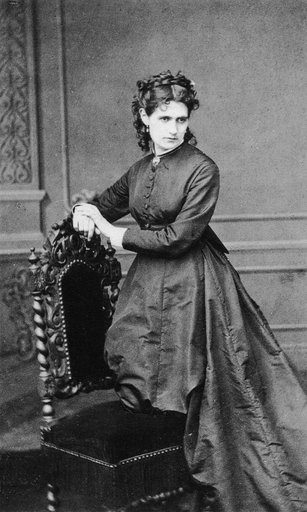
Berthe Marie Pauline Morisot was a French painter, printmaker and a member of the circle of painters in Paris who became known as the Impressionists.

 Studied in the Impressionism course