Artwork
Autoportrait with the Palette
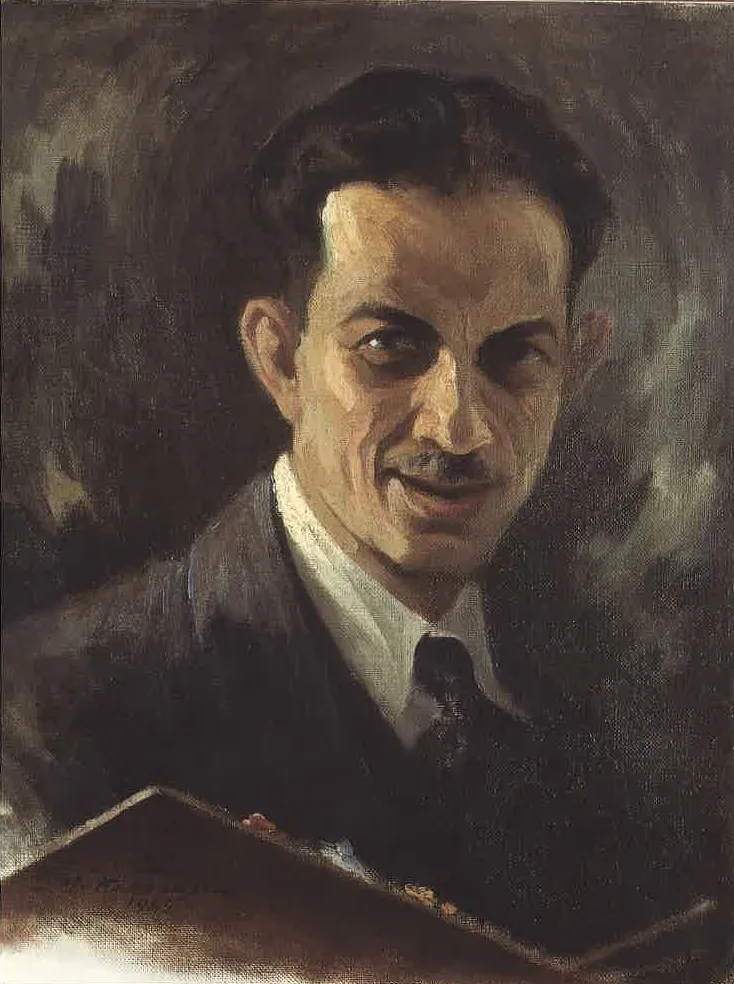
Autoportrait with the Palette is an oil painting by the Contemporary Realist artist Moustafa Farroukh. It dates from 1949 and is held in the collection of the Sursock Museum.
About this work
Overview
Moustafa Farroukh painted this self-portrait in 1949 using oil on canvas. As one of Lebanon’s most prolific 20th-century artists, he produced over two thousand works across decades. This piece reflects his engagement with figurative realism and his role as both practitioner and chronicler of Lebanese visual culture. The painting resides in the Sursock Museum’s permanent collection.
Subject & Meaning
Farroukh depicts himself in formal attire, a dark suit, white shirt, and tie, holding a painter’s palette. The gesture underscores his identity as an artist, not merely as a subject. The palette, rendered in muted tones, suggests a working tool rather than a decorative element. The somber background isolates him, emphasizing introspection and professional presence over narrative context.
Technique & Style
The dark surroundings enhance the figure’s solidity, while the palette’s subtle highlights draw attention to the artist’s hands, a quiet assertion of craft.
Rendered in oil paint, the portrait employs restrained tonal contrasts to model form without dramatic chiaroscuro. The brushwork is controlled and smooth, favoring clarity over texture. The dark surroundings enhance the figure’s solidity, while the palette’s subtle highlights draw attention to the artist’s hands, a quiet assertion of craft. The style aligns with mid-century realism, prioritizing observation over expressionism.
History & Provenance
Created in 1949, the painting entered the Sursock Museum’s collection shortly after its completion. Farroukh’s prominence in Lebanon’s art scene ensured his works were preserved in key national institutions. The painting has remained in public hands since its creation, with no documented private ownership, reflecting its status as a cultural artifact rather than a commercial commodity.
Context
In postwar Lebanon, artists like Farroukh navigated a cultural landscape shaped by European traditions and emerging Arab identity. His realism contrasted with the abstract trends gaining ground elsewhere. As a writer and painter, he contributed to intellectual discourse, positioning art as both personal expression and national documentation during a period of rapid social change.
Legacy
Farroukh’s self-portrait remains a reference point in Lebanese modern art for its quiet dignity and technical restraint. It exemplifies an era when artists defined themselves through their tools and presence, not spectacle. Though not widely exhibited internationally, it continues to inform local art education and historical narratives about Lebanon’s artistic development.
Artist & collection
Artist
Moustafa Farroukh (Arabic: مصطفى فروخ; 1901 – 1957) was one of Lebanon's most prominent painters of the 20th century.