Artwork
Coat of Arms
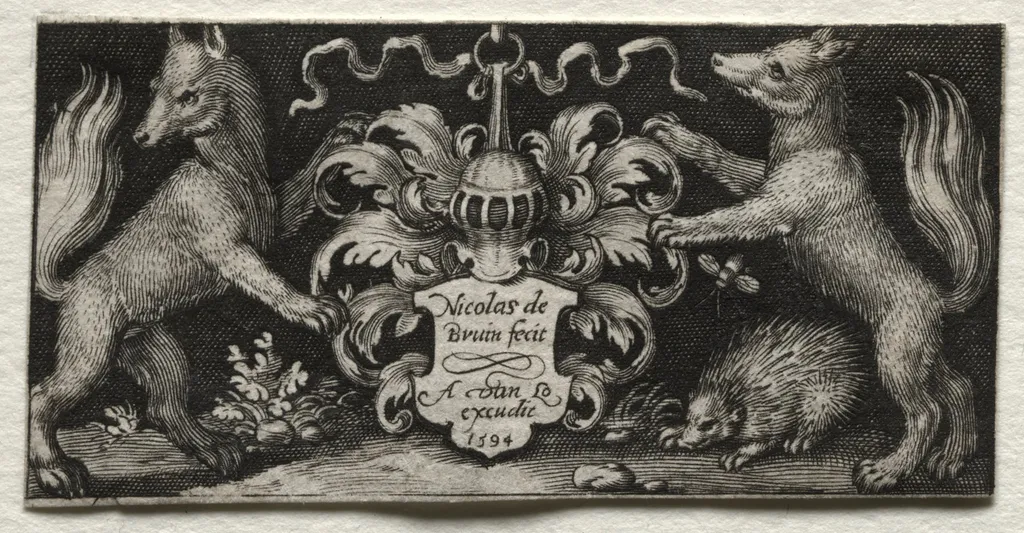
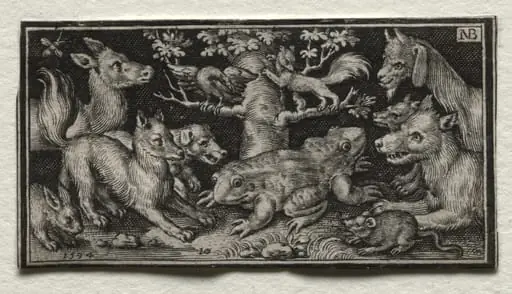
Coat of Arms is a print by the Renaissance artist Nicolaes de Bruyn. It dates from 1594 and is held in the collection of the Cleveland Museum of Art.
- Accession no.
- 1923.738
- Credit line
- Gift of The Print Club of Cleveland
About this work
The shield has a crown on top and a banner with the name "Nicolas de Bruyn fecit" and the year "1594.
This is a black-and-white print of two wolves standing on either side of a coat of arms. The wolves look alert, with their front paws resting on a shield. The shield has a crown on top and a banner with the name "Nicolas de Bruyn fecit" and the year "1594." Below the shield, there’s a small plant and some rocky ground.
The wolves seem to guard the coat of arms, which was likely a symbol of family or status. The artist’s name and the year are carved into the banner, showing this was made in 1594.
If you like this style, look up Renaissance art next.
Overview
Coat of Arms is a 1594 engraving by Flemish artist Nicolaes de Bruyn, depicting two alert wolves flanking a shield with a crown, banner, and rocky base. The piece showcases de Bruyn's distinct style, developed from his training under his uncle Abraham de Bruyn and influenced by Lucas van Leyden.
Subject & Meaning
The composition features two wolves standing guard over a coat of arms, symbolizing protection of family heritage or status. The shield bears a crown, while a banner displays the artist's name and date, 'Nicolas de Bruyn fecit 1594', asserting authorship.
Technique & Style
De Bruyn's engraving technique in Coat of Arms diverges from his uncle's, notable in execution and larger plate size. The work reflects a study of Lucas van Leyden's compositional approaches, blending these influences with his own emerging voice.
History & Provenance
Created in 1594, Coat of Arms is now part of The Cleveland Museum of Art's collection. De Bruyn, born in 1571 to a sugar manufacturer's family, was trained by his uncle before establishing himself in the Dutch Republic.
Context
This engraving is rooted in late 16th-century Flemish and Dutch artistic traditions, with the subject matter and style placing it within the broader context of Renaissance art, where heraldic symbols and meticulous engraving were valued.
Legacy
While specific long-term impacts of Coat of Arms on subsequent art are not widely documented, it contributes to the understanding of Nicolaes de Bruyn's development as an artist and the evolution of engraving techniques during the Renaissance.
Artist & collection
Artist
Nicolaes de Bruyn (Antwerp, 1571 – Rotterdam, 1656) was a Flemish engraver, who after training in Antwerp was active in the Dutch Republic.