Artwork
Interlude
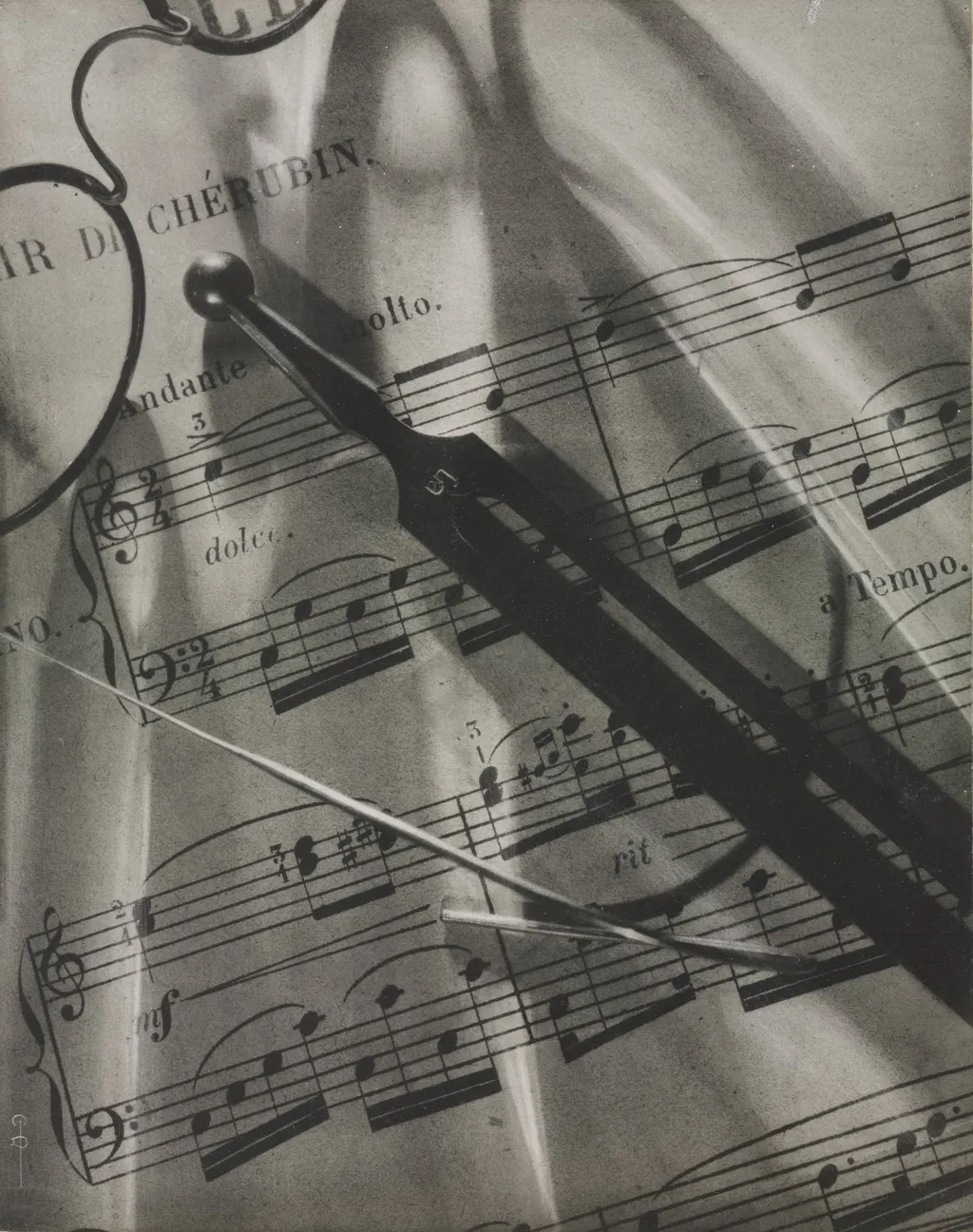
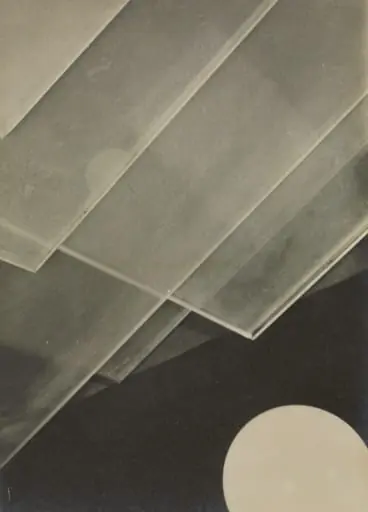
Interlude is a photography by Pierre Dubreuil. It dates from 1932 and is held in the collection of the Cleveland Museum of Art.
- Accession no.
- 1987.217
- Credit line
- John L. Severance Fund
About this work
Overview
Through precise framing and lighting, the image transforms the mundane into something enigmatic.
Pierre Dubreuil’s photograph 'Interlude' presents a quiet arrangement of everyday objects, a musical score, tuning fork, and eyeglasses, rendered with deliberate strangeness. Through precise framing and lighting, the image transforms the mundane into something enigmatic. The composition avoids narrative clarity, inviting contemplation rather than interpretation, and reflects Dubreuil’s early engagement with photographic abstraction.
Subject & Meaning
The objects in 'Interlude', tools of music and vision, suggest themes of perception, memory, and silence. Their placement, neither functional nor decorative, implies absence: the musician who played, the listener who heard, the wearer who saw. The photograph does not explain but evokes, hinting at psychological states through the stillness of things left behind, aligning with early 20th-century explorations of inner life.
Technique & Style
Dubreuil employed extreme close-up and skewed angles to disrupt conventional spatial logic. Strong chiaroscuro contrasts isolate forms against deep shadows, emphasizing texture and volume without context. The lighting is artificial and directional, heightening the sense of theatricality. These choices reject documentary neutrality, instead constructing a visual language that prioritizes mood over representation.
History & Provenance
Created in the early 1910s, 'Interlude' emerged during Dubreuil’s most experimental phase, before his work faded from public view. It was not widely exhibited or published in his lifetime. Rediscovered decades later through archival research, the photograph now stands as a rare example of pre-Surrealist photographic inquiry in France, bridging Pictorialism and modernist abstraction.
Context
Dubreuil’s approach paralleled emerging interests in psychology and the unconscious among European artists. Though not formally affiliated with the Surrealists, his imagery resonated with contemporaries in Brussels and Paris who sought to externalize inner experience. His work diverged from the romanticism of Pictorialism, instead embracing disorientation and ambiguity as tools for psychological expression.
Legacy
Though largely overlooked during his lifetime, Dubreuil’s photographs like 'Interlude' have gained recognition for their prescient use of distortion and lighting. They prefigure later Surrealist and modernist photographic experiments, offering a quiet but radical redefinition of still life. Today, his work is studied as an early example of photography’s capacity to convey psychological depth beyond literal depiction.
Artist & collection