Artwork
Expulsion of Adam and Eve
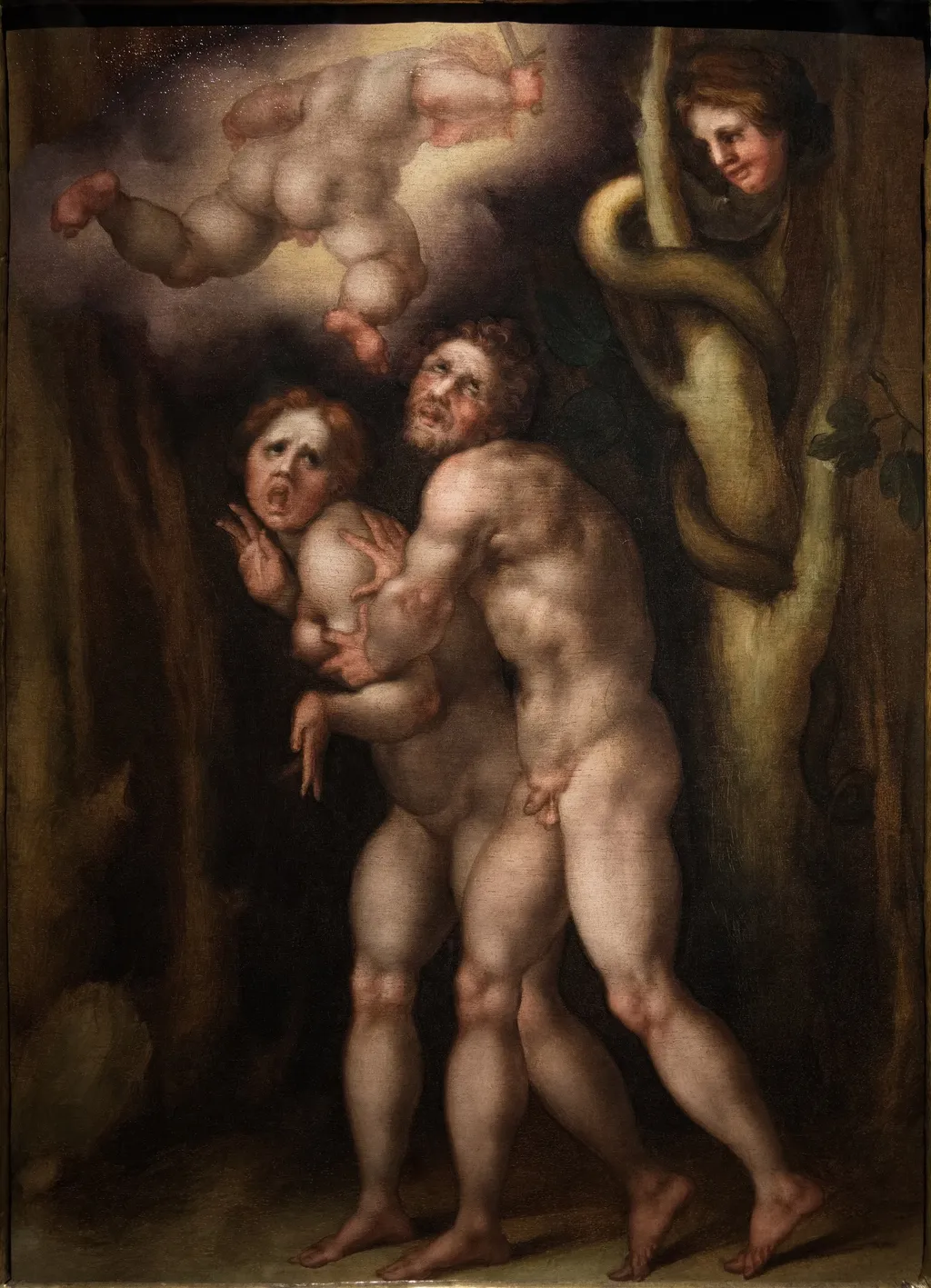
Expulsion of Adam and Eve is an oil painting by the Mannerist artist Pontormo. It dates from 1535 and is held in the collection of the Uffizi Gallery.
About this work
Pontormo’s Expulsion of Adam and Eve is an oil painting on panel. It shows the moment after Adam and Eve leave Paradise. The scene feels tense and full of emotion.
The Uffizi dates it around 1535. It’s a small but powerful work. A drawing study survives too, kept in the same museum.
This piece sits in the Uffizi Gallery in Florence. Check out the Uffizi Gallery next.
Subject & Meaning
The serpent coils around a tree, its head visible, a motif drawn from Masaccio’s Brancacci Chapel frescoes, reinforcing the scene’s scriptural authority.
The painting depicts the biblical expulsion of Adam and Eve from the Garden of Eden as narrated in Genesis, showing the couple departing through a dark, wooded landscape under the watch of an angelic figure with a drawn sword. Pontormo renders the progenitors nude and burdened by remorse, their postures conveying anguish and vulnerability. The serpent coils around a tree, its head visible, a motif drawn from Masaccio’s Brancacci Chapel frescoes, reinforcing the scene’s scriptural authority.
The angel’s luminous, radiant presence, seen from behind, heightens the spatial depth and underscores the irreversible judgment enacted. The work thus visualizes divine punishment and the onset of mortal toil while evoking the emotional and theological gravity of the Fall.
Technique & Style
Executed in oil paint on a wooden panel, the work measures 43 cm in height and 31 cm in width. The composition depicts Adam and Eve as nude figures wandering through a dark forest, a setting that amplifies their torment and remorse. Stylistically, the painting draws heavily on Masaccio, particularly in the depiction of a serpent coiled around a tree with a small head, echoing the Brancacci Chapel frescoes.
A distinctive formal element is the angel with a sword, rendered as a rosy cherub seen from behind within a luminous aura, which enhances the spatial depth of the scene. A preparatory drawing for this composition is held in the Gabinetto Disegni e Stampe of the Uffizi.
History & Provenance
The Expulsion of Adam and Eve is an oil-on-panel painting by Pontormo, generally dated to circa 1535, though scholarly estimates range between 1519 and 1543. A preparatory drawing for the work is held in the Uffizi's Gabinetto Disegni e Stampe. The painting was originally recorded in the collection of Cardinal Leopoldo de' Medici under the correct attribution to Pontormo.
However, by the time of the 1796 Gallerie fiorentine inventory, the work had been misattributed to Francesco Salviati. This incorrect attribution persisted until 1825, when the painting was reassigned to Pontormo, a consensus accepted by nearly all modern critics. Some scholars, including La Forlanini, have theorized that the piece was part of a larger series.
The painting is held in the Uffizi Gallery in Florence, where it is displayed in Room 27, dedicated to Pontormo and Rosso Fiorentino. It was inventoried in the collection of Cardinal Leopoldo de' Medici with correct attribution to Pontormo, but by 1796 the Gallerie fiorentine inventory had misattributed it to Francesco Salviati; the correct attribution was restored in 1825. The Uffizi's Gabinetto Disegni e Stampe also preserves a preparatory drawing for the work (no. 465F r).
Context
Pontormo's small panel of the Expulsion of Adam and Eve, dated c. 1535, draws heavily on Masaccio's Brancacci Chapel frescoes, adopting the motif of the serpent coiled around a tree and recasting the progenitors as guilt-stricken figures wandering nude through a darkened Eden. The angel with the sword, rendered as a chubby cherub seen from behind within a luminous aura, is considered the most original element of the composition, amplifying the spatial depth of the scene. A preparatory drawing (n. 465F r) is held by the Uffizi's Gabinetto Disegni e Stampe.
The work was correctly inventoried under Pontormo's name in Cardinal Leopoldo de' Medici's collection, but by the 1796 Gallerie fiorentine inventory it had been reassigned to Francesco Salviati, a misattribution that persisted until 1825. Virtually all modern critics accept the return to Pontormo, with the exceptions of Berti and Clapp. La Forlanini has theorized that the panel originally belonged to a series, and its dating remains debated between c. 1519 and c. 1543.
Overview
Pontormo’s Expulsion of Adam and Eve is an oil painting executed on a wooden panel. The work portrays the biblical moment when the first humans are driven out of the Garden of Eden, capturing a charged atmosphere of loss and displacement. Measuring modestly, the composition is housed in the Uffizi Gallery in Florence, where it forms part of the museum’s Renaissance holdings.
Own this work as a print
Artist & collection
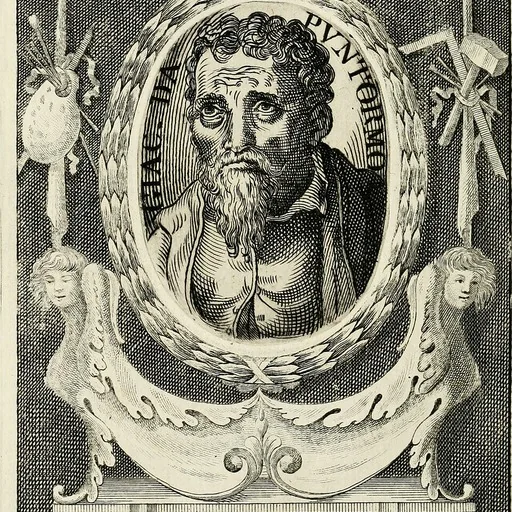
Artist
Jacopo Carucci or Carrucci (IPA:; May 24, 1494 – January 2, 1557), usually known as Jacopo (da) Pontormo or simply Pontormo (IPA: ), was an Italian Mannerist painter and portraitist from the Florentine School.