Artwork
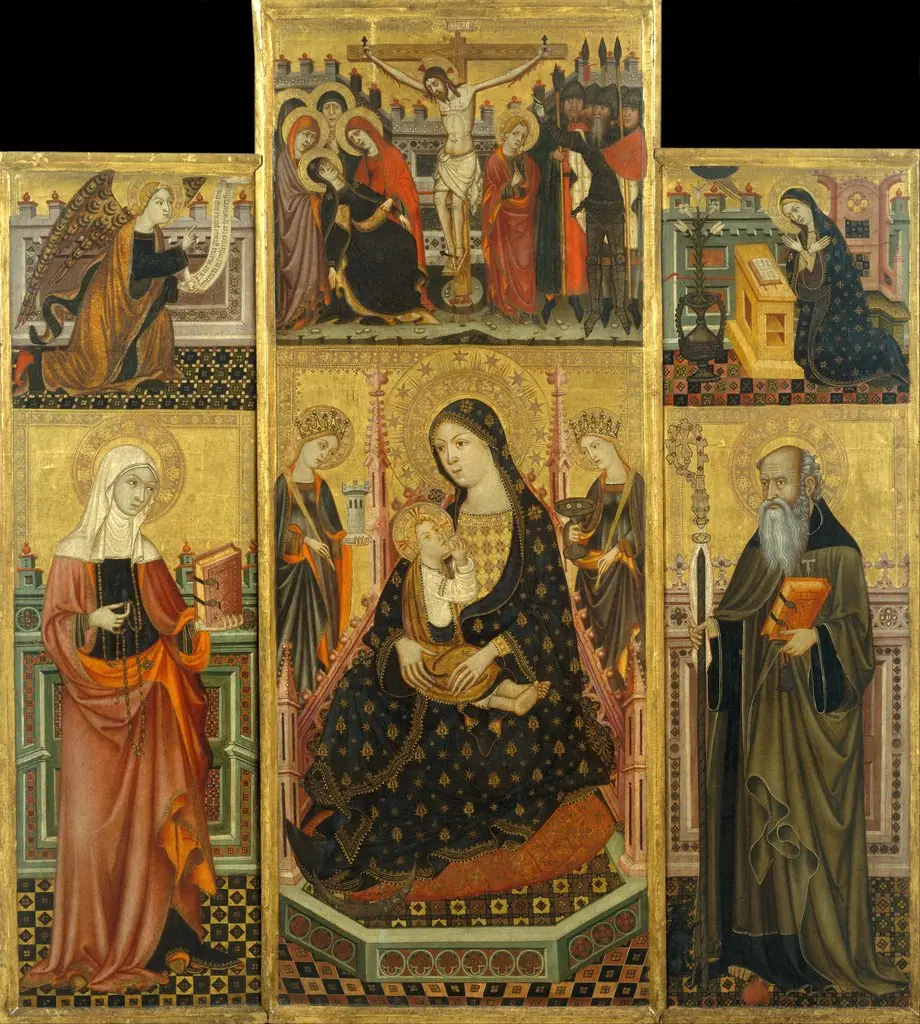
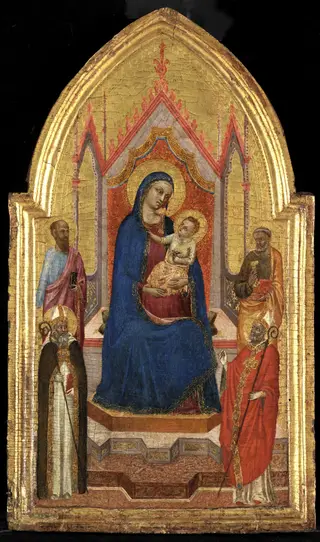
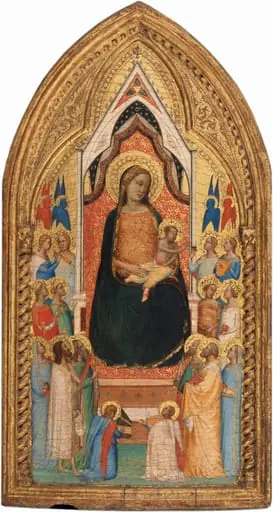
Madonna and Child Enthroned with Four Saints and Eighteen Angels [middle panel]
![Madonna and Child Enthroned with Four Saints and Eighteen Angels [middle panel], by Puccio di Simone, tempera, 1354](https://artifactworldgallery.com/img/puccio-di-simone--madonna-and-child-enthroned-with-four-saints-and-eighteen-an--24dd12ad513d60ea-w1024.webp)
Madonna and Child Enthroned with Four Saints and Eighteen Angels [middle panel] is a tempera painting by the Byzantine icon painting artist Puccio di Simone. It dates from 1354 and is held in the collection of the National Gallery of Art.
- Inscription
- Inscribed:on the Madonna's halo: .S[AN]C[T]A.MARIA.MATER.DEI.; on the Child's halo: IIS . XRO . M;[1] along the base: [MCCC]LIIII.QUESTA TA[VOLA HA F]ATTA F[A]RE. FRATE GIOVANNI DA [...] (1354, this picture was commissioned by Fra Giovanni)
About this work
In 1354, Fra Giovanni of the Antonine order commissioned a triptych for Fabriano whose central panel crowds eighteen angels around a Madonna smaller than the saints flanking her throne. Puccio di Simone painted the middle and right wings, while Allegretto Nuzi handled the left. A near-identical copy, dated fifteen years later, hangs in the Duomo of Macerata.
History & Provenance
It later entered the ownership of Joseph Russell Bailey, 1st Baron Glanusk, and by inheritance to his son, who sold it in 1915.
The central panel of the altarpiece is dated to 1354 and was likely commissioned for the high altar of the demolished church of Sant’Antonio Abate fuori Porta Pisana in Fabriano. By the early nineteenth century it had left the church and passed into a local private collection. It later entered the ownership of Joseph Russell Bailey, 1st Baron Glanusk, and by inheritance to his son, who sold it in 1915.
The work was auctioned at Sotheby’s, London, in July 1916, where it was acquired by Walter Dowdeswell for Duveen Brothers. It then belonged to Carl W. Hamilton in the early 1920s, before returning to Duveen Brothers, who sold it in December 1936 to The A.W. Mellon Educational and Charitable Trust. The panel was gifted to the National Gallery of Art in Washington in 1937.
The painting is held in the collection of the National Gallery of Art in Washington, D.C., as part of the Andrew W. Mellon collection. It was gifted to the museum in 1937 by The A.W. Mellon Educational and Charitable Trust. The work entered the National Gallery of Art from the trust, following its acquisition from the Duveen Brothers in 1936.
No specific inventory or accession number is recorded in the available sources, and no exhibition history has been documented.
Overview
This tempera on panel, painted in 1354, serves as the central element of a triptych created by Puccio di Simone, a Florentine artist. It depicts the Madonna and Child enthroned, flanked by four saints and eighteen angels. The composition is notable for its unconventional use of scale, where the figures of the flanking saints appear larger than the central Virgin. The work was originally commissioned for a church in Fabriano.
Subject & Meaning
The central Madonna gestures towards the Christ Child, who holds a small bird and his mother's cloak. A coral pendant, believed to ward off evil, hangs around his neck as a protective charm. Surrounding the Virgin are Saint Catherine of Alexandria, Saint Benedict, Saint Anthony Abbot, and Saint Elizabeth of Hungary.
Saint Anthony Abbot is uniquely depicted twice within the full triptych, emphasizing his significance to the commissioning order. Above, a Crucifixion scene occupies the gable medallion.
Technique & Style
Puccio di Simone, a Florentine painter influenced by Bernardo Daddi, executed this central panel. The complete triptych was a collaborative effort, with the left wing attributed to the Marchigian artist Allegretto Nuzi. A distinctive stylistic feature is the deliberate variation in figural proportions, where the saints positioned at the sides are rendered on a grander scale than the enthroned Virgin, creating a striking visual hierarchy within the sacred scene.
Context
The triptych's creation involved a collaboration between Florentine and Marchigian artists, reflecting regional artistic exchanges in 14th-century Italy. Its attribution has evolved through art historical scholarship, initially linked to Allegretto Nuzi by Bernard Berenson before further analysis clarified the roles of Puccio di Simone. The existence of a closely similar altarpiece, commissioned fifteen years later for Macerata, highlights the design's enduring appeal and influence.
Own this work as a print
Artist & collection


![Madonna and Child Enthroned with Twelve Angels, and with the Blessing Christ [middle panel], by Agnolo Gaddi](https://artifactworldgallery.com/img/agnolo-gaddi--madonna-and-child-enthroned-with-twelve-angels-and-with-the--f99a5efe37ce8dda-w320.webp)