Artwork
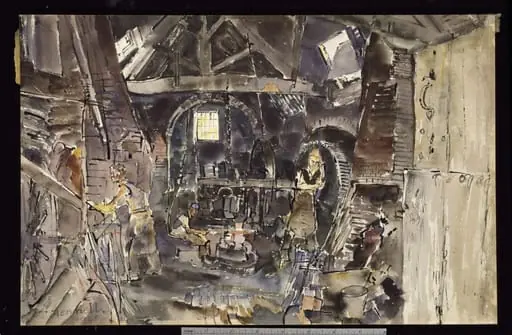
Inside a Mill;- grinding bone" near Modishall
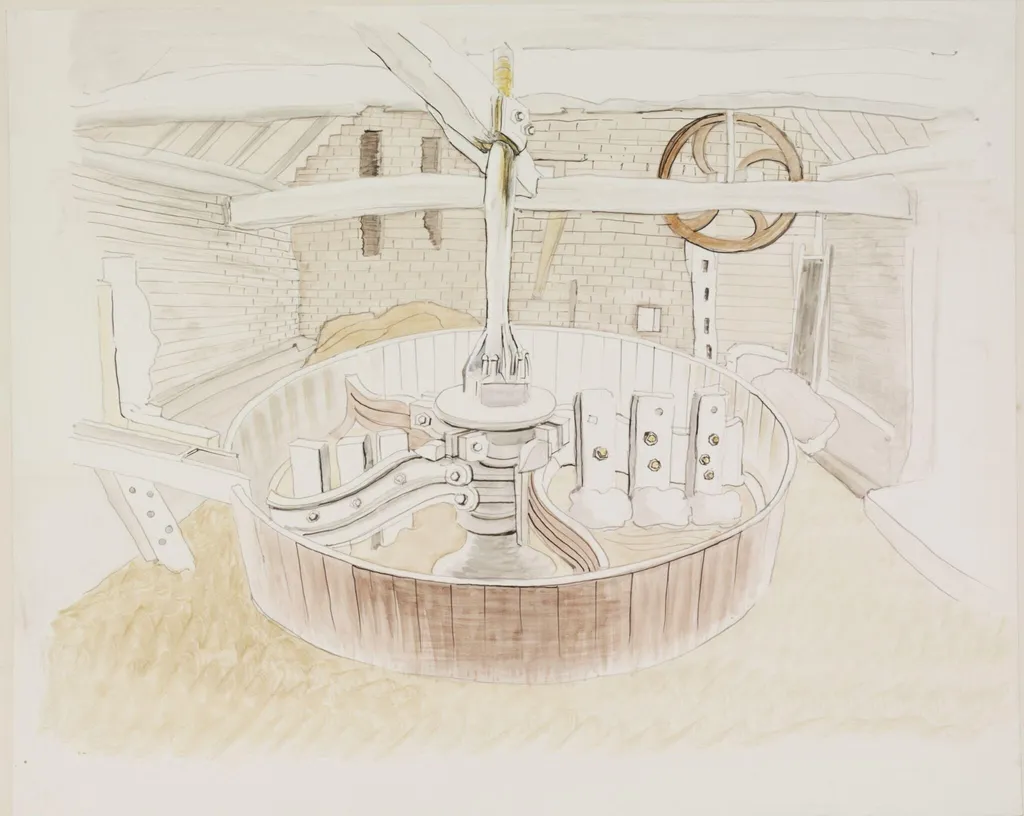
Inside a Mill;- grinding bone" near Modishall is a watercolor work on paper by the Social Realist artist Puller. It is held in the collection of the Victoria and Albert Museum.
About this work
Overview
The work captures an unadorned interior of a grinding mill near Modishall, reflecting a quiet dedication to documenting everyday labor.
Created in 1943, this watercolour by Puller is part of the Recording Britain project, a wartime initiative to visually archive rural and industrial scenes at risk of disappearing. Funded by the Pilgrim Trust and directed by Sir Kenneth Clark, the project emphasized traditional media like watercolour to preserve a sense of national heritage amid the upheaval of conflict. The work captures an unadorned interior of a grinding mill near Modishall, reflecting a quiet dedication to documenting everyday labor.
Subject & Meaning
The scene centers on a heavy wooden barrel and a suspended metal blade, likely used for grinding bone, as suggested by the title. The space is unpolished and utilitarian, walls of crumbling brick, uneven flooring, and scattered tools convey a working environment shaped by function, not aesthetics. The absence of human figures underscores the quiet endurance of such labor, framing the mill as a relic of a fading industrial rhythm tied to local livelihoods.
Technique & Style
Puller employed loose, sketch-like watercolour strokes, allowing the paper’s texture to show through in shadowed corners. Pencil underdrawing defines structural elements without rigid outlines, while areas of wash suggest dim light filtering through the space. The technique avoids finish or polish, favoring immediacy and observation.
This restrained approach aligns with the Recording Britain ethos: honesty over idealization, capturing the essence of a place through its worn details.
History & Provenance
The work entered the Recording Britain collection during the Second World War, a government-supported effort to preserve visual records of Britain’s changing landscape. It was acquired by the Victoria and Albert Museum as part of this broader archive, which included over 1,500 watercolours and drawings. The piece remains in the museum’s holdings, preserved as both an artistic document and a historical record of wartime cultural preservation.
Context
During the war, many traditional crafts and rural industries faced decline due to mechanization and shifting priorities. The Recording Britain project sought to record these spaces before they vanished, viewing them as integral to national identity. Mills like this one, once vital for processing materials such as bone or grain, symbolized continuity with the past. The project’s focus on watercolour also reinforced a belief in the medium’s capacity for truthful, intimate observation.
Legacy
This watercolour endures as part of a significant archive that reshaped how Britain’s industrial heritage was valued. It exemplifies how art served a documentary function during crisis, prioritizing authenticity over grandeur. Today, it contributes to scholarly understanding of wartime cultural policy and the role of regional industries in shaping local identity.
Its presence in the V&A ensures continued access for study and reflection on quiet, overlooked corners of British life.
Own this work as a print
Artist & collection