Artwork
The Railway Station at Tetbury
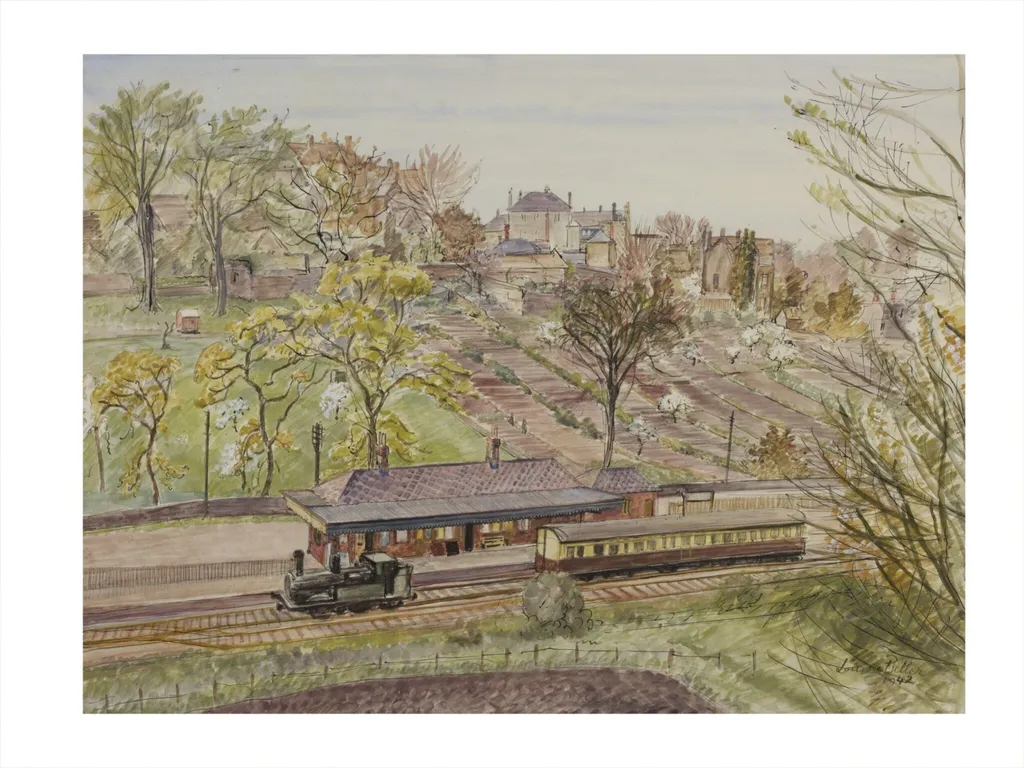
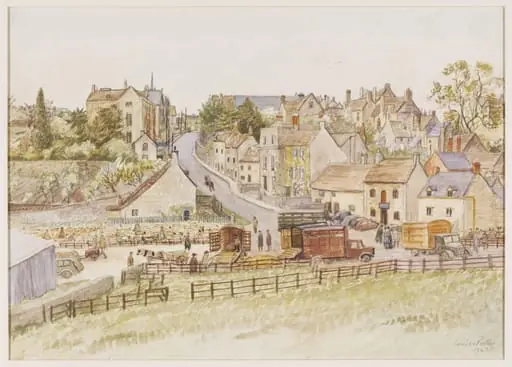
The Railway Station at Tetbury is a watercolor work on paper by the Social Realist artist Puller. It is held in the collection of the Victoria and Albert Museum.
About this work
Overview
It presents a downward view of Tetbury railway station, with the surrounding allotments visible beyond the tracks.
The work is a watercolour executed by the artist Puller in 1942, signed and dated by the creator. It presents a downward view of Tetbury railway station, with the surrounding allotments visible beyond the tracks. The composition captures a modest station building, a steam locomotive pulling a passenger carriage, and a nearby platform, set against a backdrop of sparse trees and a low hill dotted with houses.
Subject & Meaning
The painting records a moment of everyday travel in wartime Britain, emphasizing the continuity of rural infrastructure despite the surrounding conflict. By portraying the station in a calm, almost timeless manner, the image suggests a sense of stability and routine amid the broader disruptions of the early 1940s.
Technique & Style
Puller employs gentle, translucent washes characteristic of watercolour, allowing forms to soften at the edges. A muted palette of earth tones, pale greens and greys conveys a subdued atmosphere, while the light brushwork imparts a slightly hazy quality that reinforces the quiet mood of the scene.
History & Provenance
The piece belongs to the Recording Britain project, a government‑sponsored scheme launched in 1940 to document the nation’s landscapes and traditional ways of life. Funded by the Pilgrim Trust and overseen by the Committee for the Employment of Artists in Wartime under the Ministry of Labour and National Service, the initiative was directed by Sir Kenneth Clark and resulted in over 1,500 works by 97 artists between 1940 and 1943.
Context
Created during the height of World War II, the painting reflects concerns about potential damage to the British countryside and the desire to preserve visual records of places that might be altered or lost. Railway stations, as vital nodes of transport and communication, were a particular focus for the project’s aim to capture everyday scenes before they changed.
Own this work as a print
Artist & collection