Artwork
Telemachus discovering the priest of Apollo
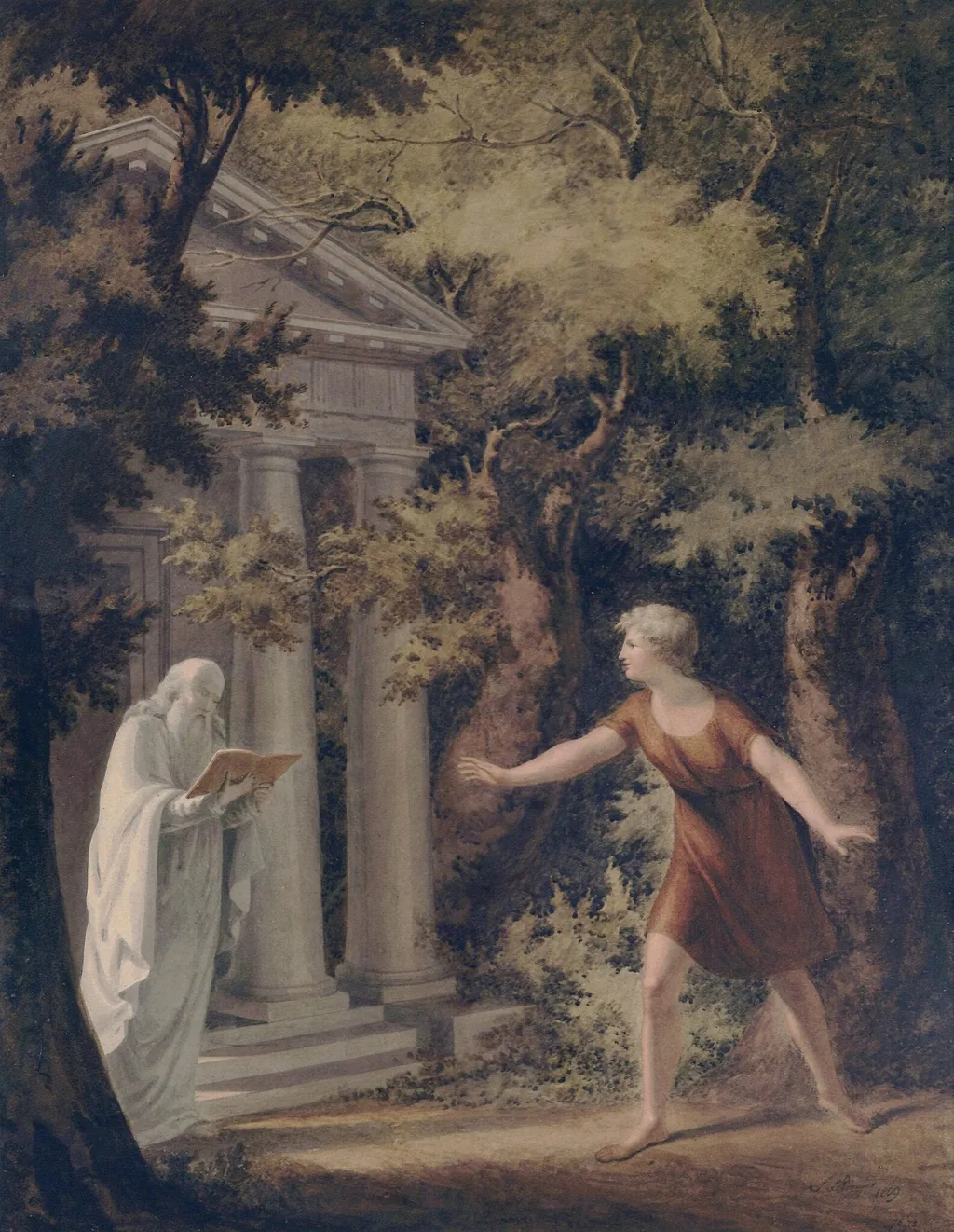
Telemachus discovering the priest of Apollo is a watercolor work on paper by the British Romanticist artist Stephen Francis Rigaud. It dates from 1809 and is held in the collection of the Victoria and Albert Museum. The watercolour portrays a youthful Telemáchos encountering an aged priest of Apollo on the steps of a Doric temple.
About this work
Overview
The watercolour portrays a youthful Telemáchos encountering an aged priest of Apollo on the steps of a Doric temple. The priest, robed in white and holding a book, stands before the stone columns while Telemáchos, barefoot in a brown tunic, reaches out toward him. A dense forest encroaches behind the structure, lending depth to the composition.
Subject & Meaning
The scene is drawn from Book II of François Fénelon’s Les Aventures de Télémaque, in which the hero describes meeting a priest within a marble sanctuary consecrated by Egyptian monarchs. The interaction suggests the transmission of wisdom from the elder priest to the aspiring young hero, emphasizing themes of guidance and the pursuit of knowledge.
Technique & Style
Delicate washes create atmospheric perspective, while the contrast of light and shadow on the temple steps enhances the sense of three‑dimensional space.
Executed in transparent watercolour, the work balances cool whites of the priest’s garment against the warm earth tones of Telemáchos’s tunic. Delicate washes create atmospheric perspective, while the contrast of light and shadow on the temple steps enhances the sense of three‑dimensional space. The composition directs the eye along the line of the figures’ outstretched arms toward the central encounter.
History & Provenance
The artist signed and dated the piece in the lower right corner, confirming its authorship and providing a clear terminus post quem. No further ownership details are recorded in the source material, indicating that the work’s provenance beyond the signature remains undocumented.
Context
Set against a backdrop of foliage, the painting situates the classical narrative within a natural environment, reflecting the 18th‑century fascination with integrating antiquity and the pastoral. The Doric temple and the Egyptian‑linked dedication echo contemporary interests in archaeological discovery and the synthesis of Greek and Near Eastern cultures.
Own this work as a print
Artist & collection
Artist
Stephen Rigaud painted detailed watercolors in late 1700s England, blending classical stories with careful brushwork.

- Diana med sit følge i et landskab
 Arcadian landscape
 Abraham Kneeling before the Three Angels
 The Angel and Hagar
 The Finding of the Infant Moses
 The Finding of the Infant Moses
 Cephalus and Procris (study)
 Invocation to Love
 Diana med sit følge i et landskab
 Ruins with Saint Paul preaching
 The Angel and Hagar
 Hagar and Ishmael in the Desert