Artwork
The Renunciants
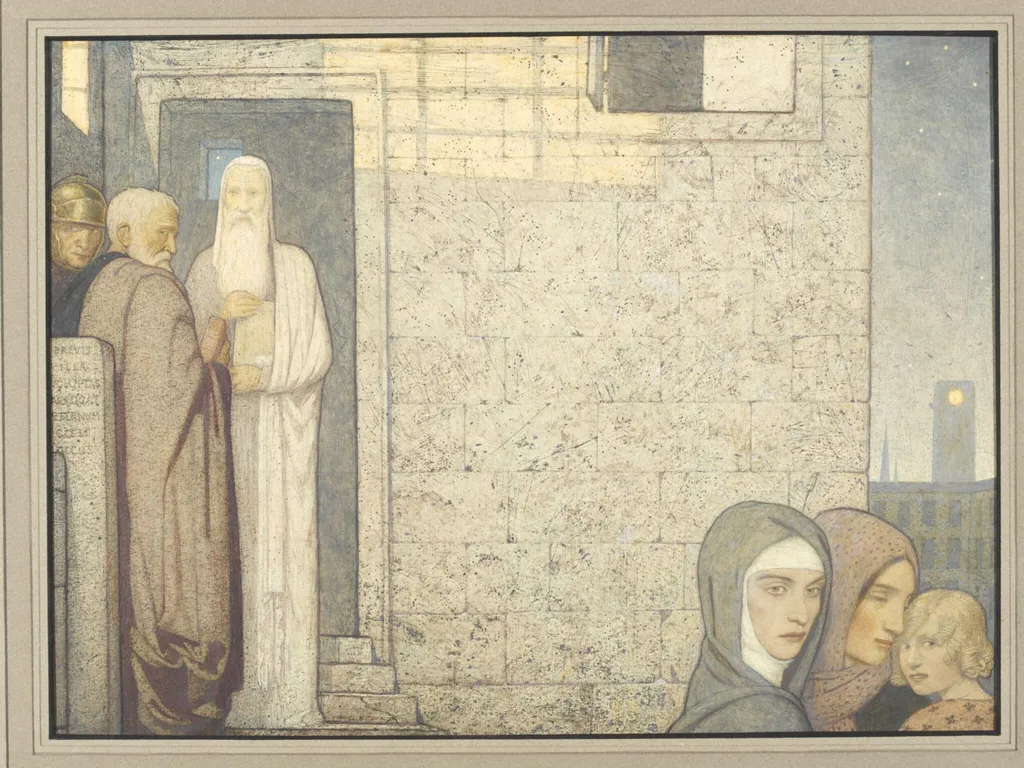
The Renunciants is a watercolor work on paper by the Aestheticist artist Frederic Cayley Robinson. It dates from 1916 and is held in the collection of the Victoria and Albert Museum.
About this work
Overview
Created in 1916, The Renunciants is a watercolour and gouache piece by Frederic Cayley Robinson that presents a quiet, contemplative scene.
Created in 1916, The Renunciants is a watercolour and gouache piece by Frederic Cayley Robinson that presents a quiet, contemplative scene. Five figures are arranged within a dimly lit stone interior, their postures and attire suggesting spiritual or emotional transition. The palette is restrained, dominated by muted grays and browns, with subtle contrasts drawing attention to the central white-robed figure. The work bears the artist’s signature and date, affirming its completion in this period.
Subject & Meaning
The painting portrays a moment of separation or farewell: two men in dark garments stand beside a figure in white monastic robes, while a woman and child on the opposite side gaze outward with solemn stillness. The white robe may signify renunciation or asceticism, and the women’s headscarves suggest mourning or devotion. The scene evokes a threshold between worlds, earthly ties and spiritual surrender, without narrative clarity, inviting quiet reflection rather than explicit interpretation.
Technique & Style
Robinson employed watercolour and gouache with deliberate restraint, layering translucent washes to build depth in the stone walls and soft modeling on the figures’ faces. The light source is indistinct, casting a gentle glow on skin and fabric without harsh shadows. The white robe stands out not through saturation but through contrast against the muted surroundings.
Fine, almost imperceptible pencil lines suggest the texture of cracked stone, reinforcing the atmosphere of stillness and age.
History & Provenance
Completed in 1916, The Renunciants was produced during a period when Robinson focused on introspective, symbolic subjects. It remained in private hands for much of the 20th century before entering a public collection. No major exhibitions or documented sales are recorded prior to its institutional acquisition, reflecting its quiet reception compared to more overtly dramatic works of the era.
Context
Robinson’s work emerged in the shadow of late Victorian symbolism and early modernist quietism. While contemporaries explored expressionism or abstraction, he favored subdued palettes and ambiguous narratives rooted in spiritual or psychological states. The Renunciants aligns with his broader interest in solitude, ritual, and the unseen dimensions of human experience, resonating with literary and religious themes of withdrawal and inner transformation.
Legacy
Though not widely exhibited during his lifetime, Robinson’s oeuvre has gained recognition for its emotional restraint and technical precision. The Renunciants exemplifies his ability to convey profound stillness through minimal means. It continues to be studied as a quiet counterpoint to the turbulence of early 20th-century art, valued for its meditative presence and understated symbolism.
![View up a Street in Sorrento [verso]](https://artifactworldgallery.com/img/francois-edouard-bertin--view-up-a-street-in-sorrento-verso--d628dffbf459271a-w320.webp)
Own this work as a print
Artist & collection

- View up a Street in Sorrento [verso]
 CERBUL DE AUR
 Elijah restoring the widow's son
 Paolo and Francesca
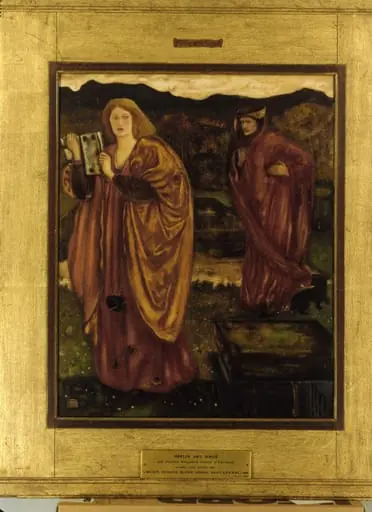 Merlin and Nimue
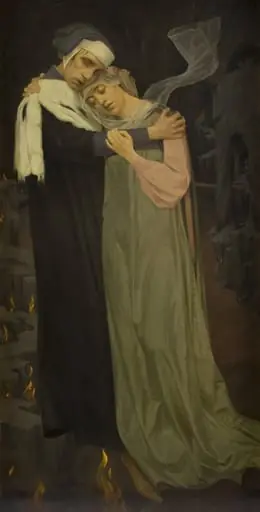 Paolo and Francesca
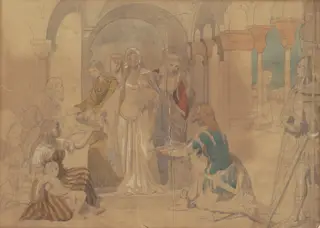 Study of Courtesans
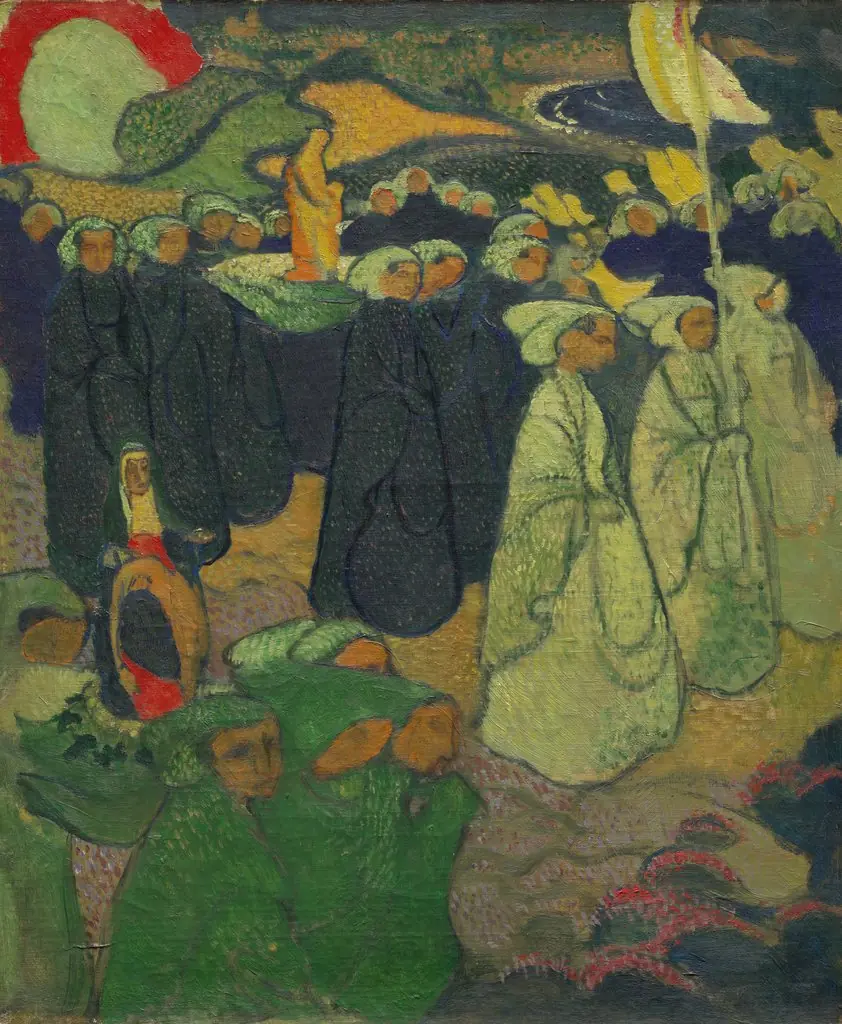 Procession or Pardon at Perros-Guirec
 Untitled
 Enthroned Mary with an angel from the scene "Coronation of the Blessed Virgin Mary" (left part). Artistic reconstruction of a stained-glass panel from the Dominican church in Kraków
 Isaac and Rebekah
 Procession or Pardon at Perros-Guirec