Artwork
Merlin and Nimue
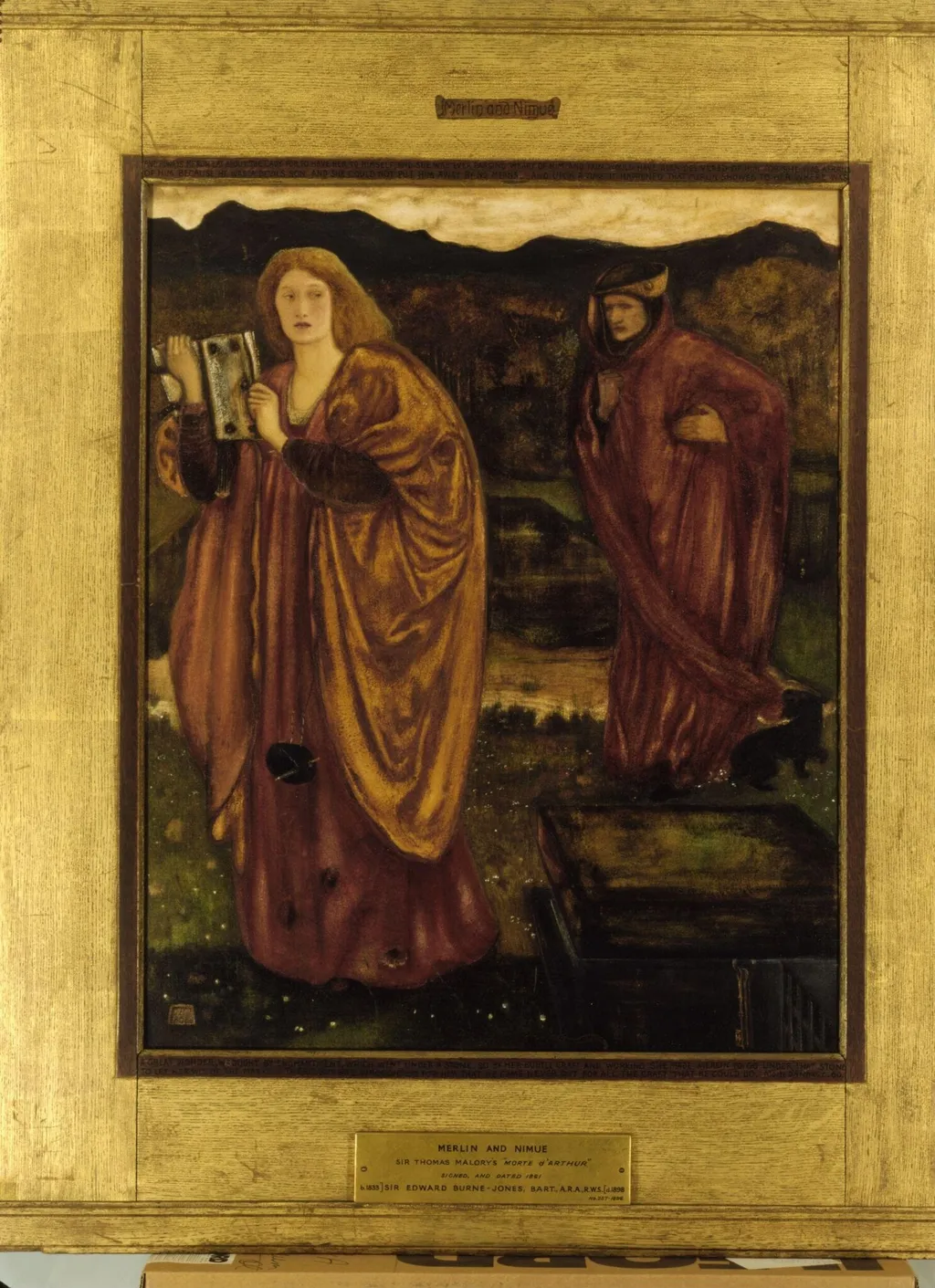
Merlin and Nimue is a watercolor work on paper by the Aestheticist artist Edward Coley, Sir Burne-Jones. It dates from 1861 and is held in the collection of the Victoria and Albert Museum.
About this work
Overview
The scene draws directly from Thomas Malory’s Le Morte d’Arthur, a text Burne-Jones encountered in 1855 and which deeply influenced his later oeuvre.
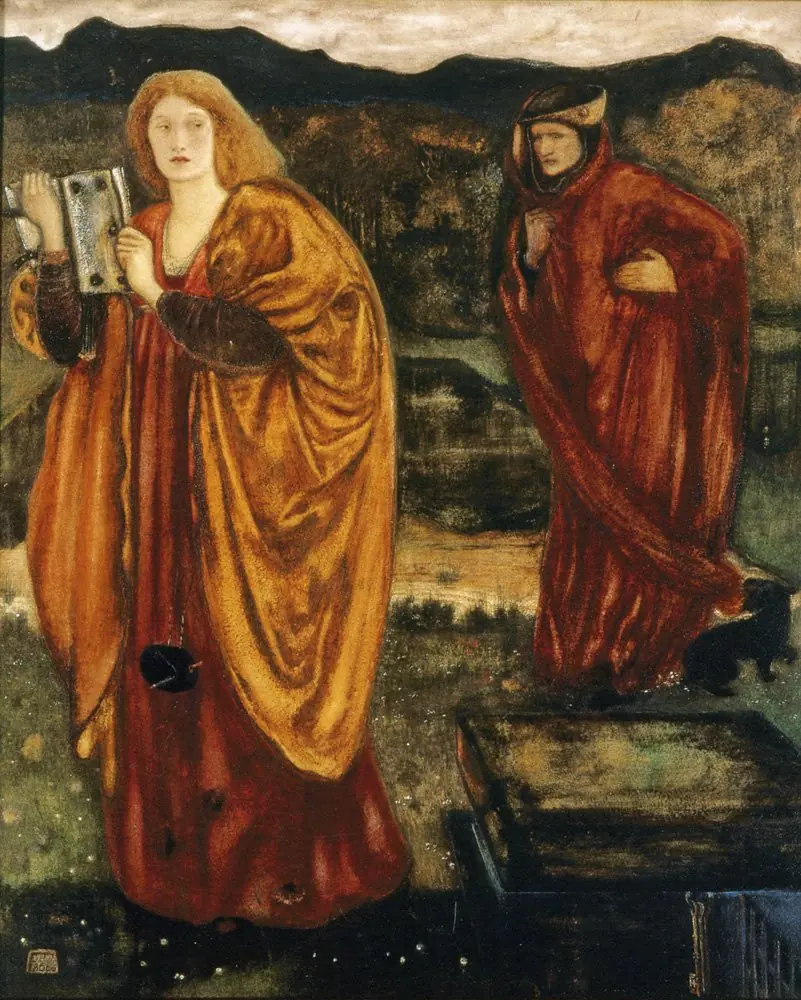
Painted in watercolour, this work by Edward Burne-Jones depicts a pivotal moment from Arthurian legend: the sorcerer Merlin, ensnared by his former pupil Nimue, is drawn into a stone tomb as she recites an incantation. The scene draws directly from Thomas Malory’s Le Morte d’Arthur, a text Burne-Jones encountered in 1855 and which deeply influenced his later oeuvre. The painting’s intimate scale and luminous technique reflect his commitment to narrative detail and poetic atmosphere.
Subject & Meaning
Nimue, once Merlin’s student, turns against him after learning his secrets, using his own magic to imprison him beneath a stone. The scene captures betrayal masked as devotion, her calm demeanor contrasts with the inevitability of his entrapment. The gravestone-like rock symbolizes not just physical confinement but the end of his power and influence.
The inscription on the frame, drawn from Malory, anchors the image in literary tradition, emphasizing the fatal consequences of knowledge passed too freely.
Technique & Style
Burne-Jones employed delicate watercolour washes to create a dreamlike, ethereal quality, with soft contours and muted tones that enhance the mystical mood. Figures are rendered with elongated, sculptural grace, characteristic of his Pre-Raphaelite-inspired style. The composition directs the viewer’s eye along the arc of Nimue’s gesture toward the stone, reinforcing the spell’s inexorable pull. The frame, inscribed with Malory’s text, functions as an integral part of the work’s narrative structure.
History & Provenance
The figure of Nimue was modeled by Fanny Cornforth, a frequent muse for Burne-Jones and a member of his artistic circle. The painting was completed in the 1870s, during a period when the artist was deeply immersed in Arthurian themes. Its provenance traces to private collections in Britain, where it remained until entering a public collection. The work reflects Burne-Jones’s sustained engagement with medieval romance as a vehicle for psychological and symbolic expression.
Context
In Victorian England, interest in medieval legends surged as a counterpoint to industrial modernity. Burne-Jones, alongside other Pre-Raphaelites, sought to revive mythic storytelling through visual art. His Arthurian subjects, including this one, responded to contemporary fascination with chivalry, fate, and the tension between knowledge and power.
The choice to depict Merlin’s downfall rather than his triumph aligns with a broader cultural preoccupation with tragic heroism.
Legacy
This watercolour exemplifies Burne-Jones’s contribution to the revival of narrative painting in the late 19th century. By merging literary source material with symbolic composition, he influenced later Symbolist and Aesthetic movements. Though less widely known than his oil paintings, this piece remains a key example of his mastery in watercolour and his ability to convey complex emotional and moral narratives through restrained, lyrical means.
Own this work as a print
Artist & collection