Artwork
Botheration
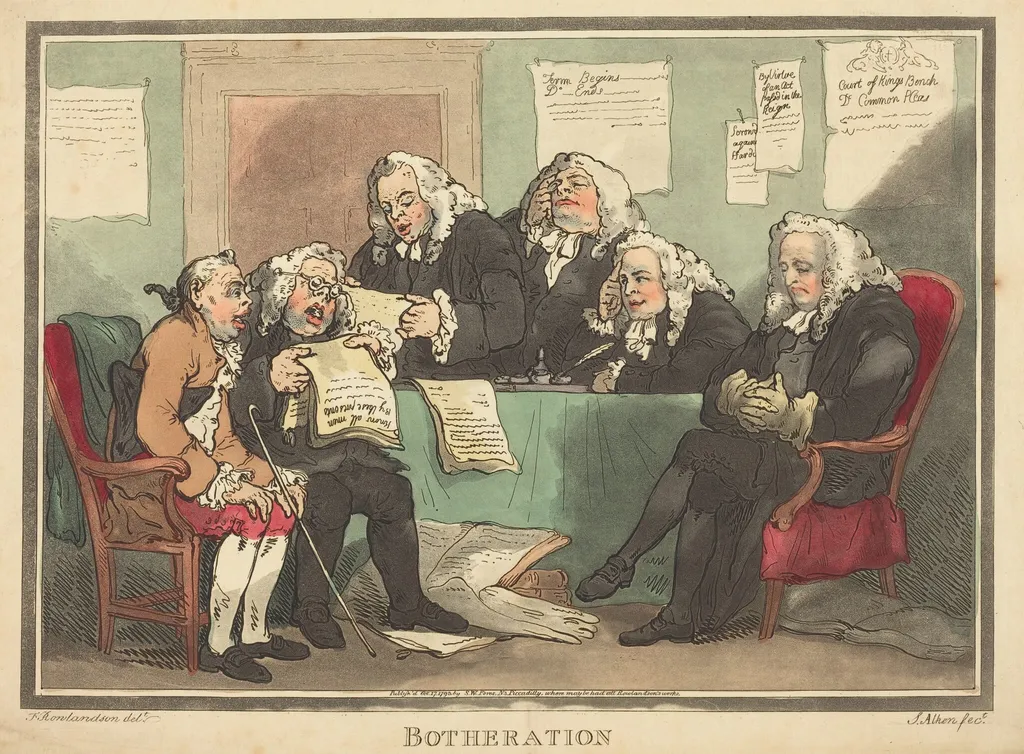
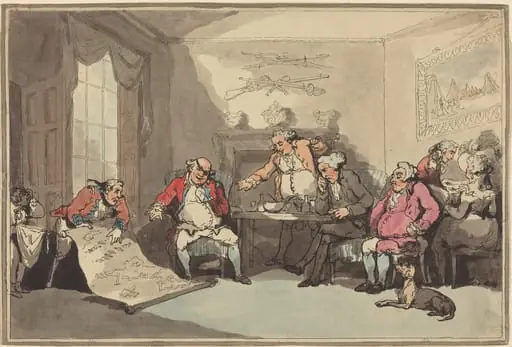
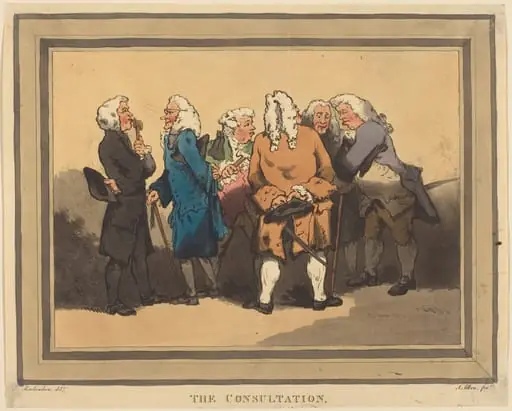
Botheration is an ink print by the Romanticist artist Thomas Rowlandson. It dates from 1793 and is held in the collection of the National Gallery of Art.
About this work
Overview
The work belongs to a broader body of satirical prints that capture everyday absurdities with wit and precision.
Created in 1793, Botheration is a hand-colored etching and aquatint by Thomas Rowlandson, an English artist known for his sharp depictions of social life during the Georgian period. The work belongs to a broader body of satirical prints that capture everyday absurdities with wit and precision. Unlike grand historical subjects, Rowlandson focused on mundane, often frustrating human interactions, rendered with a lively, informal aesthetic that blends line and wash to evoke atmosphere rather than idealization.
Subject & Meaning
The scene depicts seven men in a sparse, cluttered room, each displaying signs of weariness or irritation. One lounges with feet propped, another stares at a document, and a third rests his head in hand. Scribbled notes on the walls, 'Form Begins,' 'Court of King’s Bench', suggest a bureaucratic or legal setting.
The title Botheration underscores the futility and monotony of the gathering, framing institutional routine as a source of quiet, collective exhaustion rather than drama.
Technique & Style
Rowlandson employed etching and aquatint to achieve a range of tonal effects, from sharp, sketchy outlines to soft, atmospheric washes. Hand-coloring added subtle vibrancy to the red wooden chairs and muted walls, enhancing the sense of immediacy without idealizing the scene. The loose, almost hurried linework conveys movement and disarray, mirroring the emotional tone of the subjects. This technique allowed him to balance detail with spontaneity, characteristic of his approach to social observation.
History & Provenance
The print was produced during a period when Rowlandson was prolific in creating standalone satirical prints, often circulated as affordable broadsheets. While its early ownership is undocumented, it aligns with his broader output for publishers like Thomas Tegg, who specialized in political and social caricatures. Its survival in museum collections reflects its status as a representative example of late 18th-century British print culture, valued for its candid portrayal of institutional life.
Context
In the 1790s, Britain’s legal and administrative systems were expanding, yet widely perceived as inefficient and opaque. Rowlandson’s work tapped into public skepticism toward bureaucracy, using humor to expose the disconnect between official formality and human experience. Botheration fits within a tradition of satirical prints that mocked the pomposity of institutions, offering viewers a relatable, if irreverent, commentary on the rhythms of daily power.
Legacy
Rowlandson’s prints, including Botheration, influenced later generations of illustrators and cartoonists by demonstrating how everyday scenes could carry critical weight. His fusion of observational detail with expressive line work became a model for social satire in print. Though not widely exhibited in his lifetime as fine art, his works now serve as vital records of Georgian-era attitudes, preserving the quiet frustrations of institutional life in accessible, enduring images.
Own this work as a print
Artist & collection
Artist
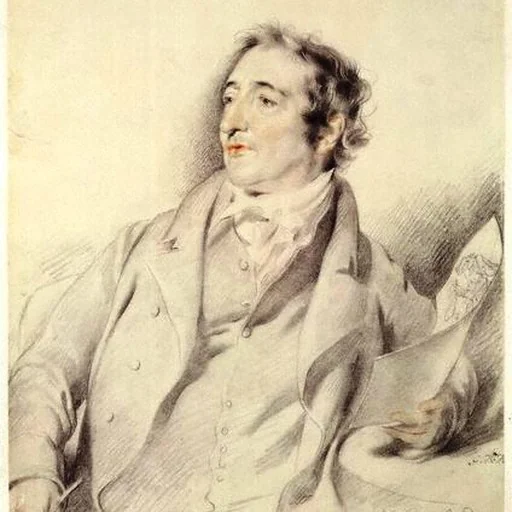
Thomas Rowlandson (; 13 July 1757 – 21 April 1827) was an English artist and caricaturist of the Georgian Era, noted for his political satire and social observation.