Artwork
Title Page for "De droeve Ellendigheden van den Oorloogh"
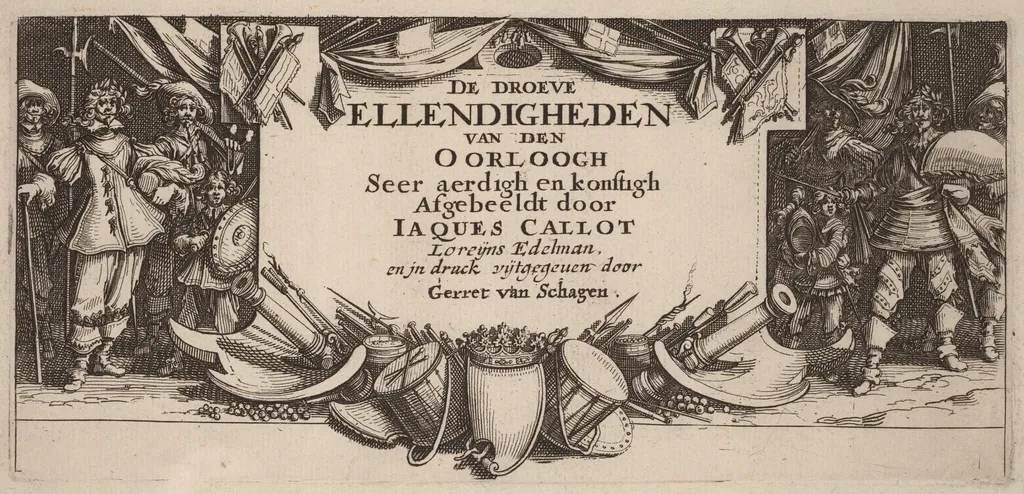
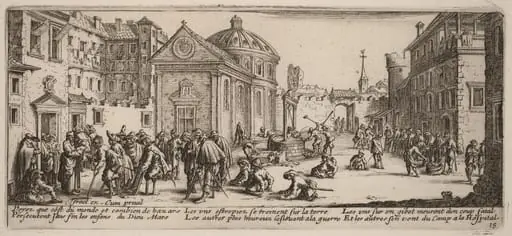
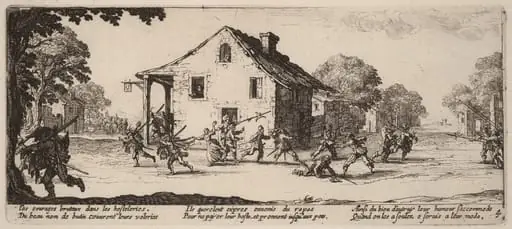
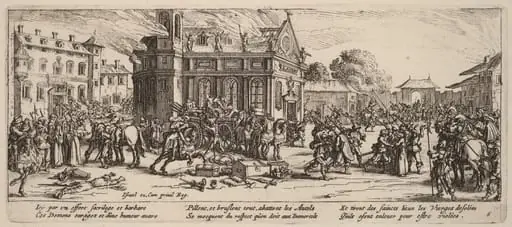
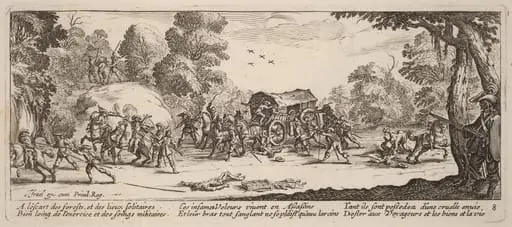
Title Page for "De droeve Ellendigheden van den Oorloogh" is an ink print by the Baroque artist Gerrit van Schagen. It dates from 1642 and is held in the collection of the National Gallery of Art.
About this work
Overview
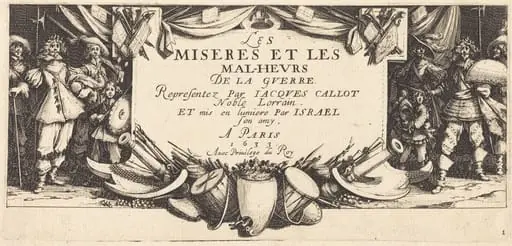
The title page for De droeve Ellendigheden van den Oorloogh is a 1642 print by Gerrit van Schagen, executed as an etching and engraving on laid paper. The work functions as a frontispiece for a text whose Dutch title translates as “The Sad Misfortunes of War,” and it presents a densely populated, monochrome composition that combines allegorical and narrative elements.
Subject & Meaning
On the left, figures in period costume gather around a table bearing a book and a skull, evoking the vanitas tradition.
Central to the image is a moralizing tableau that contrasts the consequences of conflict with symbols of mortality. On the left, figures in period costume gather around a table bearing a book and a skull, evoking the vanitas tradition. Opposite them, armored soldiers appear solemn, their weapons underscoring the martial theme, while a shipwreck occupies the middle ground, suggesting the broader devastation wrought by war.
Technique & Style
Van Schagen employed fine, incised lines characteristic of early‑modern engraving, allowing intricate detailing of armor, textiles, and wreckage. The use of laid paper provides a subtle texture that enhances the contrast between the dense foreground and the lighter background, while the black‑and‑white palette emphasizes the stark moral tone of the composition.
History & Provenance
Created as the title page for a contemporary pamphlet, the print was likely distributed alongside the text to reinforce its anti‑war message. The work bears the artist’s signature and date, anchoring it firmly within the Dutch Republic’s prolific print culture of the mid‑seventeenth century.
Context
The image reflects the turbulent period of the Eighty Years’ War and the Thirty Years’ War, when Dutch artists frequently employed allegory to comment on the human cost of prolonged conflict. Its combination of scholarly symbols and martial imagery aligns with the period’s didactic visual rhetoric.
Legacy
While not as widely reproduced as later war‑related prints, this title page exemplifies the early modern use of print media for political and moral persuasion, illustrating how artists like van Schagen contributed to the visual discourse on war and its consequences.
Artist & collection