Artwork
Counter-Composition VI
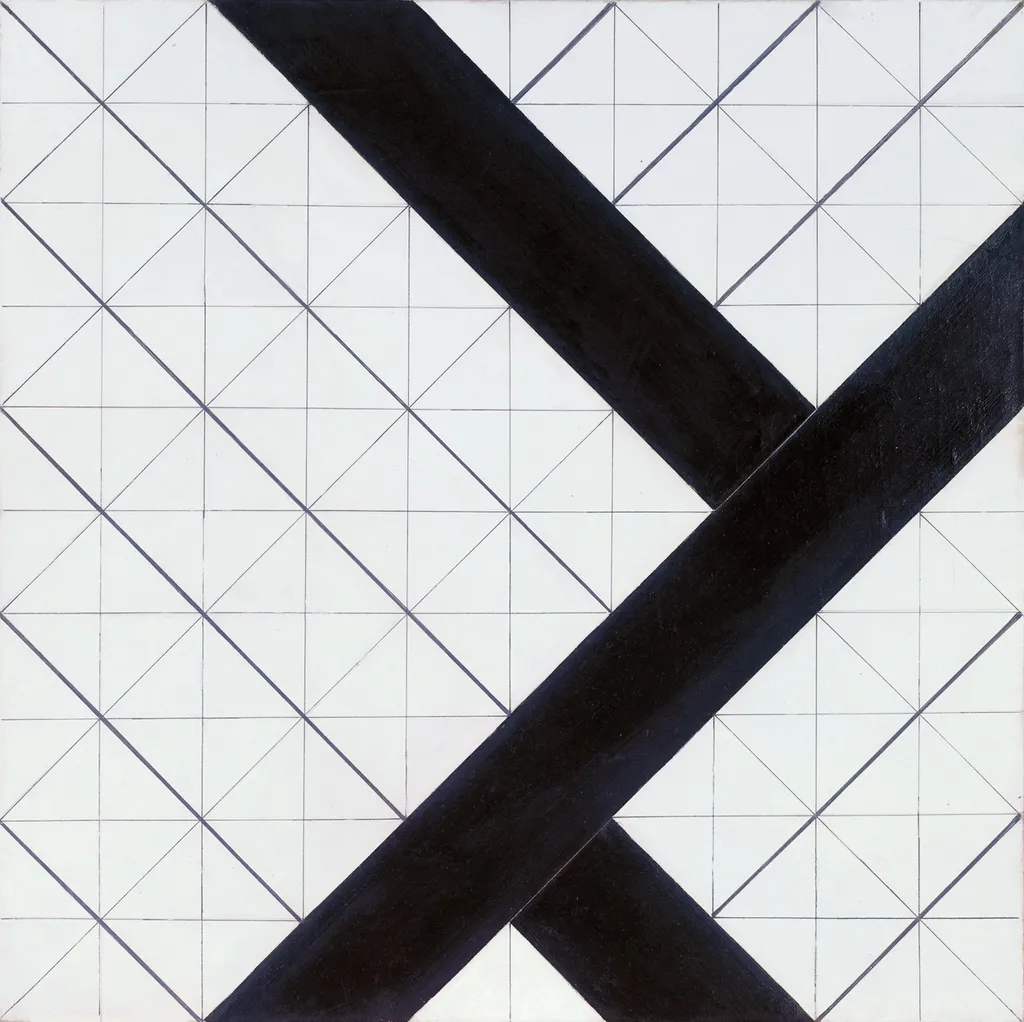
Counter-Composition VI is an oil painting by the De Stijl artist Theo van Doesburg. It dates from 1925 and is held in the collection of the Tate.
About this work
Overview
Counter-Composition VI is an abstract oil painting created by Dutch artist Theo van Doesburg in 1925, now part of the Tate Modern's collection.
Subject & Meaning
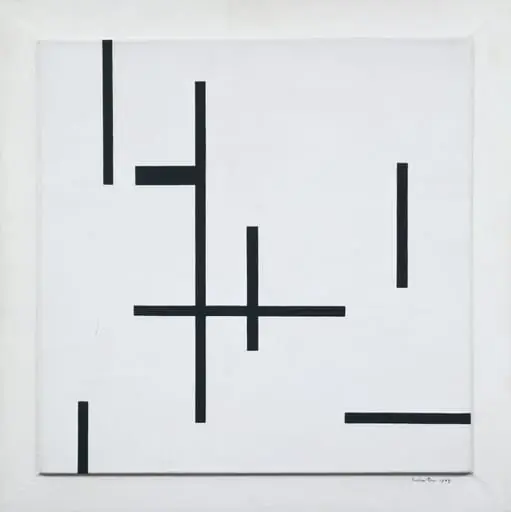
The composition explores geometric abstraction, using intersecting lines to divide the space into sections, exploring balance and visual tension through simplicity.
Technique & Style
Executed in oil paint, the work features a white background overlaid with a grid of thin black lines and two bold, intersecting black lines, characteristic of De Stijl's geometric style.
History & Provenance
Created in 1925 by Theo van Doesburg, a key figure in the De Stijl movement, the painting is currently held in the collection of the Tate Modern.
Context
Part of the broader De Stijl movement, this work reflects the artist's and movement's emphasis on geometric forms, primary colors (here, black and white), and the exploration of spatial relationships.
Legacy
As a quintessential example of De Stijl's principles, Counter-Composition VI influences subsequent geometric and abstract art movements, though its specific impact is more nuanced within the broader canon of modern art.
Own this work as a print
Artist & collection

Artist
Theo van Doesburg was a Dutch painter, writer, poet, and architect. He is best known as the founder and leader of De Stijl.

![New York City 2 [unfinished, formerly New York City III], by Piet Mondrian](https://artifactworldgallery.com/img/piet-mondrian--new-york-city-2-unfinished-formerly-new-york-city-iii--093645d7abd24628-w320.webp)