Artwork
Les Oies
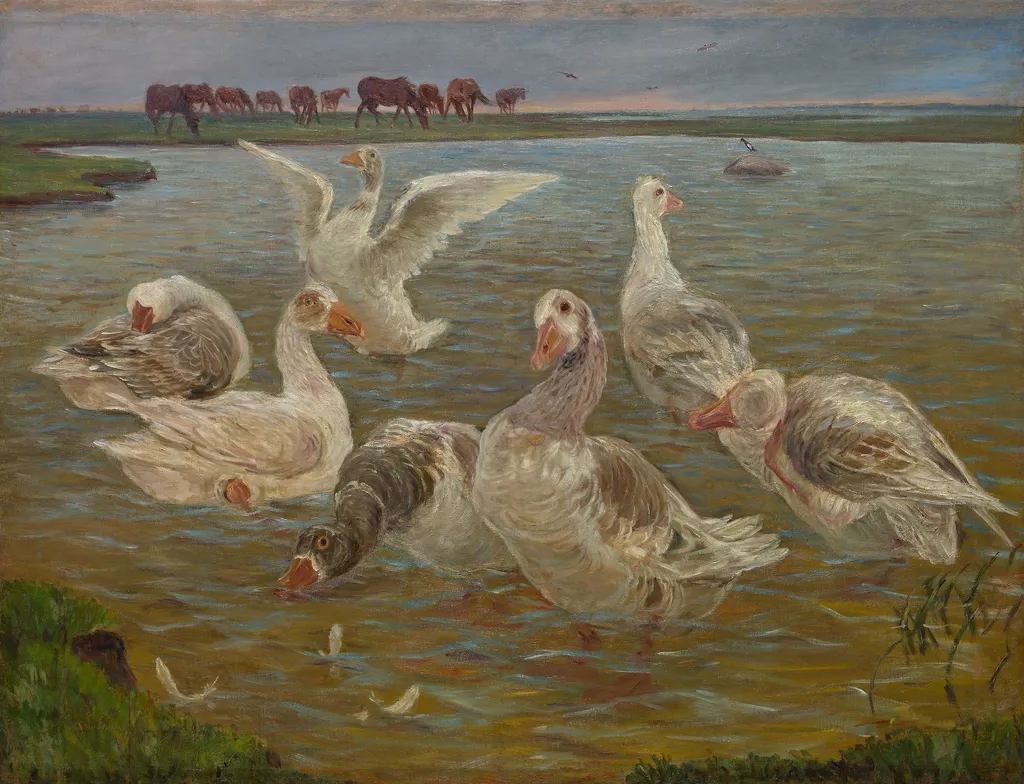
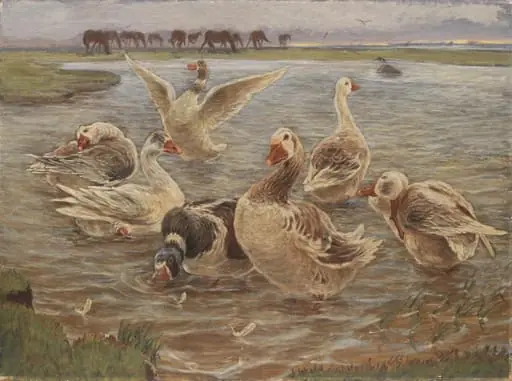
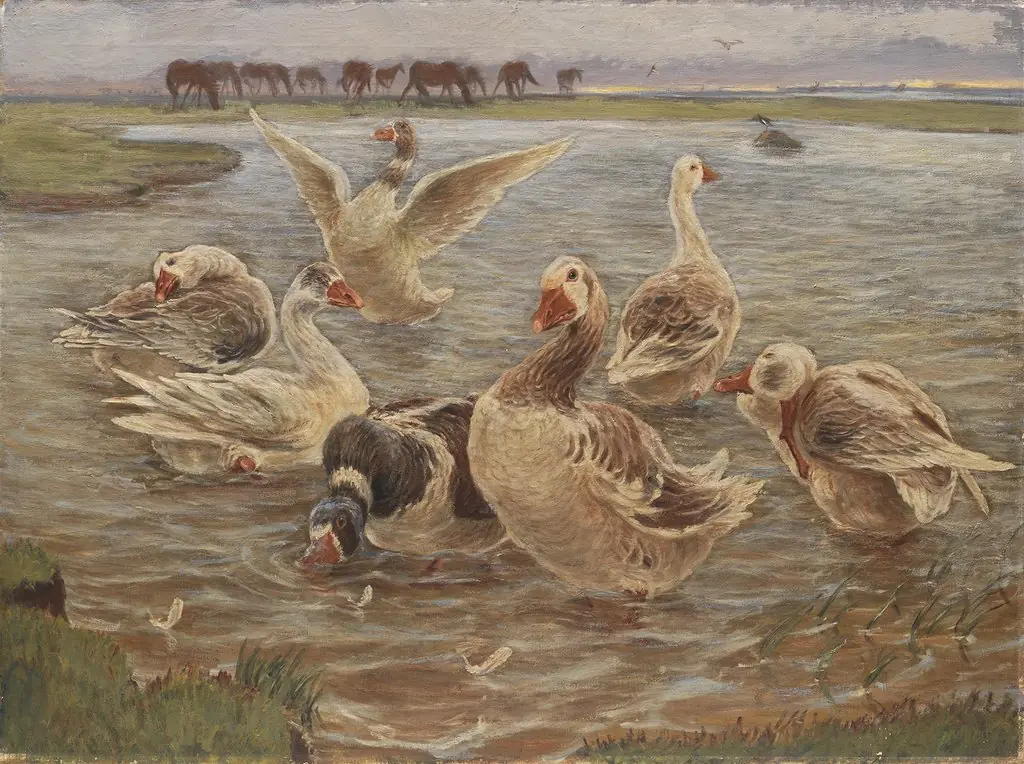
Les Oies is an oil painting by the Impressionist artist Theodor Philipsen. It dates from 1899 and is held in the collection of the Art Institute of Chicago.
About this work
Overview
Measuring 97 by 126 centimeters, the work depicts seven geese in shallow water with horses grazing in the distant background.
Les Oies (The Geese) is an oil-on-canvas painting by the Danish artist Theodor Esbern Philipsen, dated 1897. Measuring 97 by 126 centimeters, the work depicts seven geese in shallow water with horses grazing in the distant background. The painting is held in the collection of the Art Institute of Chicago, where it entered as a gift from Jean-Loup Champion in honor of Douglas Druick, with the accession number 2014.1066. As a mature work by Philipsen, who is widely recognized as a foundational figure in Danish Impressionism, Les Oies exemplifies his synthesis of French Impressionist technique with traditional Scandinavian animal painting.
Subject & Meaning
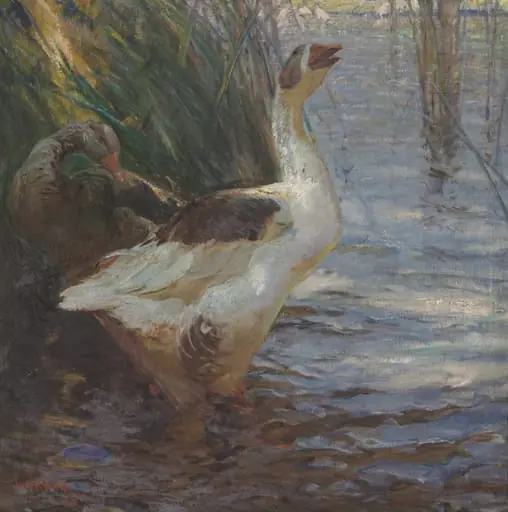
The painting presents a scene of rural animal life centered on seven geese occupying shallow water. One goose spreads its wings mid-flap, another dips its head to drink, and a third tucks its beak into its back feathers, while the remainder float or stand in alert and resting poses. Behind them, a distant line of horses grazes along the horizon, and a few birds fly in the pale sky above. The inclusion of both geese and cattle aligns with Philipsen's lifelong focus on animal subjects, which dominated his artistic output from his early training through his mature period. The scene lacks overt narrative or symbolic program, instead offering a naturalistic observation of animal behavior in a landscape setting. The work's meaning resides in its attentive recording of transient moments, gesture, and atmosphere, reflecting the Impressionist interest in everyday subjects and optical experience rather than moral or historical themes.
Technique & Style
Philipsen executed Les Oies in oil paint on canvas, employing a visible, textured brushwork that defines the white, grey, and brown plumage of the geese. The water is rendered with layered strokes of blue, green, and ochre with reflected tones, while a pale sky with soft clouds stretches above. Green vegetation borders the lower edge of the composition. The surface maintains an unpolished, painterly finish throughout, consistent with the technique Philipsen developed after his encounter with Paul Gauguin in the winter of 1884-1885, when Gauguin demonstrated the use of small brushes with quick, firm strokes. This method allowed Philipsen to capture movement and light effects while preserving structural solidity in his animal subjects. The painting shows the influence of his earlier training with Léon Bonnat in Paris, where he practiced intensive croquis drawing to capture position and movement, combined with the plein-air approach he adopted in the 1880s. The result is a distinctive style that integrates Impressionist color and brushwork with the animalier tradition of Johan Thomas Lundbye and Paulus Potter.
History & Provenance
The painting was created in 1897, during the mature phase of Philipsen's career, following his receipt of the Eckersberg Medal in 1890 and before the onset of the eye disease around 1905 that would interfere with his painting. The work was acquired by the Art Institute of Chicago as a gift from Jean-Loup Champion in honor of Douglas Druick, and bears the reference number 2014.1066. The museum makes its collection information available through the International Image Interoperability Framework (IIIF), indicating ongoing efforts to provide digital access to the work. No extensive exhibition history is recorded in the available sources.
Context
Theodor Esbern Philipsen (1840-1920) occupies a central position in Danish art history as the artist generally credited with establishing Impressionism as an important aspect of Danish painting. Born to a cultured merchant family of Jewish ancestry, he initially studied agriculture due to his interest in animals before committing to art after meeting the painter Hans Smidth in the 1860s. His studies at the Royal Danish Academy of Fine Arts with Carl Bøgh and later influence from Frederik Vermehren provided traditional foundations, but his decisive development came through Parisian training and personal contacts. His friendship with Rémy Cogghe exposed him to radical trends in French art during travels in Spain and Italy, while the pivotal encounter with Gauguin in Copenhagen in 1884-1885 introduced him to techniques of modern brushwork. Les Oies was painted during his most productive period, before the eye disease that limited his later work, and at a time when he had fully synthesized these diverse influences into a personal style. His preferred subjects and settings, including the islands of Saltholm and Amager, grounded French-derived technique in specifically Danish landscapes and rural life.
Legacy
Philipsen's reputation rests on his role in transplanting Impressionist methods onto Danish soil, and Les Oies represents a characteristic achievement within that project. The painting has entered the permanent collection of a major American museum, indicating its recognition beyond Scandinavian contexts. In commercial and popular contexts, the work has been reproduced and marketed through various print formats, though these reproductions vary in fidelity to the original. The artist's broader legacy was consolidated by the Thorvaldsen Medal, awarded in 1915, and his sustained influence on subsequent Danish painters working with light, landscape, and animal subjects. The continued availability of the image through museum digital infrastructure and commercial reproduction suggests an enduring, if modest, presence in visual culture, though specific scholarly attention to Les Oies as distinct from Philipsen's general oeuvre is not documented in the available sources.
Own this work as a print
Artist & collection
Artist
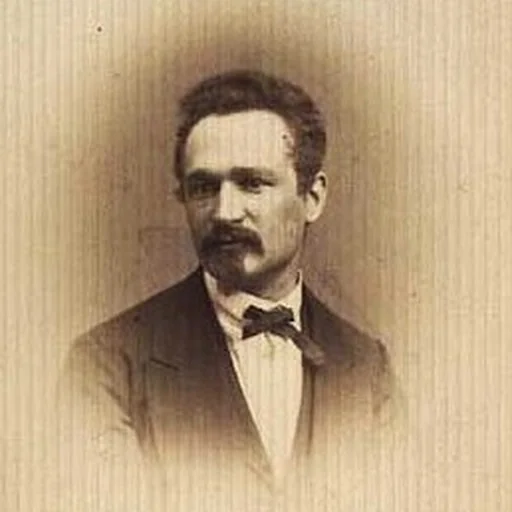
Theodor Esbern Philipsen (10 June 1840 – 3 March 1920) was a Danish painter of Jewish ancestry, known for landscapes and animal portraits. He also did small figures in wax and clay.