Artwork
Standing Woman
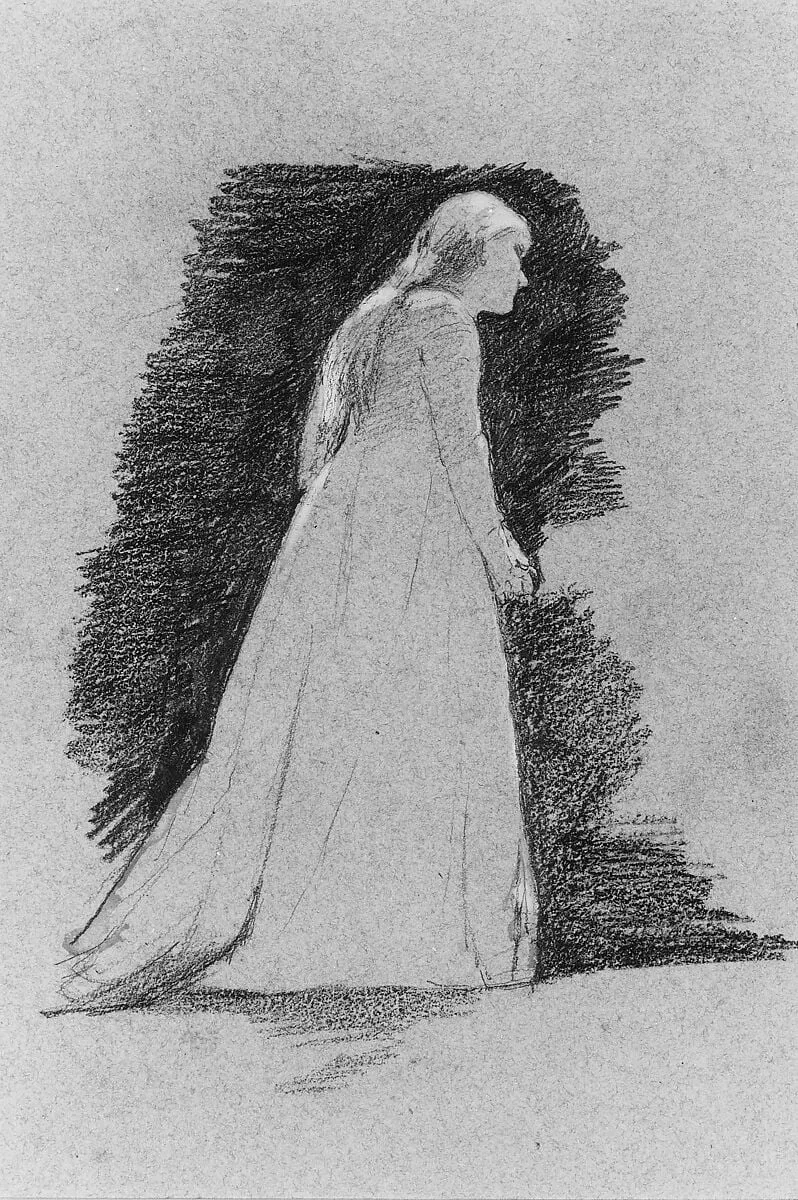
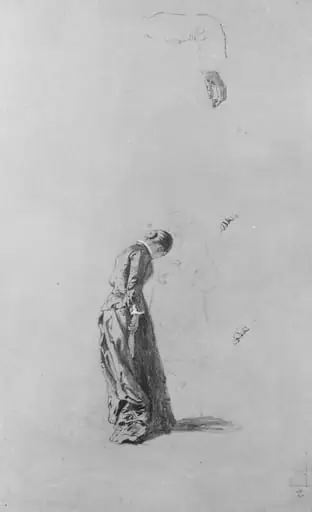
Standing Woman is a watercolor work on paper by the Impressionist artist Thomas Hovenden. It dates from 1882 and is held in the collection of the Metropolitan Museum of Art.
About this work
Overview
Standing Woman is a drawing by the Irish-born American artist Thomas Hovenden, executed circa 1881-82 in graphite and gouache watercolor on blue wove paper.
Standing Woman is a drawing by the Irish-born American artist Thomas Hovenden, executed circa 1881-82 in graphite and gouache watercolor on blue wove paper. Measuring 11 3/4 by 8 1/2 inches (29.8 x 21.6 cm), the work depicts a solitary female figure in profile and is held in the collection of the Metropolitan Museum of Art in New York, where it entered as part of the Rogers Fund in 1962 with the object number 62.198.2. The drawing belongs to the museum's American Wing and represents a significant example of Hovenden's draftsmanship from the early period of his mature American career, following his return from France and establishment near Philadelphia.
Subject & Meaning
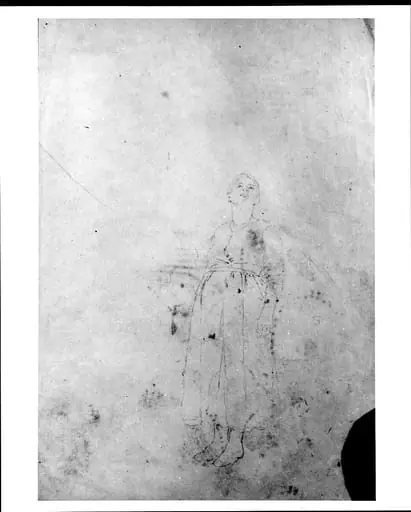
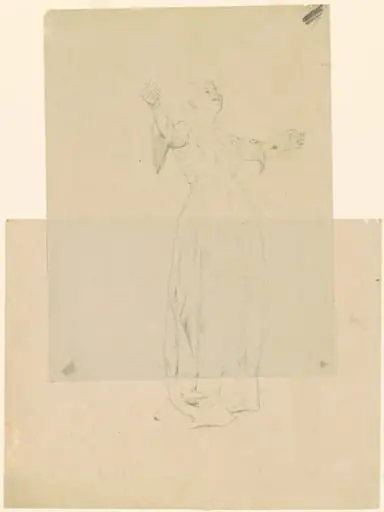
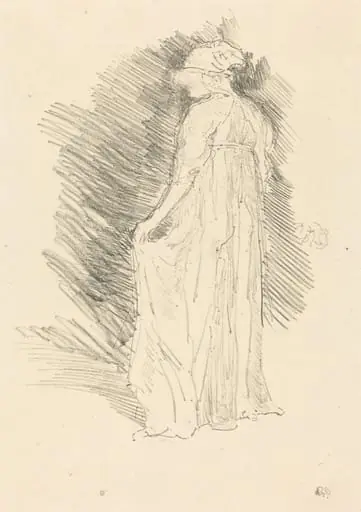
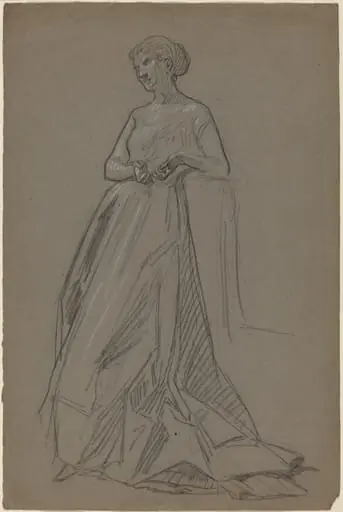
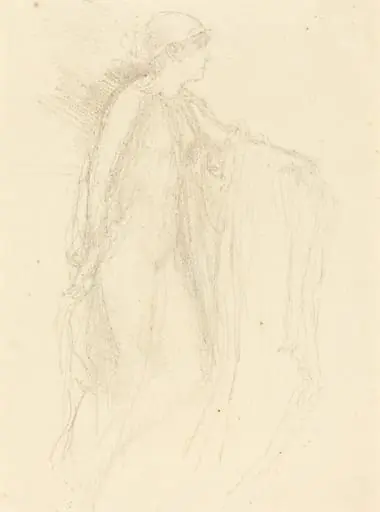
The drawing presents a single female figure standing in profile facing right. She wears a long, flowing gown that extends to the floor, with fabric pooling slightly at her feet, and her hands are clasped in front at waist level. Long hair falls down her back. Behind the figure, a roughly rectangular mass of dense dark hatching creates a stark backdrop, contrasting with the lighter figure and the empty paper surrounding it. No setting or background details are depicted beyond this abstract dark shape. The composition relies on tonal contrast between the dark ground and the lightly indicated figure, creating a contemplative, isolated presence. The absence of narrative context or identifying attributes suggests the work functions as a study of form and mood rather than a portrait of a specific individual, aligning with Hovenden's broader interest in figure painting grounded in academic training.
Technique & Style
The medium is graphite and gouache watercolor on blue wove paper, a combination that allows for both precise linear definition and tonal modulation. The technique shows loose, directional strokes in the background shading, with smoother, more minimal linework defining the dress and form. The overall effect depends on the interplay between the dark, hatched background and the lightly rendered figure, which appears to emerge from the blue paper support. The handling demonstrates Hovenden's French academic training, particularly his sensitivity to tonal values and figure construction absorbed during his studies at the École des Beaux-Arts under Cabanel and his time at the Pont-Aven artists' colony. The economical yet assured draftsmanship suggests the work may have served as a preparatory study, though its exact function within Hovenden's practice remains unspecified.
History & Provenance
The drawing is dated circa 1881-82, placing it in the immediate aftermath of Hovenden's return to the United States in 1880 and his marriage to Helen Corson in June 1881, when the couple settled in Plymouth Meeting, Pennsylvania. The work was acquired by the Metropolitan Museum of Art in 1962 through the Rogers Fund, receiving the object number 62.198.2. It was purchased in the same year as a related drawing, Standing Woman with Man in Outline (62.198.3 recto), also acquired through the Rogers Fund, suggesting these works were obtained together from the same source. The museum has published the work through its Open Access program, making images and data available for unrestricted use.
Context
Thomas Hovenden (1840-1895) was born in Dunmanway, County Cork, Ireland, and orphaned during the Great Famine. After apprenticeship as a frame carver and gilder and study at the Cork School of Design, he immigrated to the United States in 1863. He studied at the National Academy of Design in New York before moving to Baltimore, where patronage from collector William T. Walters enabled his study in Paris from 1874. At the École des Beaux-Arts under Cabanel and at Pont-Aven, Hovenden absorbed academic methods that informed his subsequent American career. Returning in 1880, he joined the Society of American Artists, became an Associate of the National Academy of Design in 1881 and Academician in 1882, and in 1886 succeeded Thomas Eakins as Professor of Painting and Drawing at the Pennsylvania Academy of the Fine Arts. Standing Woman belongs to this period of professional consolidation, when Hovenden was establishing his reputation through domestic scenes and figure studies. The drawing's spare, tonal approach contrasts with the narrative sentiment of his later celebrated works such as Breaking Home Ties (1890), yet it reveals the foundational draftsmanship underlying his painted compositions.
Legacy
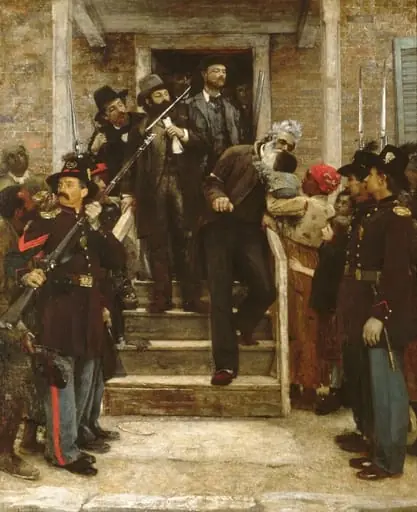
While Standing Woman does not command the public recognition of Hovenden's major paintings, its preservation and acquisition by the Metropolitan Museum of Art attest to its significance within the corpus of nineteenth-century American drawing. The work exemplifies the transatlantic character of American art of the period, combining French academic training with American institutional collecting patterns. Hovenden's broader legacy rests primarily on his narrative paintings, particularly Breaking Home Ties, voted most popular picture at the 1893 Chicago World's Columbian Exposition, and The Last Moments of John Brown (1884), both in the Metropolitan's collection. His death in 1895, struck by a train in what newspaper accounts described as a heroic attempt to save a child, cut short a career that had already achieved substantial academic and popular success. The survival of Standing Woman alongside these major paintings allows scholars to trace the continuities between Hovenden's preparatory practice and his finished compositions, contributing to understanding of his working methods and the place of drawing within nineteenth-century American academic practice.
Artist & collection

Artist
Thomas Hovenden (December 28, 1840 – August 14, 1895) was an Irish-born painter and teacher who spent most of his life in the United States.