Artwork
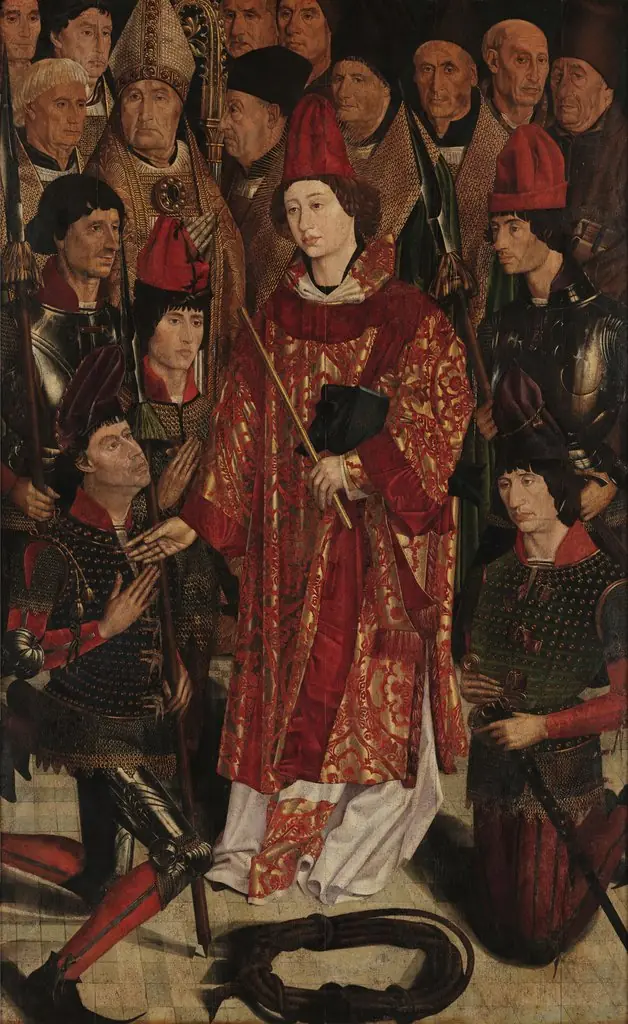
St. Vincent, deacon and martyr, with a donor
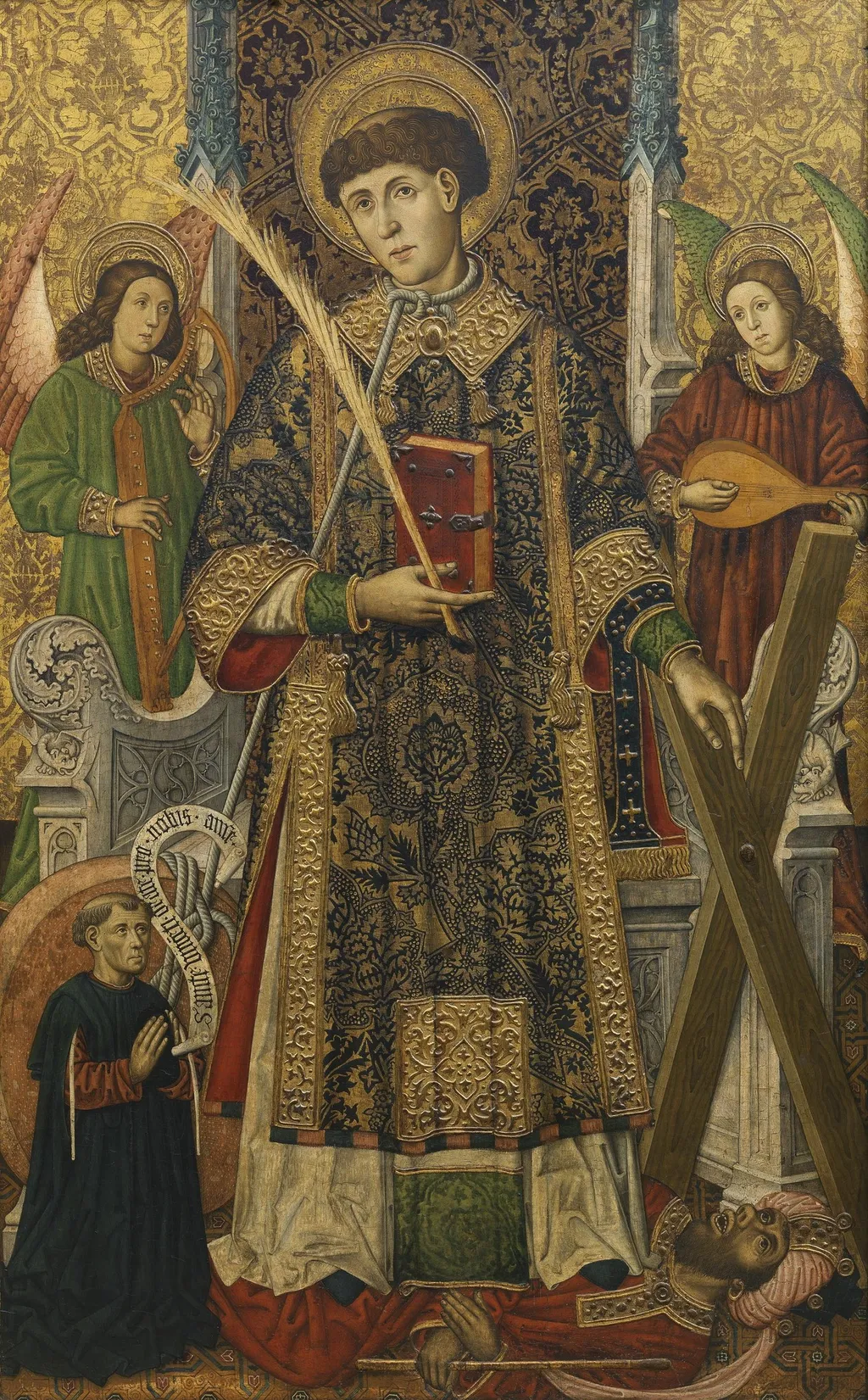
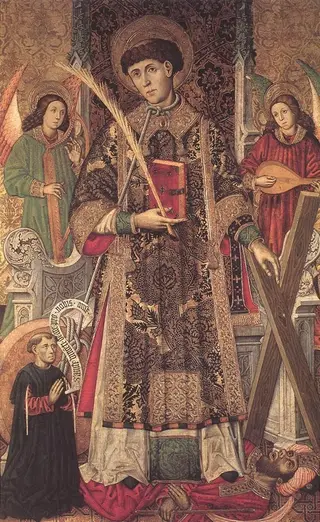
St. Vincent, deacon and martyr, with a donor is an unspecified painting by the Early Renaissance artist Tomás Giner. It dates from 1462 and is held in the collection of the Museo del Prado.
About this work
Subject & Meaning
Created in 1462 by Tomás Giner, this religious painting depicts Vincent of Saragossa, a deacon and martyr, as its central figure.
Created in 1462 by Tomás Giner, this religious painting depicts Vincent of Saragossa, a deacon and martyr, as its central figure. The saint is shown accompanied by a donor, a common convention in devotional art of the period that signifies the patron's piety and direct connection to the holy intercessor.
Vincent's iconography includes specific attributes such as a book and a lute. These objects serve as symbolic identifiers for the saint, distinguishing him within the visual language of Christian art and alluding to aspects of his life or martyrdom. The work functions as an object of veneration, visually linking the earthly donor with the heavenly status of the martyr.
Technique & Style
The work is executed in tempera on panel, a common devotional format in mid‑15th‑century Spain. It measures 185 cm in height and 117 cm in width, supporting a composition that combines flat modelling of drapery with strong linear contours. The spatial setting is shallow, focusing attention on the saint and donor, whose gestures and gazes are aligned toward the central figure of St. Vincent.
The palette relies on muted earth tones softened by subtle glazes, creating a restrained yet luminous surface. These stylistic choices reflect the influence of early Netherlandish realism filtered through a local Iberian workshop practice.
History & Provenance
The work was created in 1462 by Tomás Giner for a private donor, as indicated by its classification as a religious painting commissioned with donor figures. It entered the collection of the Museo del Prado, where it remains on display in the museum's Spanish Renaissance rooms. The painting's dimensions are 185 cm in height and 117 cm in width, matching the specifications recorded in the museum's catalog.
Its creation history is tied to the artistic practice of Giner in the mid-15th century, reflecting the devotional patronage typical of the period.
The painting St. Vincent, deacon and martyr, with a donor is held in the Museo del Prado in Madrid.
It is part of the museum’s permanent collection, though no specific accession number is documented in available sources. The work has been associated with the Prado since its inception as a public institution, reflecting its long-standing significance in the museum’s holdings.
Context
The painting St. Vincent, deacon and martyr, with a donor (1462) by Tomás Giner occupies a significant position within 15th-century Spanish religious art, reflecting evolving devotional practices and the integration of donor portraiture in sacred imagery. Scholarship emphasizes its stylistic connections to Iberian Gothic traditions while noting its role in documenting the cult of Vincent of Saragossa within the Archdiocese of Zaragoza, as evidenced by its depiction of the saint with characteristic symbols like the palm and book. The work's creation during a period of artistic transition in Aragon highlights the interplay between local workshops and broader Iberian networks, with its formal qualities, such as spatial composition and iconographic precision, contributing to discussions on the development of naturalism in pre-Renaissance painting.
Its presence in the Museo del Prado collection underscores its importance in contextualizing Spanish artistic identity during the Reconquista era, making it a focal point for understanding the fusion of devotional narrative and artistic innovation in late medieval Iberia.
Legacy
Tomás Giner’s St. Vincent, deacon and martyr, with a donor (1462) has been recognized as a significant example of late medieval Aragonese painting, reflecting the region’s devotional and artistic traditions. Since its acquisition by the Museo del Prado, the work has been integral to the museum’s representation of 15th-century Spanish religious art, contributing to scholarly and public appreciation of the period’s visual culture.
The painting’s inclusion in major exhibitions and collections has reinforced its reputation as a key work by Giner, often cited in studies of Spanish Renaissance art for its iconographic details and stylistic qualities. Its depiction of St. Vincent of Saragossa, accompanied by symbolic attributes such as a lute and book, has also made it a reference point for discussions on hagiographic representation in Iberian art.
Overview
Created in 1462 by the Spanish painter Tomás Giner, this panel presents Saint Vincent of Saragossa as a deacon and martyr. The central saint is shown in elaborate vestments, holding a book and a staff, his head crowned with a halo. Flanking him are three secondary figures, including a kneeling donor, a lute‑player, and a figure with a scroll, all set against a richly patterned gold background.
Own this work as a print
Artist & collection
Artist
Spanish Gothic painter Tomás Giner made vivid religious panels on wood in the 1400s.