Artwork
Apostle St. James the Elder and Philip the Apostle
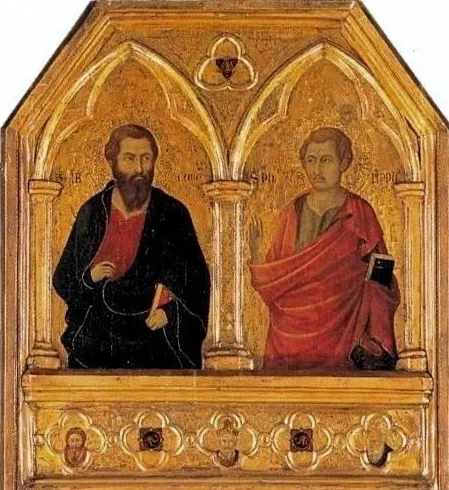
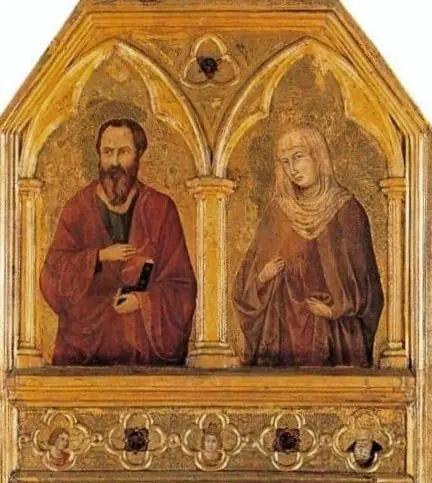
Apostle St. James the Elder and Philip the Apostle is an unspecified painting by the Byzantine icon painting artist Ugolino di Nerio. It dates from 1325 and is held in the collection of the Gemäldegalerie Berlin. Apostle St.
About this work
Overview
James the Elder and Philip the Apostle is a tempera painting on poplar wood by the Italian Sienese artist Ugolino di Nerio, dated to approximately 1325.
Apostle St. James the Elder and Philip the Apostle is a tempera painting on poplar wood by the Italian Sienese artist Ugolino di Nerio, dated to approximately 1325. The panel, a fragment from a larger polyptych, depicts two standing male saints beneath pointed Gothic arches against a gold-leaf background. It is currently held in the collection of the Gemäldegalerie in Berlin. The work represents a significant example of early fourteenth-century Sienese panel painting and contributes to understanding Ugolino di Nerio's role in disseminating the stylistic innovations of his master, Duccio, beyond Siena.
Subject & Meaning
The painting portrays two apostles: St. James the Elder (James the Greater) on the left and Philip the Apostle on the right. Both figures are identified by inscriptions in dark script near their heads and are distinguished by their halos, marking their sanctity. James wears a dark blue-black mantle over a red undergarment and holds a book in his left hand while gesturing with his right. Philip is draped in a red mantle over a green tunic, holds a book in his left hand, and raises his right hand in a speaking gesture. The books signify their roles as preachers and evangelists, while the gestures suggest active teaching and theological discourse. A small roundel with a bust figure appears in the lower left corner, set within a floral border running along the base, possibly representing a donor or a subsidiary saint. The entirely gold background with tooled decorative patterns creates a heavenly, non-terrestrial space characteristic of medieval devotional imagery, emphasizing the sacred nature of the apostles and their eternal significance within the Christian faith.
Technique & Style
The work is executed in tempera on poplar wood, a standard support for Italian panel paintings of this period. The surface exhibits smooth, flat color application with linear drapery folds, and the light appears even and non-directional, avoiding the later Renaissance interest in modeling three-dimensional form through chiaroscuro. The palette is dominated by gold, red, and deep blue-black, with the gold leaf background serving both as a symbolic representation of divine light and as a luxurious material assertion of the work's sacred purpose. The panel is set within a gabled wooden frame featuring architectural details including columns and a trefoil at the apex, integrating the painted image with its structural support in a manner typical of Gothic altarpiece design. The tooled decorative patterns on the gold background demonstrate the meticulous craftsmanship involved in creating such devotional objects. The overall vertical format with a shaped top suggests the panel's original function within a larger polyptych structure, likely the Santa Croce Altarpiece based on scholarly attribution of related panels.
History & Provenance
The panel is dated to approximately 1325, with related works by Ugolino di Nerio from the Santa Croce Altarpiece assigned to the period between 1325 and 1328. The painting was acquired by the Kaiser Friedrich Museumsverein in 1904, establishing its presence in the collection that would become the Gemäldegalerie Berlin. The work was previously owned by John Fuller Russell and later by Helene Tepelmann-Vieweg before its institutional acquisition. Its current location is the Gemäldegalerie Berlin, where it is catalogued as part of the museum's holdings of early Italian painting. The panel's fragmentary nature indicates it was once part of a larger complex, consistent with the dismemberment of many Italian polyptychs during the Renaissance and later periods when altarpiece formats fell out of favor and individual panels were separated for private collections.
Context
Ugolino di Nerio was a prominent Sienese painter active in the early fourteenth century, working in the tradition established by Duccio di Buoninsegna. The panel's attribution to Ugolino places it within the context of Sienese painting's expansion beyond its home city, as the artist received commissions in Florence and elsewhere. The work's connection to the Santa Croce Altarpiece, painted for the Franciscan church of Santa Croce in Florence, demonstrates the international reach of Sienese artistic influence during this period. The depiction of apostles in individual panels reflects the structural conventions of large-scale polyptychs commissioned for major religious institutions, where multiple saints and sacred figures were arranged in hierarchical compositions for liturgical and devotional contemplation. The pairing of James and Philip, while not their traditional joint feast day (which pairs Philip with James the Less), follows the broader medieval practice of representing the apostolic college in systematic visual programs. Critical scholarship has focused on reconstructing the original appearance of dismembered works by Ugolino, with panels in Berlin and other collections contributing to ongoing efforts to understand his oeuvre and workshop practices.
Legacy
As a surviving fragment from a major altarpiece by Ugolino di Nerio, the panel contributes significantly to reconstructing the artist's body of work and understanding the visual culture of early Trecento Florence. The Gemäldegalerie's acquisition in 1904 reflects the broader nineteenth and early twentieth-century interest in collecting and studying early Italian painting, which led to the reevaluation of artists previously overshadowed by the later Renaissance canon. The work continues to serve as an important document for studying the transmission of Duccesque style through Ugolino's workshop, the material practices of tempera painting on poplar wood, and the original appearance of the Santa Croce Altarpiece. Its presence in a major German museum collection also illustrates the international dispersal of Italian panel paintings and their role in shaping modern art historical narratives of the proto-Renaissance. The panel remains a touchstone for scholarship on Sienese painting outside Siena and the devotional art produced for Franciscan patrons in fourteenth-century Florence.
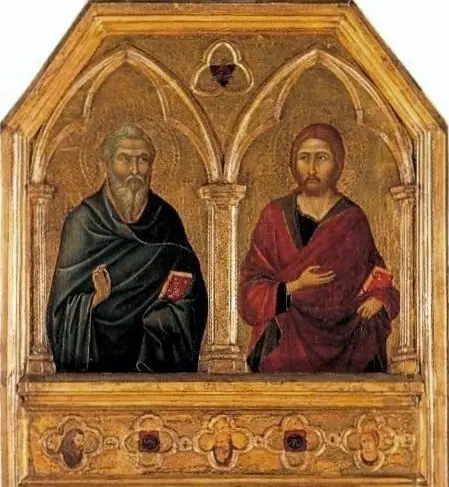
Artist & collection
Artist
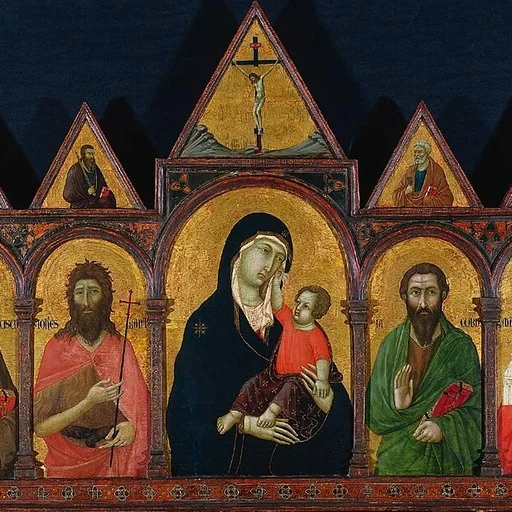
Ugolino di Nerio (1280? – 1349) was an Italian painter active in his native city of Siena and in Florence between the years 1317 and 1327. He was a follower of Duccio di Buoninsegna, from whose Maestà some of his…

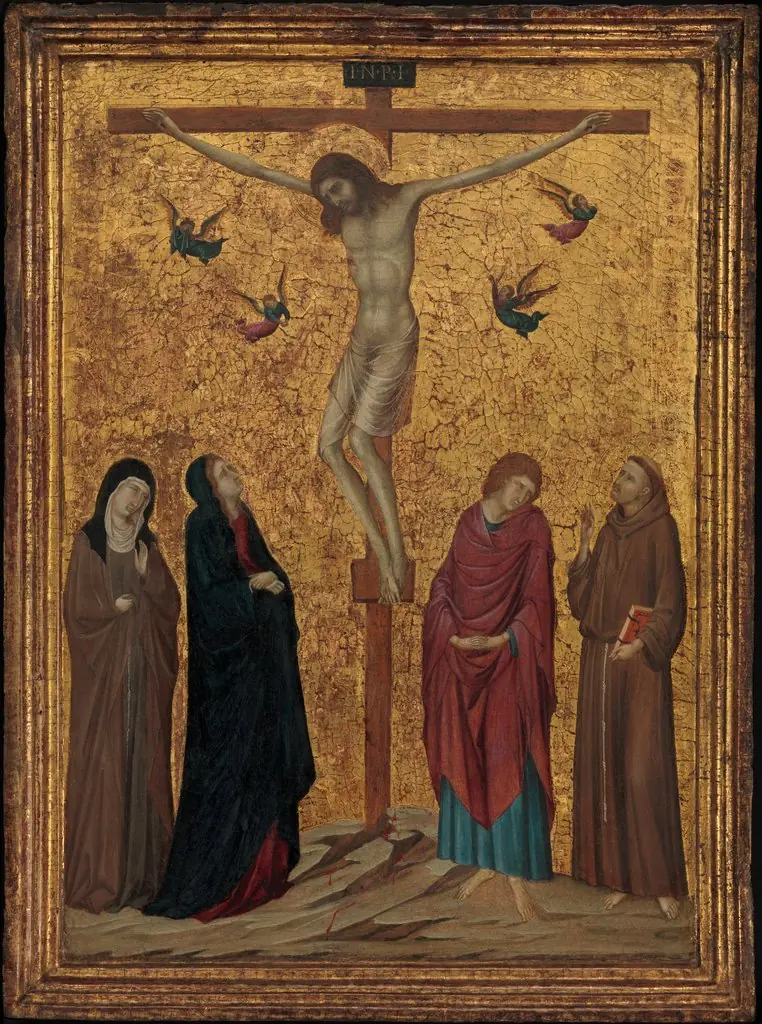
 Saints Matthias and Elizabeth of Hungary (?)
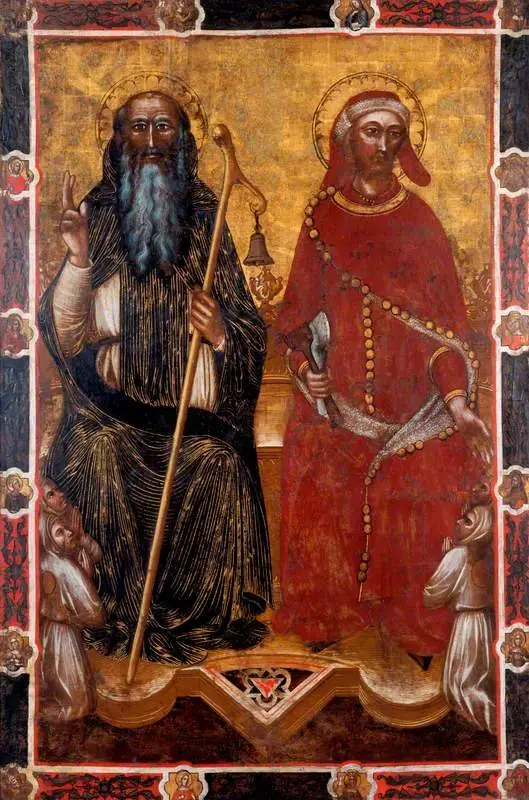 Saint Anthony Abbot and Saint Eligius with Two Pairs of Kneeling Worshippers (one side of a processional banner) (formerly attributed to Barnaba da Modena)
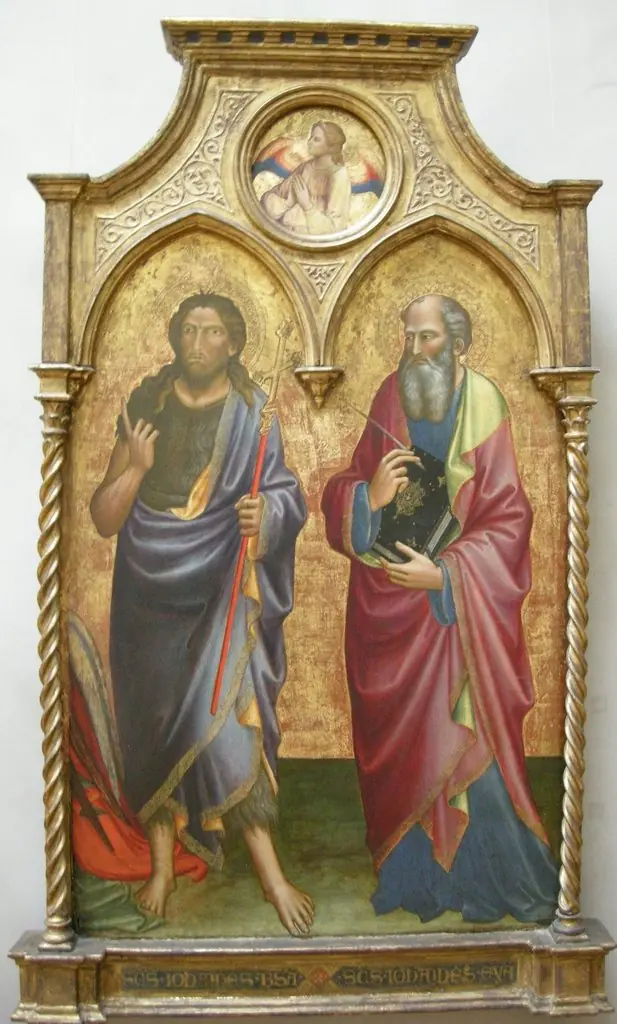 Saints John the Baptist and John the Evangelist
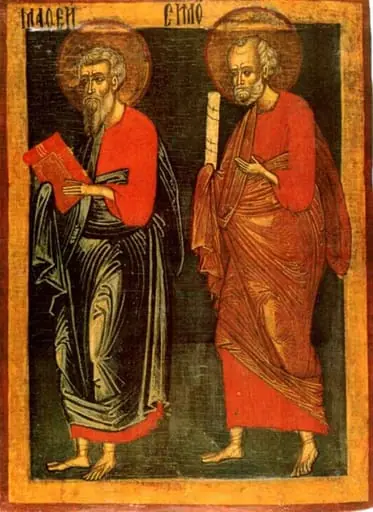 Sfinții Apostoli Matei și Simon
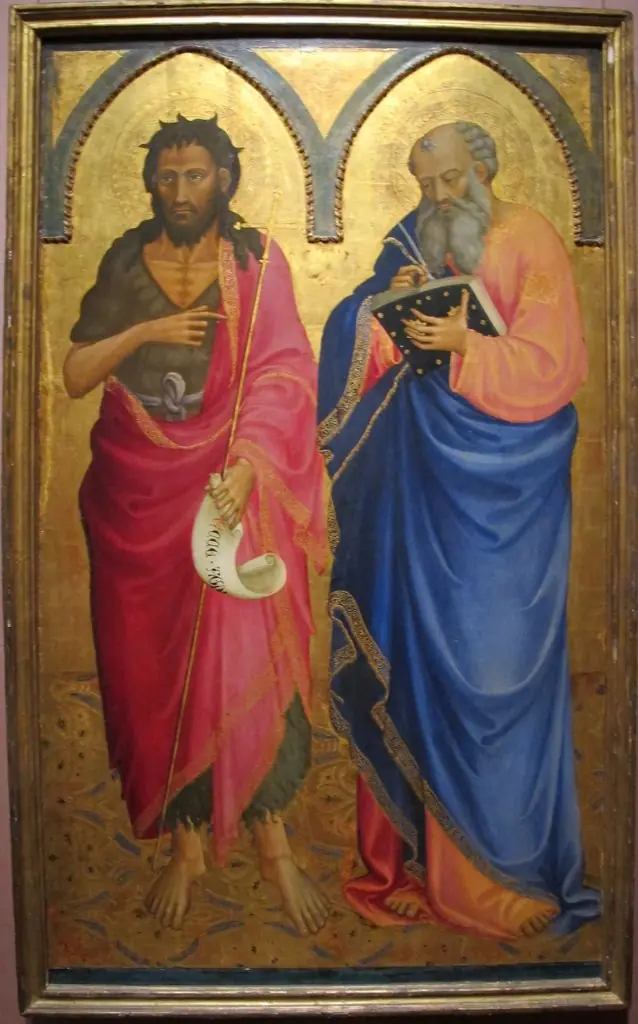 Saints John the Baptist and Mathew
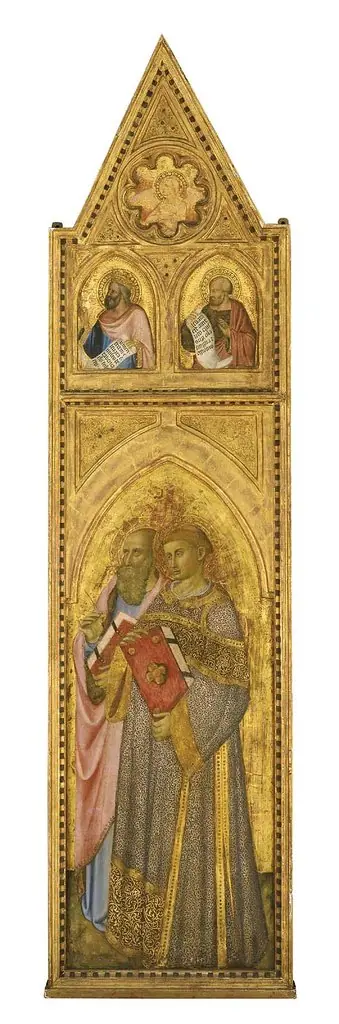 Saint John the Evangelist and a Deacon Saint (right panel)
 Saint Paul
![Saint Andrew and Saint Benedict with the Archangel Gabriel [left panel], by Agnolo Gaddi](https://artifactworldgallery.com/img/agnolo-gaddi--saint-andrew-and-saint-benedict-with-the-archangel-gabriel-l--ddd94720dea7e794-w320.webp) Saint Andrew and Saint Benedict with the Archangel Gabriel [left panel]
Saint Andrew and Saint Benedict with the Archangel Gabriel [left panel] Saints John the Evangelist(?) and Martin of Tours
 SS. bishop, Petrus, Paulus and a diacon
 Hieronymusaltar von Santo Stefano in Venedig: Der heilige Markus