Artwork
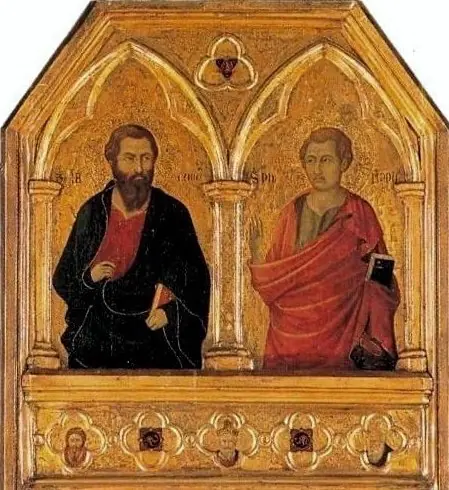
Saints Matthew and James the Less
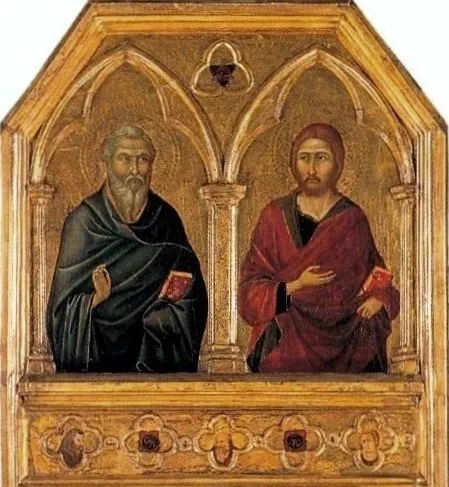
Saints Matthew and James the Less is a paint painting by the Byzantine icon painting artist Ugolino di Nerio. It dates from 1325 and is held in the collection of the Gemäldegalerie Berlin.
About this work
Overview
It is one of the surviving fragments from the celebrated Santa Croce Altarpiece, originally painted for the Franciscan basilica of Santa Croce in Florence.
Saints Matthew and James the Less is a tempera painting on wood with gold ground, created by the Sienese master Ugolino di Nerio in 1325. The panel, measuring approximately 15 1/8 by 12 3/4 inches (38.4 by 32.4 cm), is now housed in the Gemäldegalerie, Berlin, where it is displayed in Room 41. It is one of the surviving fragments from the celebrated Santa Croce Altarpiece, originally painted for the Franciscan basilica of Santa Croce in Florence. The work matters as a crucial witness to early fourteenth-century Sienese painting and to the devotional art medievalism of one of Duccio's most important followers, representing a significant commission that bridged the rival artistic cultures of Siena and Florence.
Subject & Meaning
The panel depicts two apostles, Matthew and James the Less, set within a gilded architectural framework of Gothic pointed arches and slender columns. Both saints bear halos and bearded faces turned slightly toward the viewer. Matthew, traditionally an evangelist, appears on the left in a dark blue-black mantle, holding a small red book in his left hand while raising his right hand in a gesture of teaching or blessing. James the Less, on the right, wears a deep red mantle over dark undergarments, his right hand placed upon his chest in a gesture of devotion or inward contemplation, his left hand also holding a small red book. The red books likely signify their respective writings or gospel traditions. The ornamental frieze below, with its repeating circular motifs containing small busts and floral elements, and the pointed gable with trefoil opening above, frame the sacred figures within an elaborate micro-architecture that elevates their spiritual status. The gold ground, patterned with faint tooled designs, creates an otherworldly atmosphere divorced from earthly space, consistent with Byzantine-influenced devotional imagery where saints were presented as severe, authoritative intercessors rather than approachable figures.
Technique & Style
The painting is executed in tempera on a poplar panel support with extensive gold leaf application. The surface appears smooth with an enamel-like finish, characterized by fine linear drapery folds that reveal Ugolino's meticulous hand. The palette is dominated by the warm interplay of deep reds, blues, and ochres against the overwhelming gold ground. Light is rendered as even and diffuse, with minimal shadow, a technique that flattens form in favor of decorative pattern and spiritual clarity. The precise handling and codified figure types reflect the direct influence of Duccio di Buoninsegna, whose Maestà (1308-11) established the canonical Sienese approach. The figures show Byzantine-inspired stylization rather than naturalistic observation, with features that are more conventionalized than realistic. This aesthetic conservatism, with its emphasis on linear elegance and hierarchical composition, distinguishes Ugolino's work from the emerging naturalism of contemporary Florentine painting.
History & Provenance
The panel was originally part of the high altarpiece commissioned for the Franciscan Basilica of Santa Croce in Florence, painted between 1325 and 1328. A late eighteenth-century drawing attributed to Humbert de Superville records the polyptych in its complete form before dismantlement. The altarpiece was subsequently broken up and sold to private collectors during a period when early medieval art was considered too primitive for devotional use. Most fragments eventually entered public collections, with the Berlin panels joined by others in the National Gallery, London. The central panel depicting the Virgin and Child, already shown as damaged in the Superville drawing, has never been identified and was probably destroyed. The current panel, Saints Matthew and James the Less, is now owned by Helene Tepelmann-Vieweg and held by the Gemäldegalerie, Berlin, where it is displayed in Room 41 among other works from the same altarpiece complex.
Context
Ugolino di Nerio, active in Siena from 1317 until his death between 1339 and 1349, was one of the most significant painters to emerge from Duccio's workshop tradition. The Santa Croce commission presents a notable historical puzzle: why did the Franciscans of Florence, who were among the earliest patrons of Giotto's revolutionary naturalism and whose own church housed frescoes by Giotto and his followers including Taddeo Gaddi and Maso di Banco, choose a Sienese painter working in a conservative, Byzantine-influenced idiom for their most important altar? The question remains open in scholarship, though Ugolino's subsequent intensive work for Franciscan patrons throughout his career suggests the order found particular value in his devotional style. The altarpiece's placement in Florence, Siena's great rival, underscores the complex circulation of artistic ideas across political boundaries. The preserved fragments in Berlin and London now serve as essential documents for reconstructing one of the most important dismembered altarpieces of the Trecento.
Legacy
The dismembered Santa Croce Altarpiece has become a foundational case study for understanding the material history of medieval panel painting and the afterlives of sacred art. The late eighteenth-century dismantlement, driven by changing aesthetic values that dismissed early Renaissance work as primitive, exemplifies the vulnerability of medieval altarpieces before the rise of modern conservation consciousness. The survival of multiple panels in Berlin and London has enabled scholarly reconstruction of Ugolino's largest and most ambitious commission, securing his reputation as Duccio's principal heir and a major figure in fourteenth-century Italian painting. The altarpiece fragments continue to inform debates about workshop practice, the relationship between Sienese and Florentine visual culture, and the specific devotional requirements of Franciscan patronage. Their presence in major public collections ensures ongoing scholarly attention and public engagement with early Sienese painting.
Artist & collection
Artist
Ugolino di Nerio (1280? – 1349) was an Italian painter active in his native city of Siena and in Florence between the years 1317 and 1327. He was a follower of Duccio di Buoninsegna, from whose Maestà some of his…

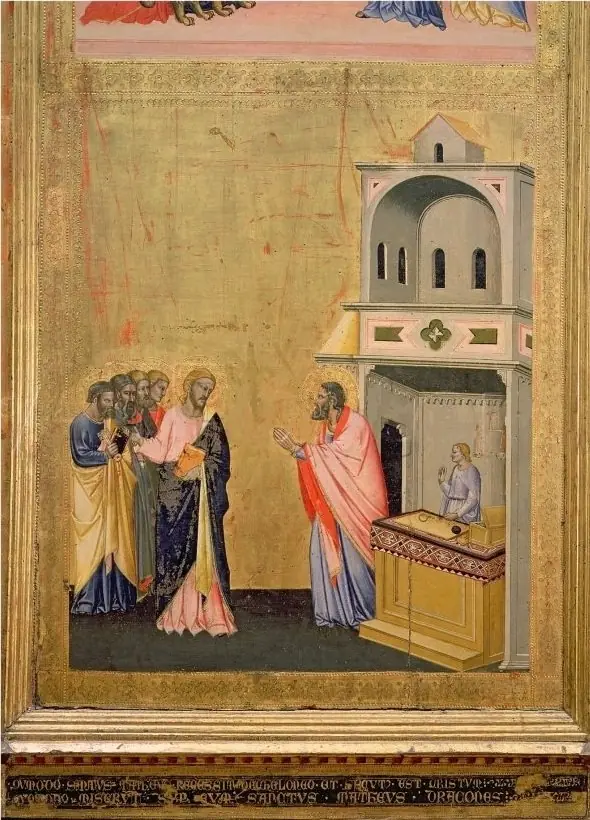
- The Calling of St. Matthew
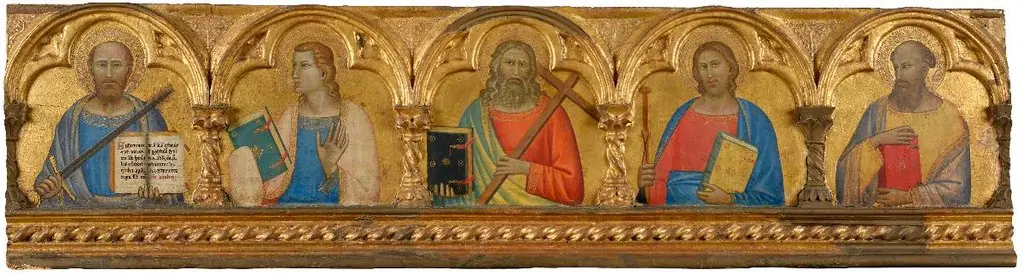 Five apostles
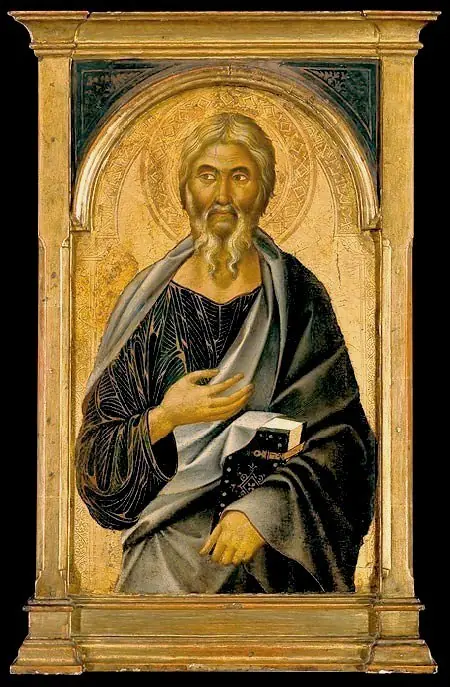 Saint John the Evangelist
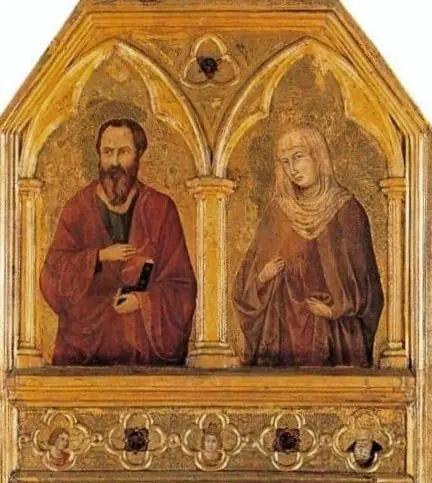 Saints Matthias and Elizabeth of Hungary (?)
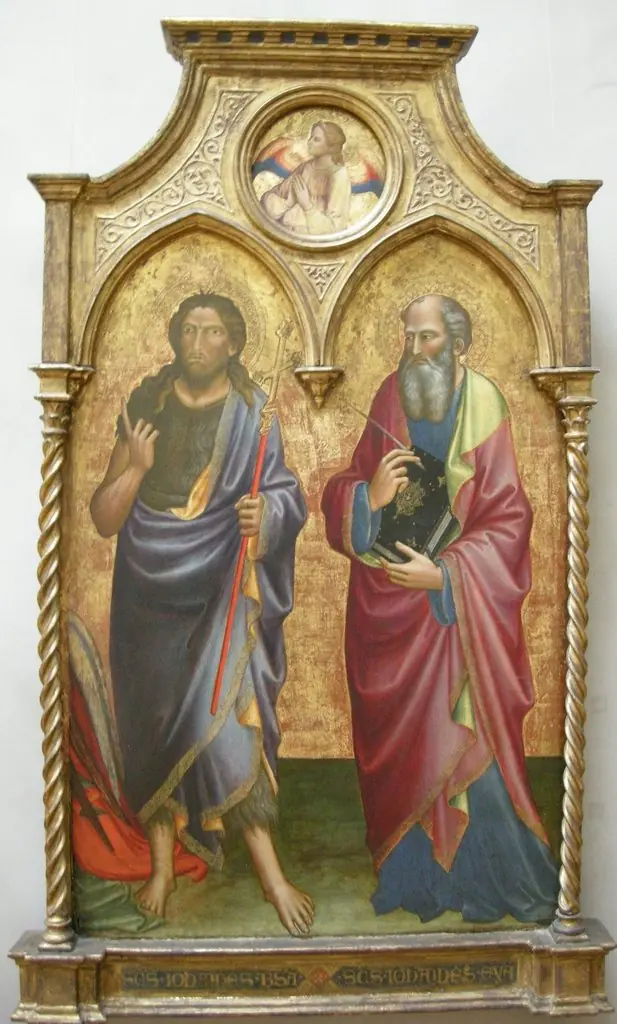 Saints John the Baptist and John the Evangelist
![Saint Andrew and Saint Benedict with the Archangel Gabriel [left panel], by Agnolo Gaddi](https://artifactworldgallery.com/img/agnolo-gaddi--saint-andrew-and-saint-benedict-with-the-archangel-gabriel-l--ddd94720dea7e794-w320.webp) Saint Andrew and Saint Benedict with the Archangel Gabriel [left panel]
Saint Andrew and Saint Benedict with the Archangel Gabriel [left panel]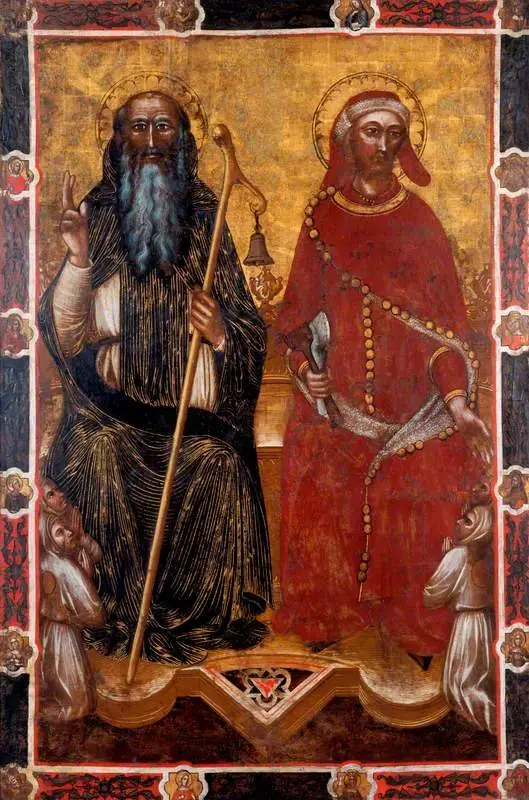 Saint Anthony Abbot and Saint Eligius with Two Pairs of Kneeling Worshippers (one side of a processional banner) (formerly attributed to Barnaba da Modena)
 Christ and the Twelve Apostles
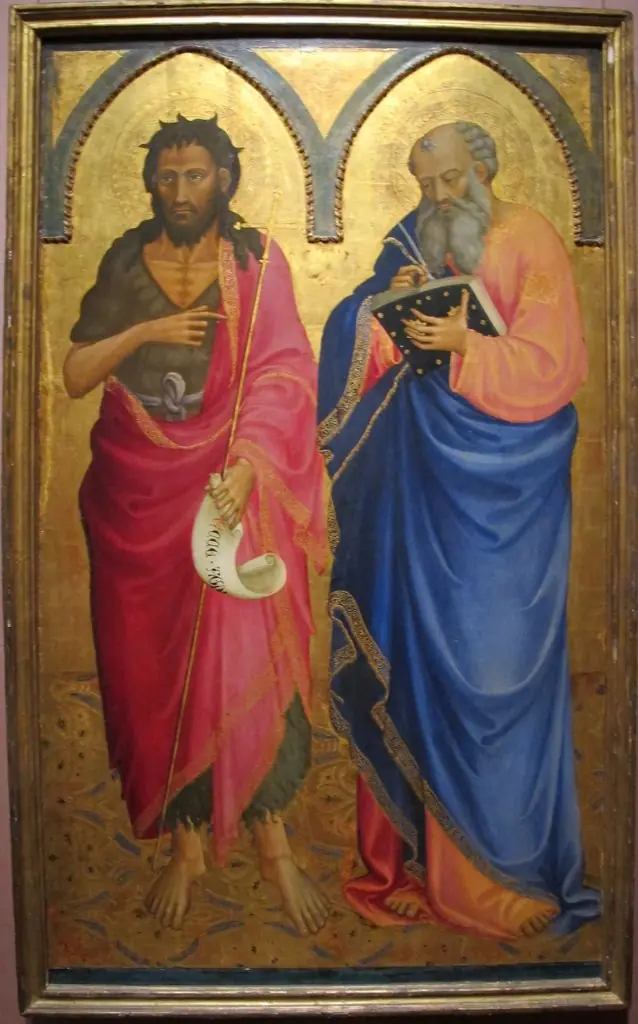 Saints John the Baptist and Mathew
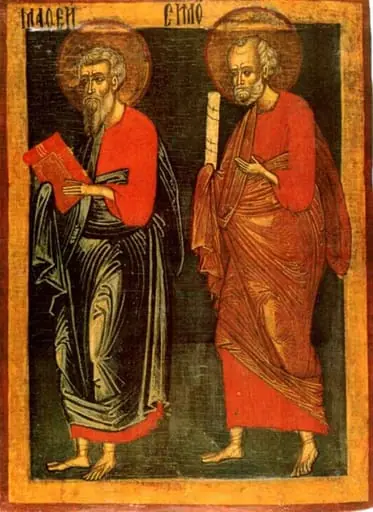 Sfinții Apostoli Matei și Simon
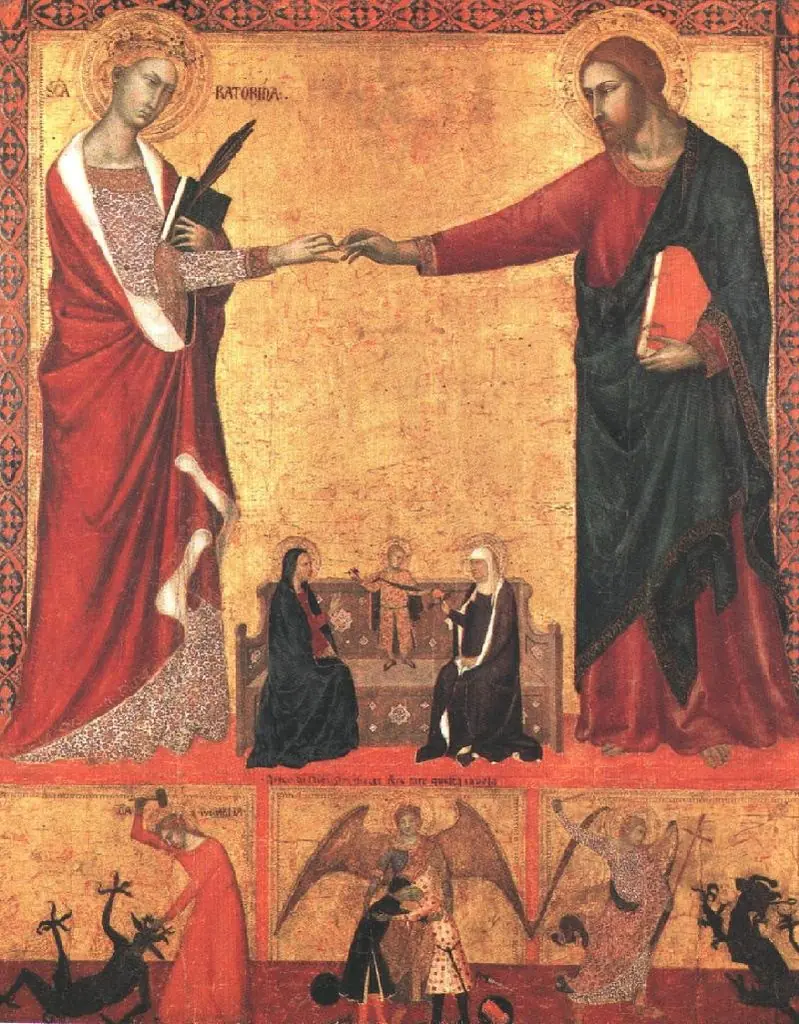 The Mystical Marriage of Saint Catherine