Artwork
Anne of Austria (1601-66). Wife of Louis XIII, king of France
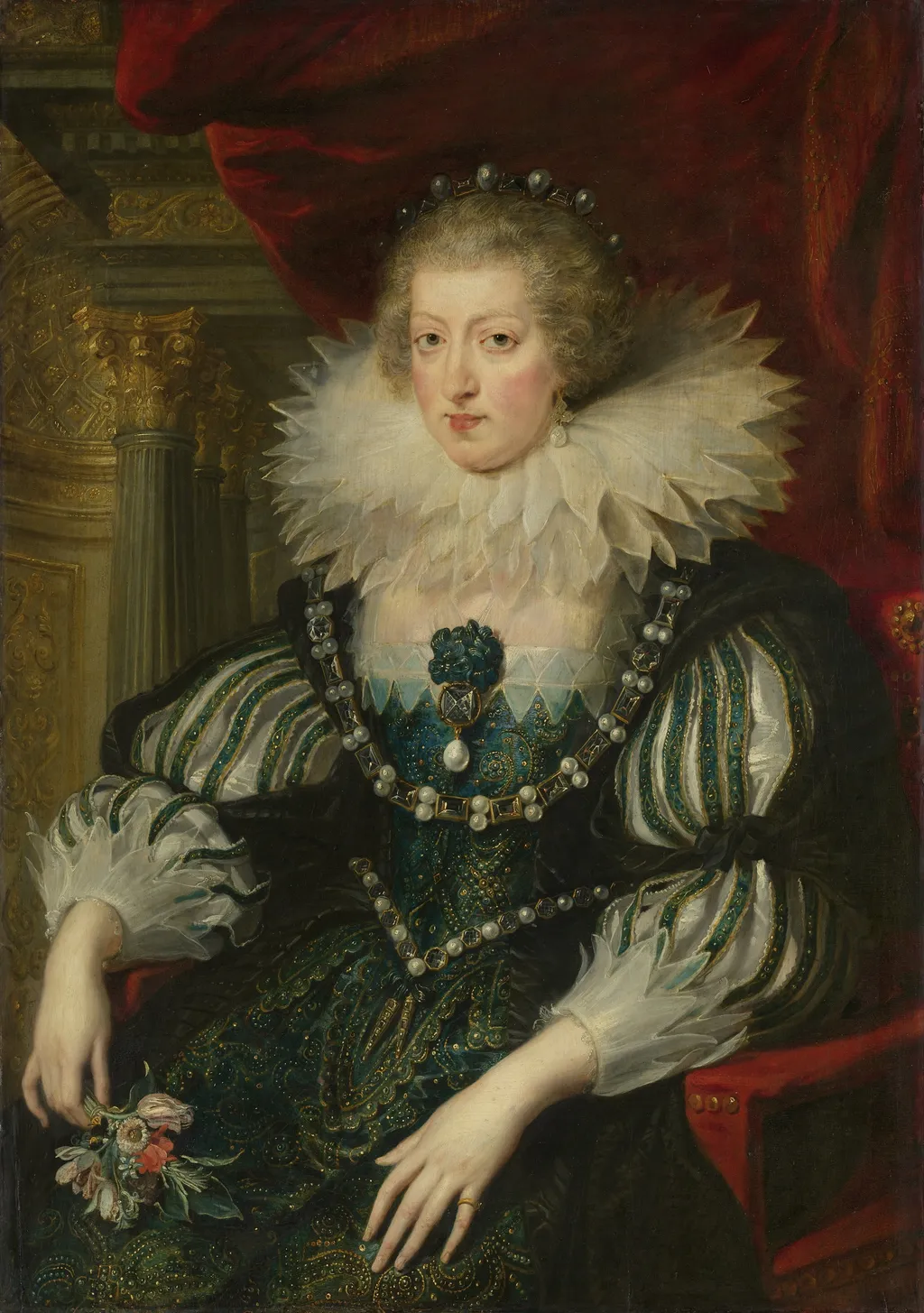
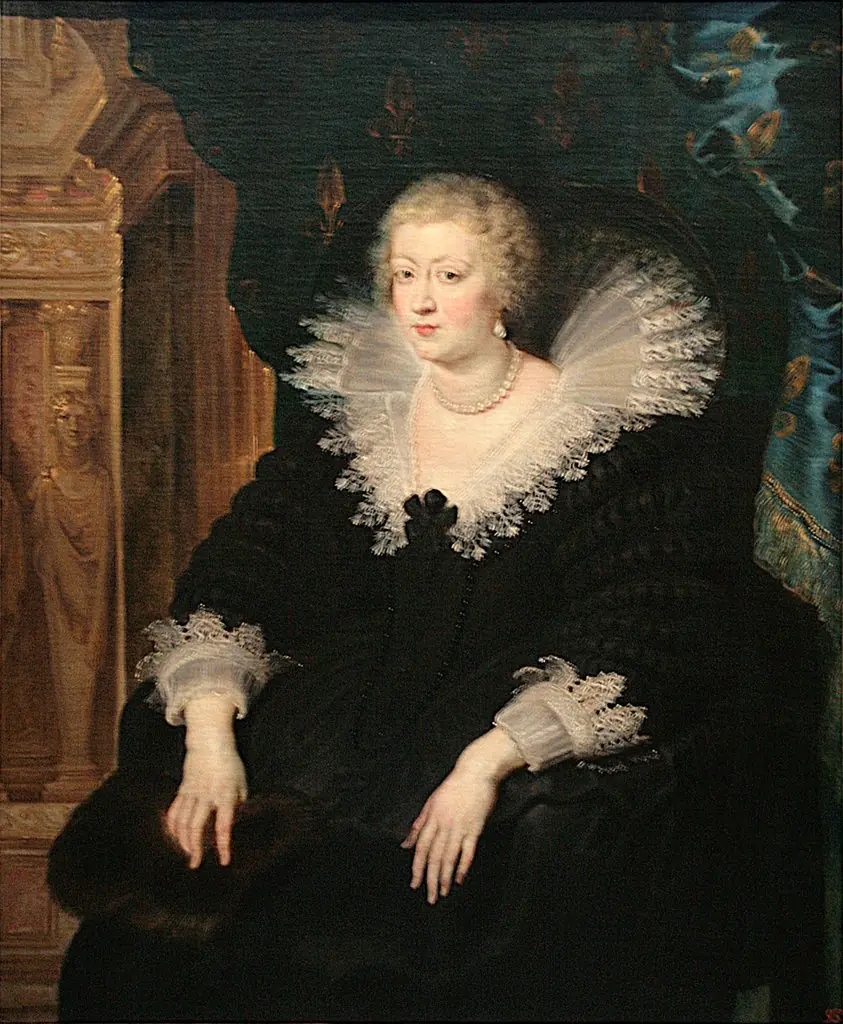
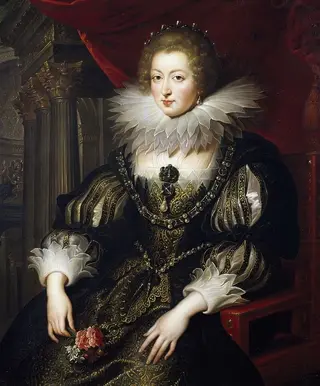
Anne of Austria (1601-66). Wife of Louis XIII, king of France is an oil painting. It dates from 1625 and is held in the collection of the Rijksmuseum. The work is an oil portrait of Anne of Austria, who was queen consort of France as the spouse of Louis XIII.
About this work
Subject & Meaning
As a portrait of a Habsburg queen married into the French monarchy, the image serves to visually assert her dynastic lineage and royal status.
The work depicts Anne of Austria, daughter of King Philip III of Spain and wife of Louis XIII of France, seated on a chair while holding a bouquet of flowers in her right hand. Her gaze is directed toward the viewer, establishing a direct engagement. The composition includes a red curtain on the right and a view into an ornately decorated hall featuring a colonnade and apse on the left.
As a portrait of a Habsburg queen married into the French monarchy, the image serves to visually assert her dynastic lineage and royal status.
Technique & Style
Executed in 1625, this portrait utilizes oil paint applied to both panel and canvas supports. The composition depicts Anne of Austria seated on a chair, holding a bouquet of flowers in her right hand while directing her gaze toward the viewer. The background features a red curtain on the right and an architectural vista on the left, revealing a richly decorated hall with a colonnade and apsis.
Scholarly attribution regarding the specific handling of the paint remains divided. Max Rooses characterized this version as a high-quality workshop repetition, suggesting the original Louvre variant featured Rubens's hand in the figure and chair, with a pupil executing the background. Conversely, art historian Frances Huemer argued that this specific work is the autograph original, dismissing the Louvre version as an excellent studio piece.
History & Provenance
The portrait was painted in Antwerp between 1620 and 1625 while Rubens was at the French court, initially attributed to his workshop before being linked to his own hand and that of an assistant, with later scholarship differing on whether the Maastricht or Louvre version is the original; it entered the ownership chain of Peter Paul Rubens, Maria Hoofman, Christianus Johannes Nieuwenhuys, and Adriaan van der Hoop, who bequeathed it to Amsterdam where it was displayed at the Museum Van der Hoop before being loaned to the Bonnefantenmuseum, where it remains
The painting is held by the Bonnefantenmuseum in Maastricht. In 1851 it was purchased at auction by Adriaan van der Hoop for 3,000 Dutch guilders and bequeathed by him to the city of Amsterdam in 1854.
It entered the Rijksmuseum in 1885 on loan from Amsterdam and was subsequently transferred on long-term loan to the Bonnefantenmuseum.
Context
The 1625 portrait of Anne of Austria exists in multiple versions, sparking significant scholarly debate regarding its attribution and originality. While art historian Max Rooses identified the Louvre version as the primary autograph work by Peter Paul Rubens, with the Maastricht exemplar considered a high-quality workshop repetition, other scholars like Frances Huemer argue the reverse. Huemer posits that the Maastricht painting is the authentic original, describing the Louvre piece as an excellent workshop production.
This divergence highlights the complexity of Rubens' studio practices during his time in Paris, where the artist often executed portraits personally while leaving backgrounds or secondary elements to assistants. The work's presence in the 1640 inventory of Rubens' estate confirms its immediate association with the artist, yet the ongoing disagreement among experts illustrates the challenges in distinguishing between the master's hand and his atelier's output in this specific commission.
Overview
The work is an oil portrait of Anne of Austria, who was queen consort of France as the spouse of Louis XIII. Rendered in a realistic manner, the painting captures the queen in a richly adorned gown, emphasizing her status and the fashion of the early‑17th century.
Artist & collection