Artwork
Esther Kneeling before Ahasverus
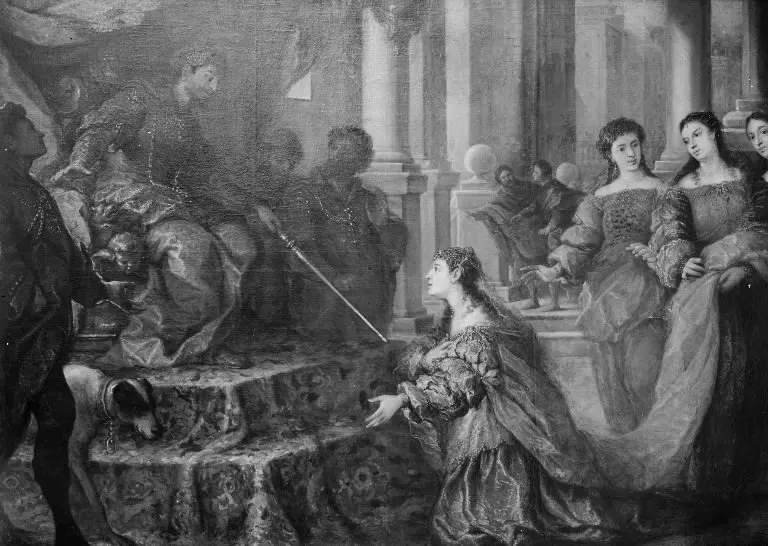
Esther Kneeling before Ahasverus is an oil painting. It dates from 1645 and is held in the collection of the Statens Museum for Kunst. The work is an oil painting that presents an interior scene dominated by a dramatic encounter.
About this work
Subject & Meaning
The work is classified as a religious painting, situating the narrative within the tradition of biblical history painting.
The painting depicts the Old Testament episode of Esther kneeling before Ahasuerus, a scene drawn from the Book of Esther in which the Jewish queen risks her life by approaching the Persian king unbidden to plead for her people. In the biblical narrative, Esther approaches Ahasuerus in a posture of supplication, an act of courage that became a popular subject in religious art as an exemplum of faith, intercession, and deliverance.
The work is classified as a religious painting, situating the narrative within the tradition of biblical history painting. The pairing of the supplicating Esther with the enthroned Ahasuerus carries symbolic weight: Esther represents faithfulness and the power of humble petition, while the king's reception of her signals divine favor working through human agency. The scene ultimately foreshadows the salvation of the Jewish people from the threatened massacre, giving the image its meaning as a meditation on providence, courage, and deliverance.
Technique & Style
Created in 1645, this religious painting is executed in oil paint on a canvas support. The work presents a large-scale composition, measuring 2300 cm in height and 3160 cm in width. Stylistically, the piece functions as a narrative depiction of the biblical figures Esther and Ahasuerus, adhering to the conventions of religious genre painting from the mid-seventeenth century.
History & Provenance
Esther Kneeling before Ahasverus was created in 1645, executed in oil paint on canvas and depicting the biblical encounter between Esther and Ahasuerus. The painting is held in the collection of the Statens Museum for Kunst, where it remains part of the museum's holdings. No information is available in the provided sources regarding the original commission, the chain of ownership before the museum's acquisition, or the circumstances of its creation.
The work measures 230 cm in height and 316 cm in width, indicating a large-scale canvas. Beyond the date of inception and its current institutional home, the sources do not document an earlier provenance, a patron, or intermediate owners through which the painting passed before entering the Statens Museum for Kunst.
The painting Esther Kneeling before Ahasverus is held in the collection of the Statens Museum for Kunst. Its inventory number is listed as KMS 1177. The provided sources do not contain any information regarding a specific exhibition history for this work.
Context
The painting Esther Kneeling before Ahasverus, created in 1645 by the workshop of the Danish painter KMS 1177 Ubekundet, is housed in the Statens Museum for Kunst in Copenhagen. Its religious subject matter aligns with biblical narratives, specifically the Book of Esther, reflecting the artist's engagement with Lutheran devotional themes. The work's composition, depicting the Jewish queen before the Persian king Ahasuerus, has been analyzed in scholarship as a nuanced exploration of power and humility within Counter-Reformation aesthetics.
Measuring 230.0 cm by 316.0 cm, the large-scale canvas demonstrates the artist's technical mastery of oil paint and narrative depth, contributing to the development of historical painting in Northern Europe. Its presence in a national collection underscores its significance as a representative example of 17th-century Danish religious art.
Overview
The work is an oil painting that presents an interior scene dominated by a dramatic encounter. A woman is shown kneeling before a man seated on a raised platform, while additional figures observe from the periphery. The setting is defined by grand columns and dark, ornate architectural elements, with a focused light that isolates the central pair.
Artist & collection

 The Continence of Scipio
 The Continence of Scipio
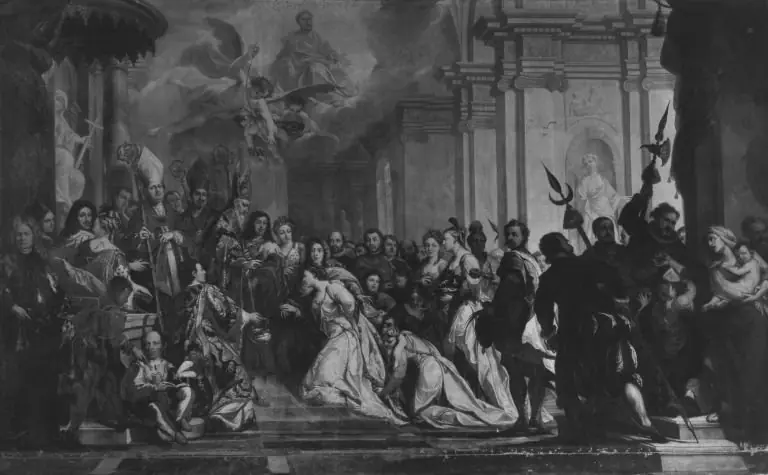 Trauung des Kurfürsten Johann Wilhelm von der Pfalz
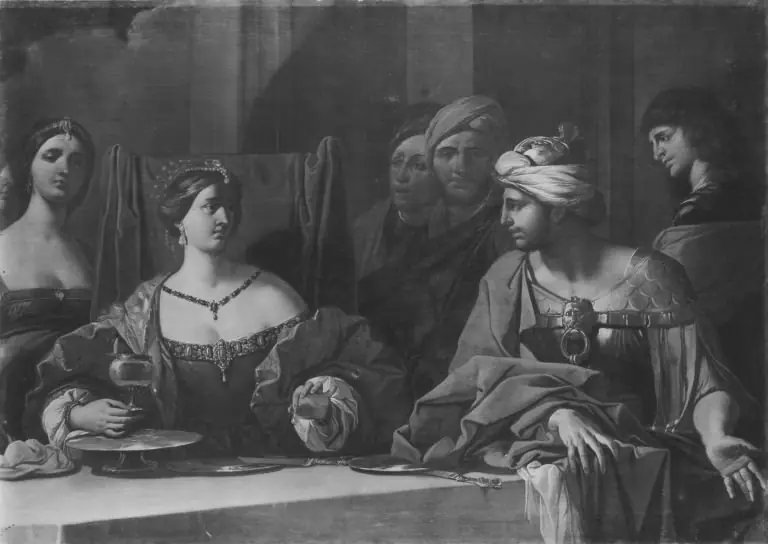 Das Gastmahl der Kleopatra
 Allegory on the Crowning of Charles II
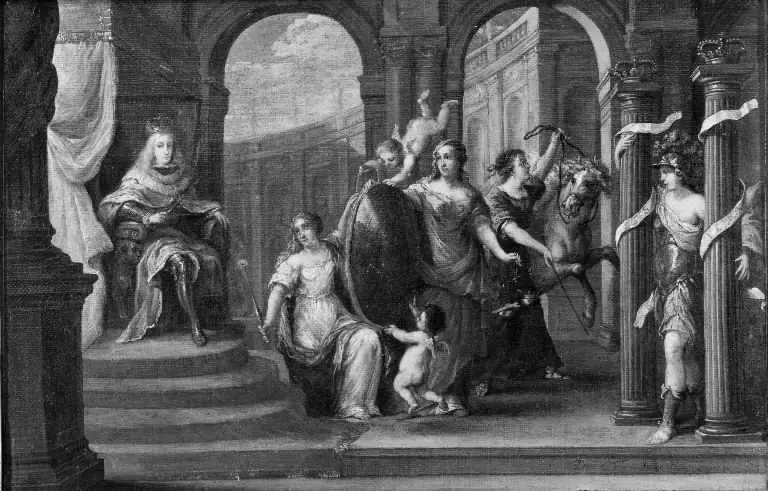 Allegory on the Crowning of Charles II
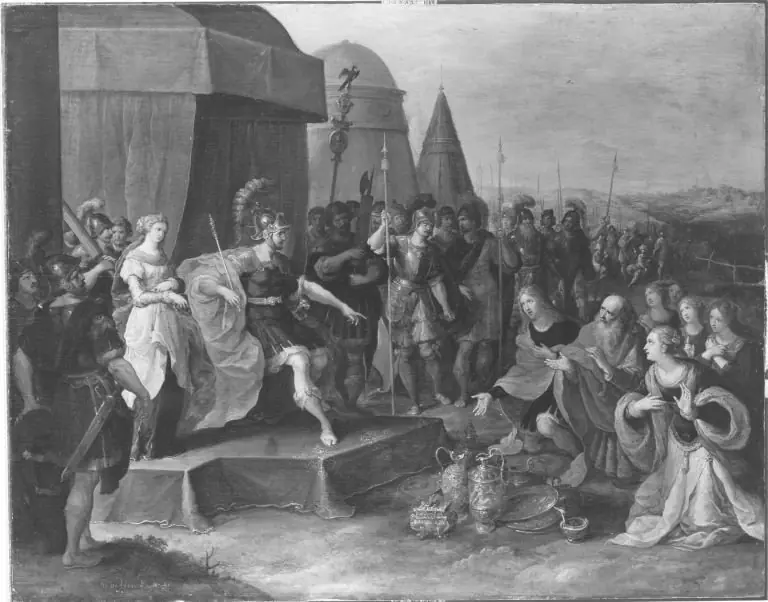 Enthaltsamkeit des Scipio
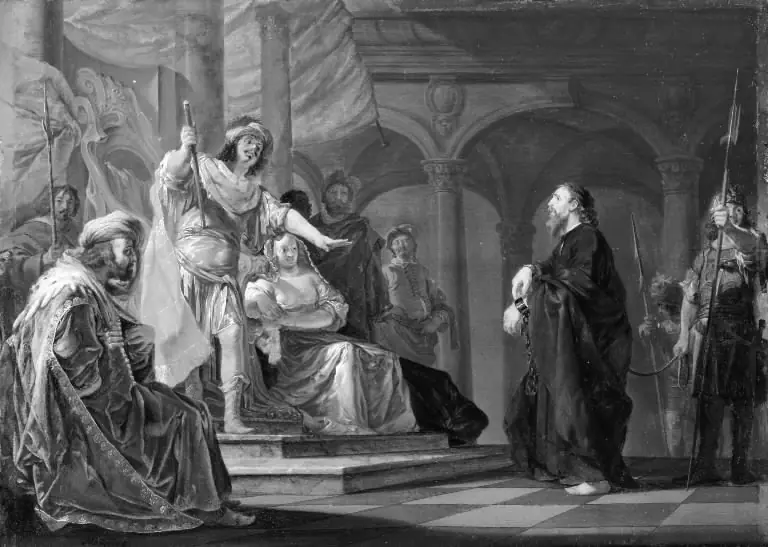 Paulus the Apostle defending himself at the Trial in Caesarea
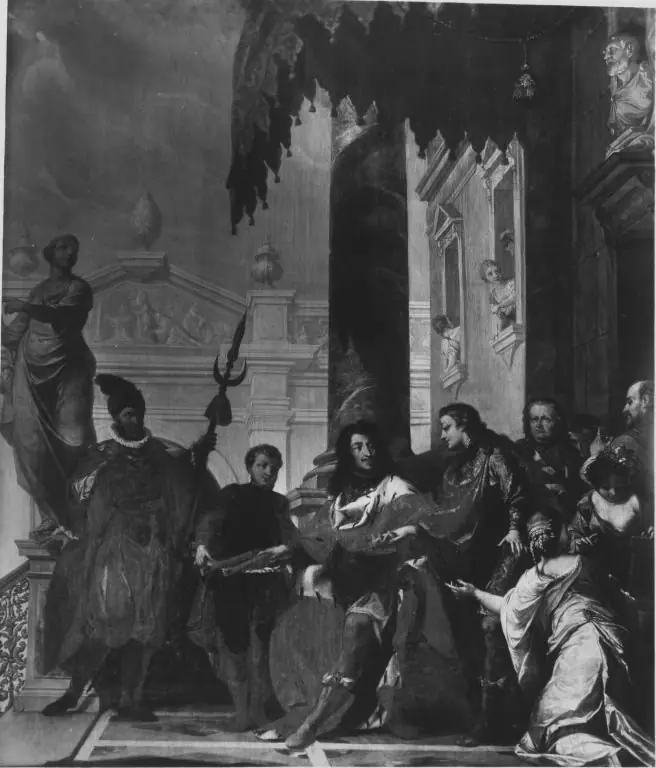 Kurfürst Johann Wilhelm übergibt den Kommandostab
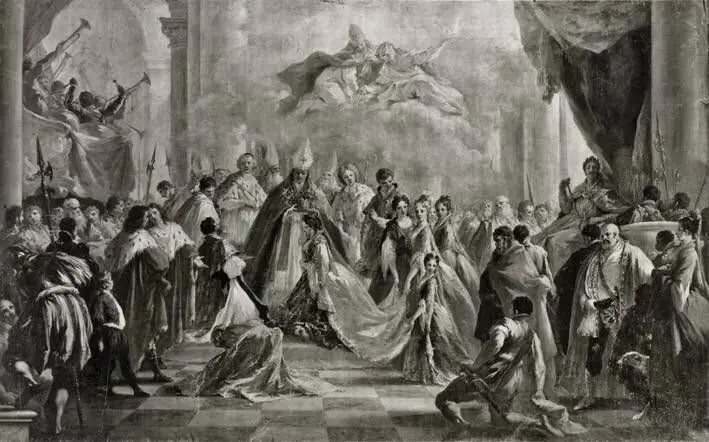 Krönung der Eleonora Magdalena von Pfalz-Neuburg zur Kaiserin
![Margaret of Austria Giving Audience to a Nobleman [verso], by Raffaello Schiaminossi](https://artifactworldgallery.com/img/raffaello-schiaminossi--margaret-of-austria-giving-audience-to-a-nobleman-verso--86ac2347af277f00-w320.webp) Margaret of Austria Giving Audience to a Nobleman [verso]
Margaret of Austria Giving Audience to a Nobleman [verso]- Esther Kneeling before Ahasverus