Artwork
Philip II, King of Spain
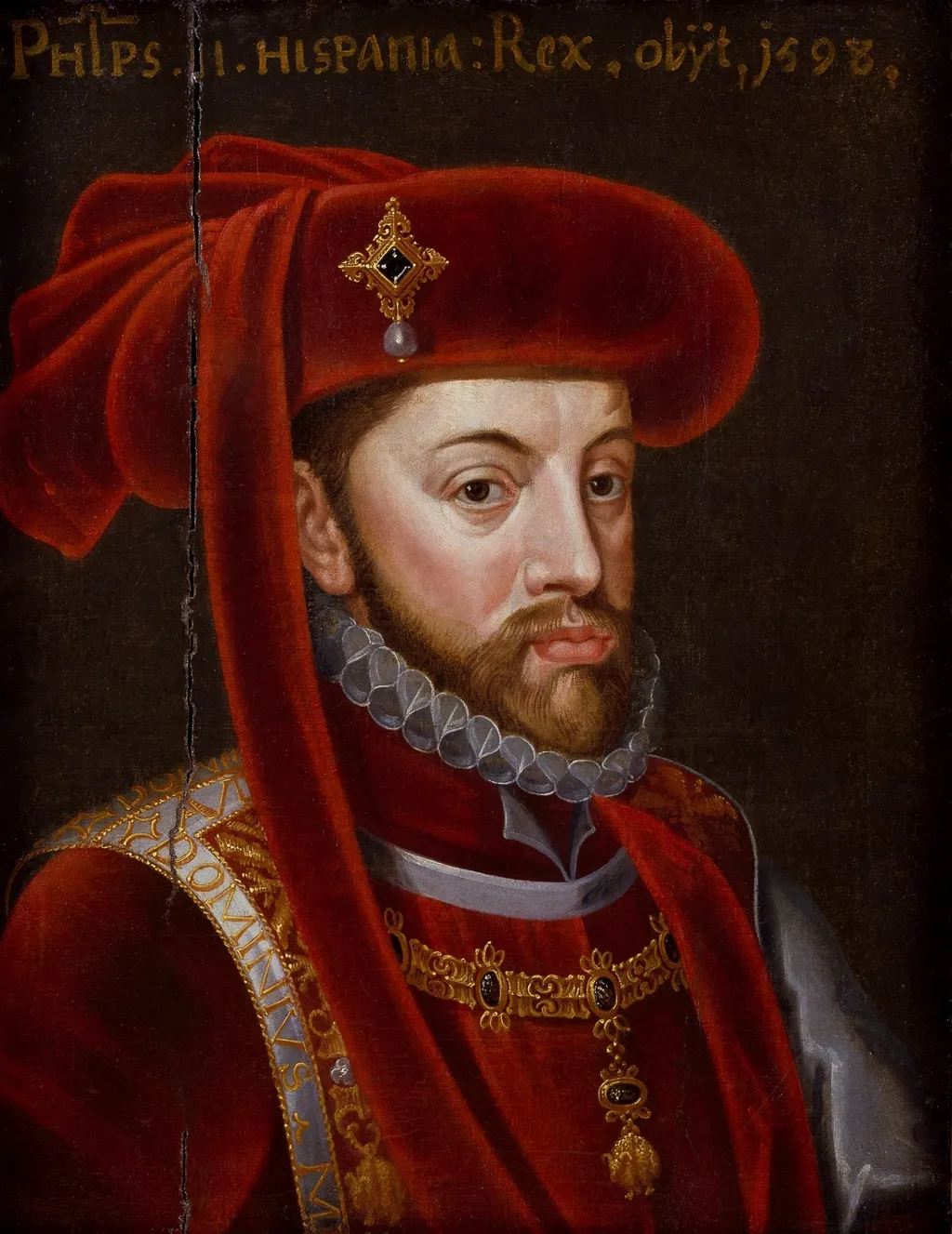
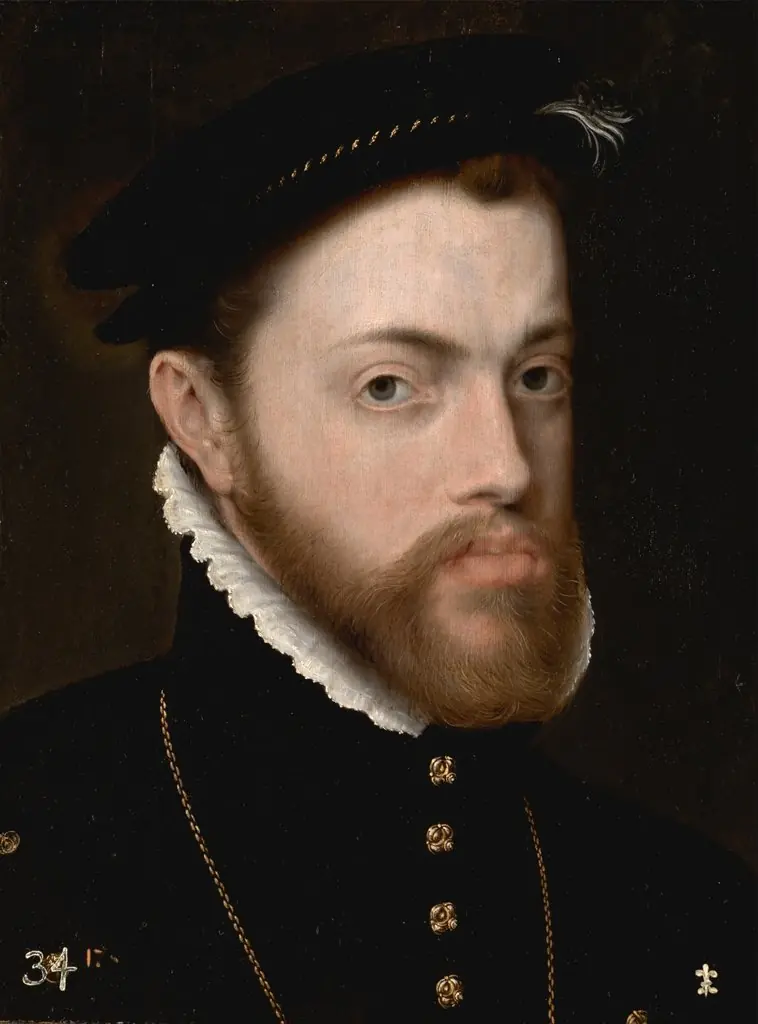
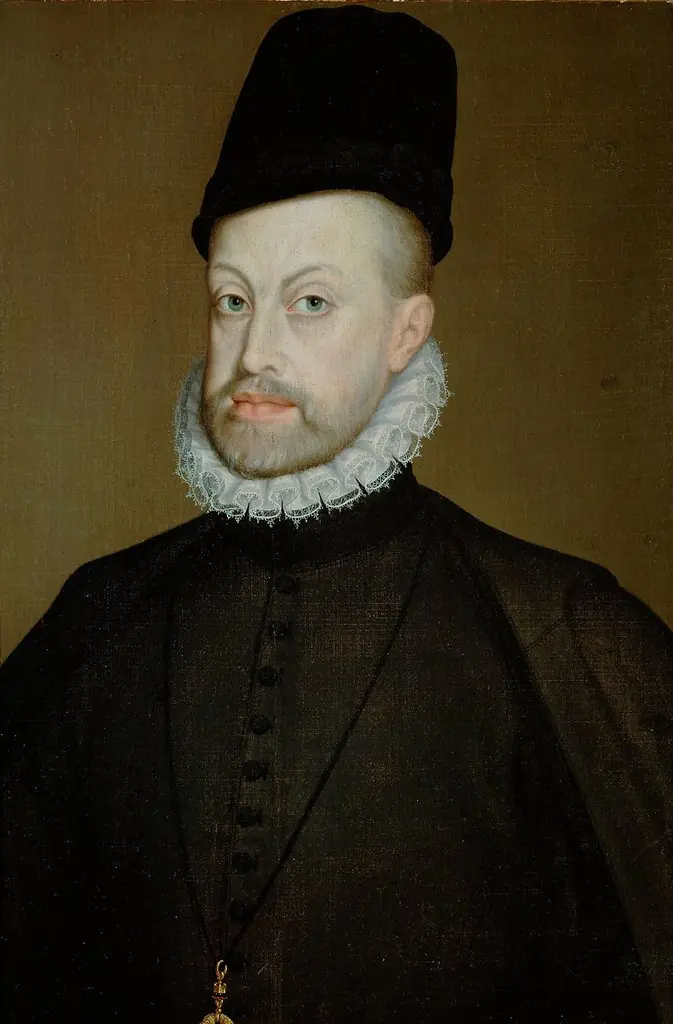
Philip II, King of Spain is an oil painting. It dates from 1501 and is held in the collection of the Museo del Prado. The portrait presents Philip II, the late monarch of Spain, rendered in oil on canvas.
About this work
The artist used small brushstrokes to show light hitting his beard and the folds of his robe.
This painting shows a man in a bright red robe and matching hat. His collar is stiff white, trimmed with gold. A thick gold chain with a black jewel hangs over his chest. The background is plain and dark, keeping all focus on his face and clothes.
The text at the top says "Philip II, King of Spain," and he died in 1598. The artist used small brushstrokes to show light hitting his beard and the folds of his robe.
Next, look up chiaroscuro to see how artists use light and shadow like this.
Subject & Meaning
The portrait depicts Philip II of Spain, the Habsburg monarch, as its main subject. The composition is built around symbols of royal rank and dynastic identity. Among the attributes identified in the work is the Golden Fleece, the chivalric order founded by the Burgundian branch of the House of Valois and adopted by the Habsburgs, whose insignia was worn by Philip II as a knight of the order.
A gemstone is also depicted, functioning as a marker of wealth and princely status consistent with Habsburg court portraiture of the period.
Together, these elements frame the sitter as a sovereign whose legitimacy rested on hereditary lineage, Catholic devotion, and membership in one of Europe's most prestigious knightly orders. The portrait thus operates less as a private likeness than as a statement of dynastic authority and the ceremonial self-image projected by Philip II's court.
Technique & Style
The portrait presents Philip II in formal regal attire rendered through layered oil paint on a wooden panel, a technique evident in the subtle chiaroscuro and fine brushwork that model the king's features and fabric textures. The canvas dimensions measure 58 by 46 centimeters, supporting a composition that emphasizes symbolic elements such as the Golden Fleece and a gemstone, reinforcing his sovereign authority. The handling of light across the surface reveals a polished finish typical of early 16th-century Spanish portraiture, while the stylistic choices reflect a blend of realism and emblematic grandeur characteristic of the period.
History & Provenance
The work was created in 1501 as an oil portrait of Philip II of Spain, depicting him with symbols such as the Golden Fleece and a gemstone. It was painted on canvas and panel and belongs to the portrait genre. The painting entered the collection of the Museo de Segovia and is also associated with the Museo del Prado.
Its inception date is recorded as 1 January 1501, with dimensions of 58 cm in height and 46 cm in width.
The painting is held by the Museo de Segovia, according to the Wikidata record for the work. The same entry also lists the Museo del Prado as an associated collection, indicating an institutional link between the two repositories. No inventory or accession number is provided in the available sources, and no exhibition history is documented.
The work's location is given as the Museo de Segovia, with the Museo del Prado listed as a related collection.
Overview
The portrait presents Philip II, the late monarch of Spain, rendered in oil on canvas. He is depicted in a vivid scarlet robe and matching hat, his white, stiffly ruffled collar edged with gold. A substantial gold chain bearing a dark jewel rests across his chest, while the background is a uniform, deep shade that isolates the figure.
Context
Philip II’s reign marked the height of Spanish imperial power in the late 16th century, a time when portraiture served to reinforce monarchical legitimacy. The use of rich textiles and jewelry reflects contemporary courtly fashion and the visual language employed to communicate sovereign authority.
Artist & collection