Artwork
The arrest of Christ
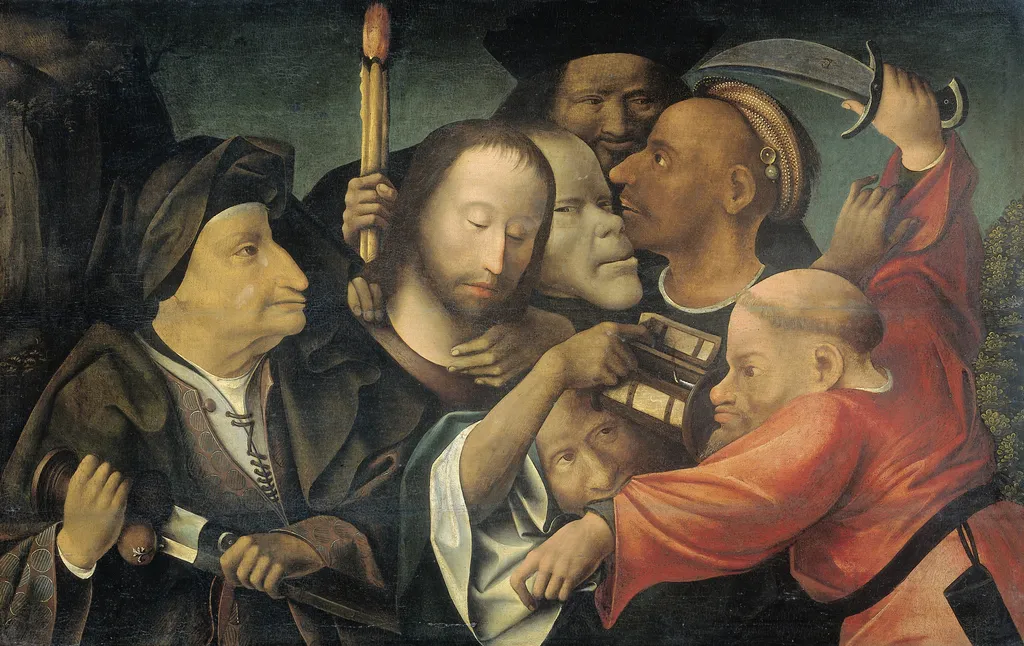
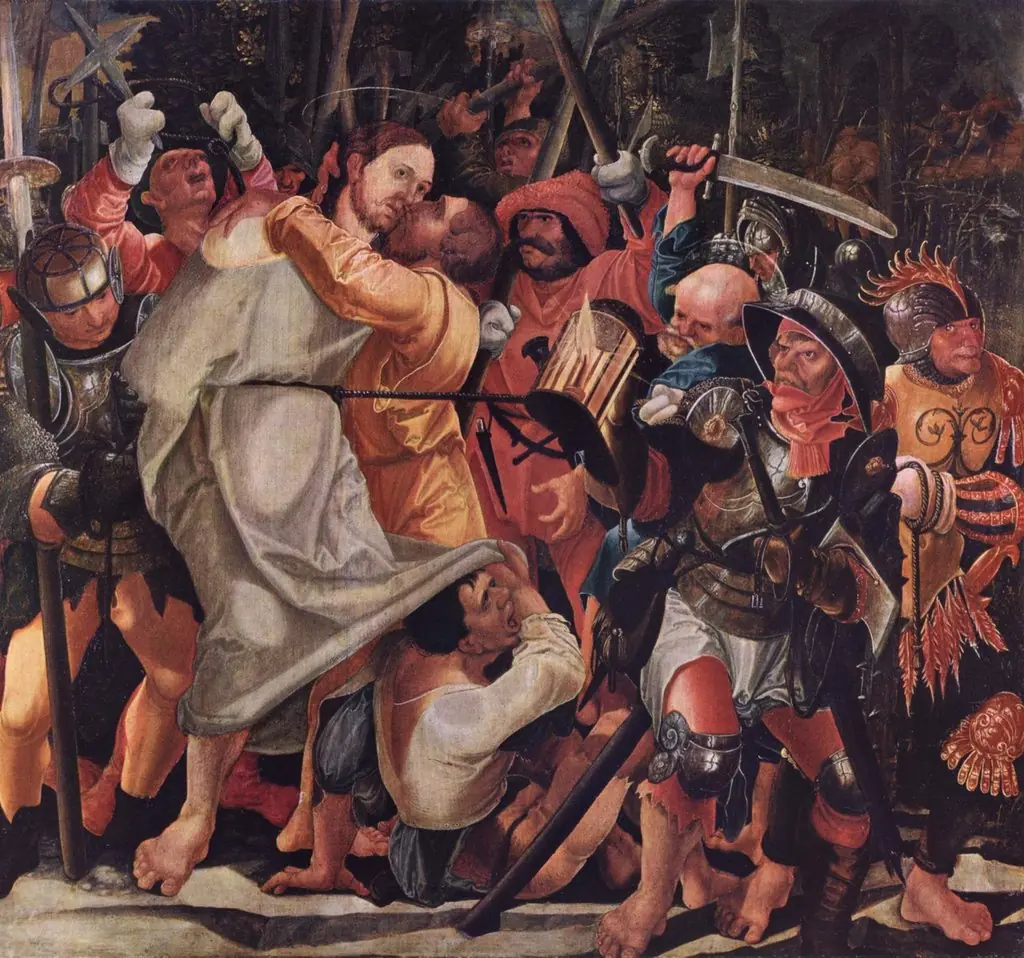
The arrest of Christ is an oil painting. It dates from 1530 and is held in the collection of the Rijksmuseum.
About this work
Subject & Meaning
On the right, Saint Peter wields a sword against Malchus, the high priest's servant, who bites Peter's arm as the apostle defends himself with a lantern.
The painting depicts the arrest of Jesus as described in John 18:10–11, set within a nocturnal landscape featuring seven half-length figures. Christ is portrayed with downcast eyes, embodying passive suffering while surrounded by hostile figures. On the right, Saint Peter wields a sword against Malchus, the high priest's servant, who bites Peter's arm as the apostle defends himself with a lantern.
Judas Iscariot appears with a deathly pale face, his hands clasped around Christ's neck to signify the treacherous embrace of betrayal. A sinister figure holding a torch looms above the scene. The composition utilizes caricatured heads and dramatic tension to represent the moment of betrayal and capture, reflecting the iconographic tradition of Early Netherlandish religious art focused on the Passion narrative.
Technique & Style
Executed circa 1530, this work is an oil painting on a wooden panel support. Dendrochronological analysis indicates the timber dates to 1462 or later, though scholars note this early date lacks a definitive explanation given the stylistic evidence suggesting a creation post-1528. The composition features seven half-length figures set against a nocturnal landscape, characterized by caricatured heads and dramatic lighting from a torch.
While once considered a well-preserved original by Jheronimus Bosch, current attribution assigns it to a follower, specifically the Master of the Passion Triptych in Valencia. The painting depicts specific narrative details, including Judas's pale face and Saint Peter drawing a sword, rendered with a style that diverges significantly from Bosch's confirmed late works, leading some experts to deem precise dating difficult.
History & Provenance
The Arrest of Christ is dated 1530 and is classified as a religious oil-on-panel painting attributed to a follower of Jheronimus Bosch rather than to Bosch himself. The work was previously held in a private collection in Paris, where it remained for several generations. On 9 October 1930 it was purchased by the Rijksmuseum in Amsterdam for 80,000 guilders, a substantial sum at the time, brokered by Dr. A.G.C. de Vries of the R.W.P. de Vries auction house with support from the Vereniging Rembrandt.
Rijksmuseum director Frederik Schmidt Degener believed the panel to be an authentic Bosch, an opinion bolstered by a letter from Max Friedländer describing it as a well-preserved Bosch work. After Friedländer encountered a copy of the composition in Munich in 1931, his attribution shifted, and the painting was consigned to the Rijksmuseum's storage. In 2001 it was placed on long-term loan to the Noordbrabants Museum in 's-Hertogenbosch, where it has since been displayed in the permanent exhibition De wereld van Bosch. Earlier owners listed in records include Allen Loebl and Reinier de Vries.
The painting is presently held in the collection of the Noordbrabants Museum in 's‑Hertogenbosch. It entered the Rijksmuseum Amsterdam in 1930 after being purchased from a Parisian private collection, a transaction documented in museum records. Following its acquisition the work was exhibited at the Rijksmuseum before being placed in storage, and in 2001 it was loaned to the Noordbrabants Museum where it now forms part of the permanent exhibition 'De wereld van Bosch'.
Context
The painting is classified as a religious work in the manner of Jheronimus Bosch, situated within Early Netherlandish painting. It is regarded as a variant of the left panel of a Passion triptych in the Museo de Bellas Artes in Valencia, attributed to a follower of Bosch. Art historian Gerd Unverfehrt proposed that both works were produced by the same hand, whom he designated the Master of the Valencia Passion Triptych, active in Antwerp between 1520 and 1530.
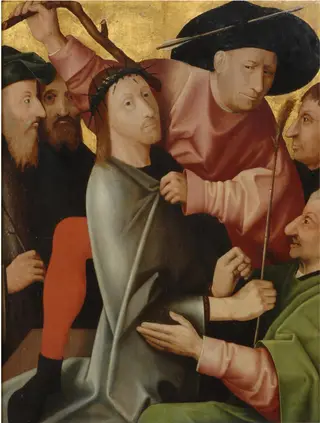
Earlier Bosch scholars, including Charles de Tolnay, treated the panel as a copy after a lost late Bosch original, linking it stylistically to half-length caricature works such as the Crowning with Thorns in London, Christ before Pilate in Princeton, and the Carrying of the Cross in Ghent. More recent scholarship questions whether Bosch ever developed in that manner, and Ludwig von Bladass considered the deviations from the supposed original so substantial that dating is nearly impossible. Two further copies exist, in the San Diego Museum of Art and one of unknown location, both produced after the 's-Hertogenbosch version.
Legacy
Following its acquisition by the Rijksmuseum in 1930 for 80,000 guilders, the painting was initially celebrated as an autograph work by Hieronymus Bosch, bolstered by Max Friedländer’s endorsement. Within a year, however, Friedländer revised his attribution after encountering a copy in Munich, prompting the Rijksmuseum to relegate the panel to storage. The work’s reputation recovered only after 2001, when it entered the Noordbrabants Museum as a centerpiece of the permanent exhibition "De wereld van Bosch," anchoring its legacy within the regional cultural narrative.
Parallel copies in San Diego and a lost location further complicated connoisseurship, yet the painting’s inclusion in Bosch-focused displays at the Noordbrabants Museum has stabilized its reception as a significant follower’s variant rather than an original.
Overview
The oil painting titled "The arrest of Christ" captures a pivotal and dramatic moment from the biblical narrative. The composition places Christ at its center, enveloped by a surrounding crowd, effectively conveying the intensity of his apprehension. The artist utilizes a somber, atmospheric setting to amplify the emotional weight of the scene, drawing the observer into the unfolding event.
Artist & collection