Artwork
The court jester meets a Zangi dancing with joy, and learns from him that the cause of his happiness is his assignation with a woman who is the jester’s own wife, from a Tuti-nama (Tales of a Parrot): Twenty-second Night
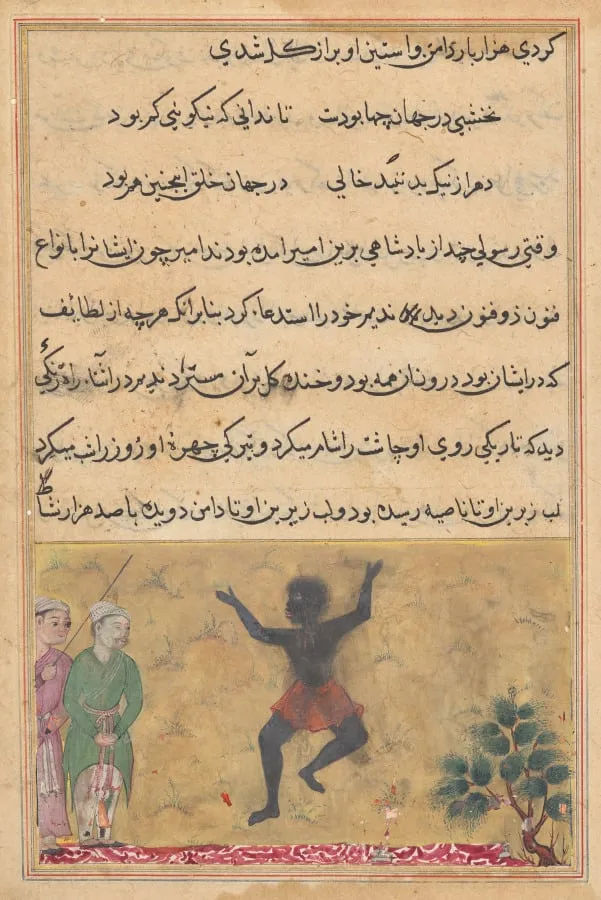
The court jester meets a Zangi dancing with joy, and learns from him that the cause of his happiness is his assignation with a woman who is the jester’s own wife, from a Tuti-nama (Tales of a Parrot): Twenty-second Night is an unspecified painting by the Mughal Painting artist Unknown. It dates from 1560 and is held in the collection of the Cleveland Museum of Art. This 16th-century Indian painting illustrates a scene from the Tuti-nama, a collection of tales about a parrot.
About this work
If you like this kind of storytelling art, look up Mughal India, court of Akbar (reigned 1556–1605).
You see a man in green—probably a jester—standing frozen on a road. Beside him, a dark-skinned dancer in bright clothes twirls, arms raised. The dancer’s grin says he’s about to meet someone special.
This painting comes from a 16th-century Indian book of parrot tales. The jester just learned the dancer’s lover is his own wife. The story is funny and messy, like a soap opera. The artist made the dancer look a little wild, almost like a cartoon.
If you like this kind of storytelling art, look up Mughal India, court of Akbar (reigned 1556–1605).
Overview
This 16th-century Indian painting illustrates a scene from the Tuti-nama, a collection of tales about a parrot. It depicts a jester encountering a dancing figure, Zangi, on a road.
Subject & Meaning
The scene shows the jester, dressed in green, reacting to Zangi's joyful dance. Zangi's happiness stems from an assignation with a woman, who is revealed to be the jester's wife, causing the jester distress.
Technique & Style
The artist portrayed Zangi with caricatured physical traits, minimal clothing, and an uncovered head, conveying a semi-wild character. The contrast between the jester's restraint and Zangi's energetic dance is visually striking.
Context
The painting is part of a manuscript from the court of Akbar, a Mughal Indian ruler who reigned from 1556 to 1605, known for its richly illustrated books.
Artist & collection

 Domestic Scene
 Giacomo and Cardinal Marco, investing Andrea, Abbot of San Zeno, with his Benefice
 The Nymph of Fontainebleau
 Portrait of a Woman
 Madonna and Child with Saints in the Enclosed Garden
 Venus and Minerva
 Family Group of Four on Sofa
 Wall painting from Room H of the Villa of P. Fannius Synistor at Boscoreale
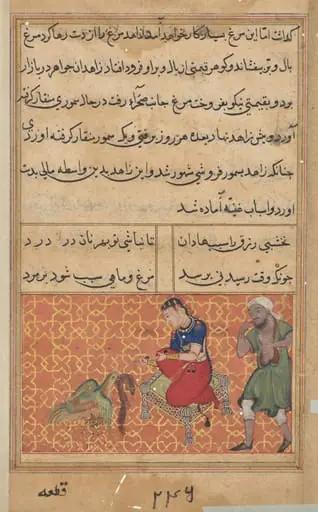 The bird of seven colors brings a sable to the pious man, from a Tuti-nama (Tales of a Parrot): Fifty-second Night
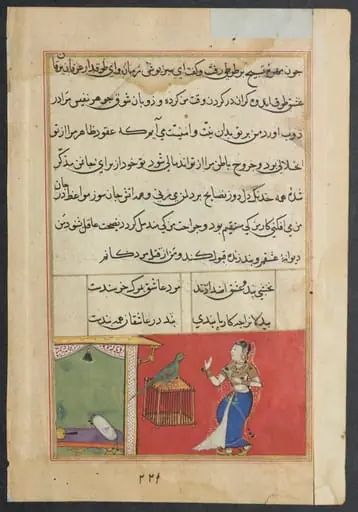 The parrot addresses Khujasta at the beginning of the forty-seventh night, from a Tuti-nama (Tales of a Parrot): Forty-seventh Night
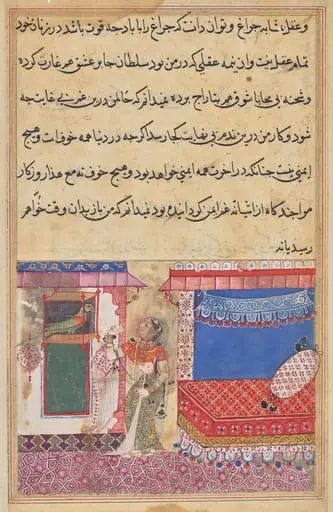 The Parrot Addresses Khujasta at the Beginning of the Eighteenth Night, from a Tuti-nama (Tales of a Parrot)
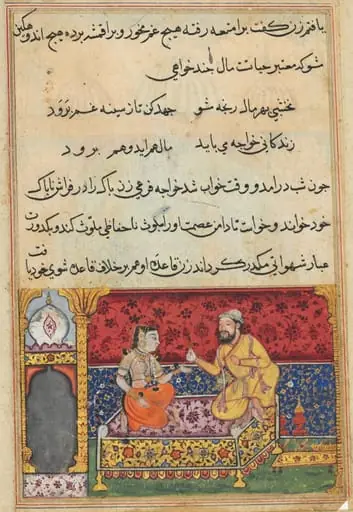 The young man changes himself to look like Mansur, and thus inveigles himself into the bed of Mansur’s wife, but is put off by her, from a Tuti-nama (Tales of a Parrot): Seventeenth Night
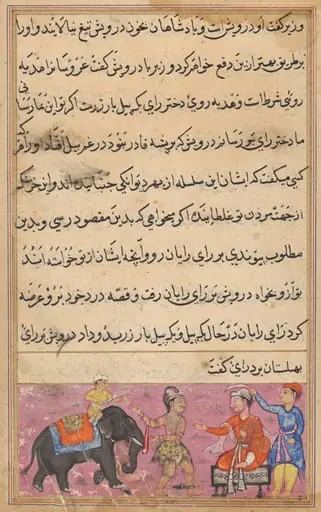 The dervish brings in as dowry an elephant laden with gold, from a Tuti-nama (Tales of a Parrot): Seventh Night
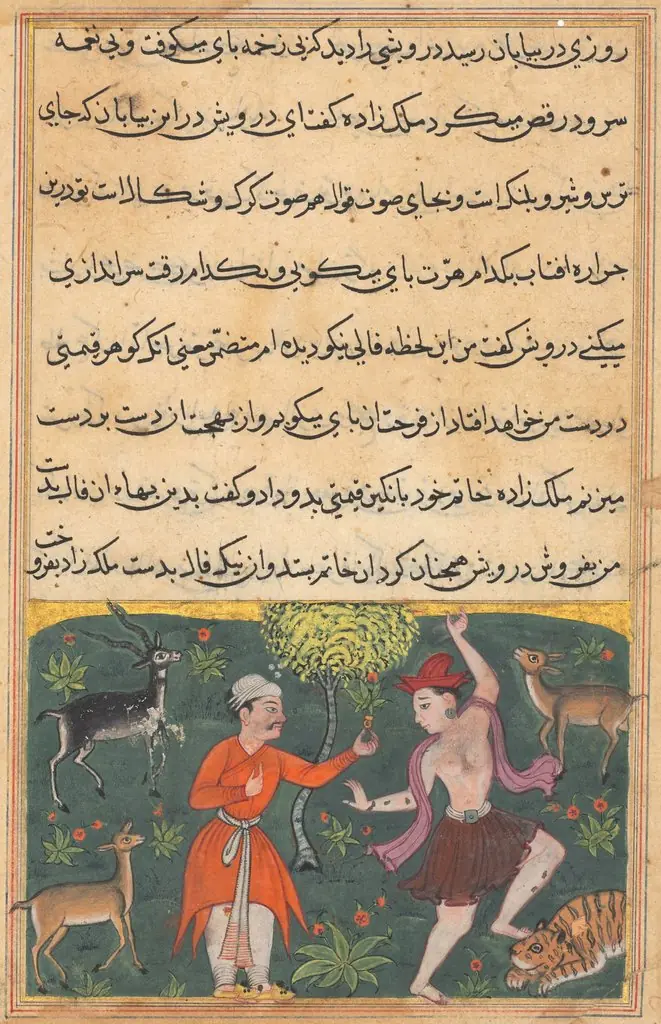 The prince meets a carefree dancing dervish whose good fortune he purchases for his ring, from a Tuti-nama (Tales of a Parrot): Eighteenth Night
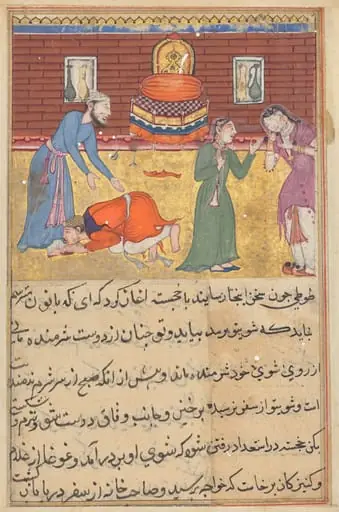 The pious man’s son, now a king, reveals himself to his father; his nurse upbraids his unfaithful mother, from a Tuti-nama (Tales of a Parrot): Fifty-second Night