Artwork
Untitled
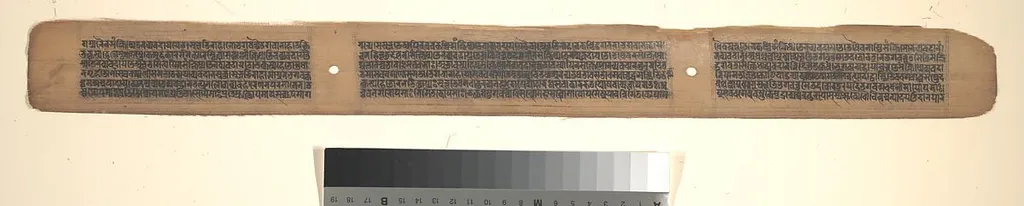
Untitled is a watercolor painting. It dates from 1090 and is held in the collection of the Metropolitan Museum of Art.
About this work
Subject & Meaning
Its subject matter reflects Buddhist religious themes, illustrating core elements of the Buddhist tradition.
The painting Untitled, dated to 1090, is an opaque watercolor on palm leaf created in India by an anonymous artist and classified as a religious work that depicts Buddhist iconography. Its subject matter reflects Buddhist religious themes, illustrating core elements of the Buddhist tradition. The piece is part of the Metropolitan Museum of Art collection in New York, where it is displayed as a representative example of early Buddhist art from the Indian subcontinent.
Technique & Style
Created in 1090 in India, this anonymous religious painting utilizes opaque watercolor applied directly onto a palm leaf support. The work measures 5.7 units in height and 57 units in width, resulting in a distinctively elongated horizontal format typical of its region and era. Stylistically, the piece functions as a Buddhist devotional image, employing the durable organic medium of the palm leaf to preserve the pigment.
The handling of the opaque watercolor allows for solid, flat areas of color suitable for the detailed iconography required by the genre. As a surviving example of South Asian manuscript art from the late 11th century, the material choice reflects local artistic traditions where palm leaves were the standard substrate for religious texts and imagery before the widespread adoption of paper.
History & Provenance
The work, titled Untitled, is a religious painting depicting Buddhism created in India around 1090. Executed in opaque watercolor on palm leaf, the piece is attributed to an anonymous artist. While specific details regarding the original commission or the precise chain of ownership prior to its current location are not detailed in the available records, the work was created during the late 11th century.
It is currently held in the collection of the Metropolitan Museum of Art. The painting measures 5.7 units in height and 57 units in width. As an anonymous religious artwork from this period, its creation reflects the artistic traditions of India at the time, though the specific patron or initial context of its production remains unidentified in the provided documentation.
The anonymous religious painting titled Untitled, dated to 1090, is held in the collection of the Metropolitan Museum of Art. The work, created in India using opaque watercolor on palm leaf, measures 5.7 cm in height and 57 cm in width. While the sources confirm its current location and physical dimensions within the museum's holdings, no specific accession number, inventory code, or exhibition history is provided in the available records. The artwork remains part of the museum's general collection of religious art depicting Buddhism.
Overview
This untitled painting, rendered in opaque watercolor on a palm leaf, depicts a seated Buddha in red robes, his hands positioned in a gesture of teaching. He is flanked by smaller figures of monks and trees, creating a vibrant scene. This individual leaf once served as a page within a larger manuscript, where multiple such leaves were bound together between wooden covers to form a book.
Context
This palm leaf is a remnant of an ancient manuscript tradition, where individual pages were meticulously painted and then assembled into complete books. These volumes were typically secured between protective wooden covers, forming a portable and durable format for religious texts and illustrations. Such manuscripts were crucial for the dissemination and preservation of Buddhist teachings across generations.

Artist & collection

 Untitled
 Text, Folio 148 (recto), from a Manuscript of the Perfection of Wisdom in Eight Thousand Lines (Ashtasahasrika Prajnaparamita-sutra)
 Text, folio 172 (recto), from a Manuscript of the Perfection of Wisdom in Eight Thousand Lines (Ashtasahasrika Prajnaparamita-sutra)
 Untitled
 Untitled
 Untitled
 King Kumarapala Pays Reverence to Hemachandra: Folio 2 (recto), from a Great Poem about Twos (Dvyashraya Mahakavya) of Hemachandra with Commentary by Abhayatilaka
 Untitled
 Untitled
- Text, folio 51 (recto), from a Manuscript of the Perfection of Wisdom in Eight Thousand Lines (Ashtasahasrika Prajnaparamita-sutra)
 Text, Folio 146 (recto), from a Manuscript of the Perfection of Wisdom in Eight Thousand Lines (Ashtasahasrika Prajnaparamita-sutra)
 Text, folio 170 (recto), from a Manuscript of the Perfection of Wisdom in Eight Thousand Lines (Ashtasahasrika Prajnaparamita-sutra)