Artwork
Untitled
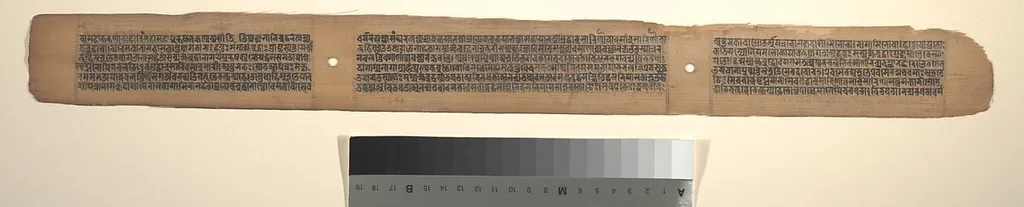
Untitled is a watercolor painting. It dates from 1090 and is held in the collection of the Metropolitan Museum of Art.
About this work
Technique & Style
Formal qualities include a narrow vertical format, hieratic figuration, and schematic drapery, aligning with contemporaneous Buddhist iconographic conventions.
The work employs opaque watercolor applied to palm-leaf folios, a traditional support in medieval Indian manuscript painting. Handling features fine brushwork and delicate linear outlines typical of eleventh-century Pala-school illumination, with pigments bound in gum and applied in flat, unmodulated fields. Condition is reported as stable, with minor flaking along creases and marginal losses consistent with palm-leaf aging.
Formal qualities include a narrow vertical format, hieratic figuration, and schematic drapery, aligning with contemporaneous Buddhist iconographic conventions.
History & Provenance
The work titled Untitled was created circa 1090 in India by an anonymous painter, who executed it in opaque watercolor on a palm leaf. Its subject matter belongs to the Buddhist religious tradition, and it was classified as a painting within the genre of religious art. The work measures 5.7 units in height and 57 units in width, with an inception date recorded as 1090-01-01.
It entered the collection of the Metropolitan Museum of Art, where it remains on view under accession number 55.121.36.18. No documented commission or specific ownership chain prior to its acquisition by the museum is recorded; the artist remains unidentified.
The painting is held by the Metropolitan Museum of Art, where it is recorded under the inventory designation MET 55.121.36.18. The work entered the museum's collection as part of its holdings of religious paintings and remains in the institution's custody. No prior provenance details or earlier ownership history are documented in the available records. No exhibition history is recorded in the available sources.
Legacy
The 1090 palm‑leaf painting, listed as Untitled and attributed to an anonymous Indian painter, is one of the earliest dated Buddhist works in the Metropolitan Museum of Art. Its status as a religious artwork and its depiction of Buddhist themes have made it a key example in studies of early South Asian visual culture, illustrating how religious patronage shaped artistic production before named artists emerged. The work’s inclusion in a major museum collection has reinforced its role in shaping scholarly narratives about anonymous creators and the spread of Buddhist iconography in medieval India.
Overview
This untitled painting, rendered in opaque watercolor on a palm leaf, depicts a seated Buddha in red robes, gesturing in a teaching posture. He is flanked by smaller figures of monks and trees. This individual leaf originally served as a page within an early Buddhist manuscript, where multiple such leaves were bound together to form a complete text in the Bengal region.
Subject & Meaning
The central figure is a Buddha, identifiable by his red monastic robes and the specific hand gesture, known as a mudra, signifying teaching or discourse. He is depicted seated, with smaller attendant monks and natural elements like trees completing the scene. Such imagery frequently illustrated sacred narratives or doctrinal points within the Buddhist scriptures it accompanied.
Context
This painting originates from Bengal and formed a component of a larger manuscript. In this region, early Buddhist texts were often created by stacking individual palm leaves, each inscribed or painted, and then binding them together. These portable and durable books served as vital vehicles for the dissemination and study of Buddhist teachings.

Artist & collection

- Untitled
 Untitled
 Untitled
 Untitled
 Untitled
 King Kumarapala Pays Reverence to Hemachandra: Folio 2 (recto), from a Great Poem about Twos (Dvyashraya Mahakavya) of Hemachandra with Commentary by Abhayatilaka
 Untitled
 Untitled
 Text, folio 172 (recto), from a Manuscript of the Perfection of Wisdom in Eight Thousand Lines (Ashtasahasrika Prajnaparamita-sutra)
 Untitled
 Untitled
 Text, Folio 100 (verso), from a Manuscript of the Perfection of Wisdom in Eight Thousand Lines (Ashtasahasrika Prajnaparamita-sutra)