Artwork
Untitled

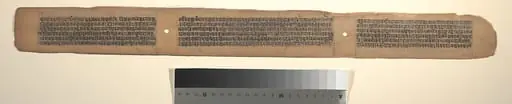
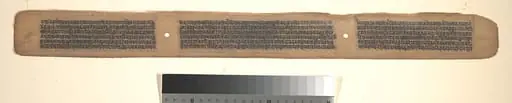
Untitled is an ink painting. It dates from 1090 and is held in the collection of the Metropolitan Museum of Art. The work consists of a rectangular fragment of palm leaf, its natural light‑brown hue and weathered edges indicating considerable age.
About this work
History & Provenance
The work is dated to circa 1090 and was made in India; it is classified as religious art and attributed to an anonymous artist.
The work is dated to circa 1090 and was made in India; it is classified as religious art and attributed to an anonymous artist. Its ownership history prior to the twentieth century is undocumented. The painting entered a public collection when it was accessioned by the Metropolitan Museum of Art, where it is now held.
The available sources do not provide a verified accession number or a documented exhibition history for the piece.
Legacy
The work's legacy is anchored in its status as a rare surviving example of early religious painting from 11th-century India, housed in the Metropolitan Museum of Art since its acquisition. Its attribution to an anonymous master has shaped scholarly discussions on unsigned devotional works in South Asian art, influencing studies of manuscript production during the Pala period. The painting's stylistic features, including its ink and mineral pigment technique on palm leaf, have been cited in analyses of cross-cultural artistic exchange between India and the broader Buddhist world, though its unsigned nature limits direct lineage claims.
Its inclusion in major exhibitions on early Asian art has reinforced its role as a benchmark for dating similar works, cementing its reputation as a key artifact for understanding medieval religious aesthetics.
Overview
The work consists of a rectangular fragment of palm leaf, its natural light‑brown hue and weathered edges indicating considerable age. Across the surface runs black ink arranged in orderly rows, each line comprising a short passage of an unfamiliar script. The piece is presented as a painted object, though the primary emphasis lies in the written content rather than pictorial representation.
Subject & Meaning
The inked text appears to be a form of writing no longer in common use, suggesting the leaf served a documentary or ritual function. Without a deciphered translation, the precise subject remains speculative, yet the careful arrangement implies a deliberate record, perhaps a liturgical chant, a legal decree, or a literary excerpt preserved for posterity.
Technique & Style
The artist employed a simple yet durable medium: black ink applied with a fine brush or reed pen onto a prepared palm leaf. The leaf’s texture, slightly torn and worn, indicates a traditional substrate used in South and Southeast Asian manuscript cultures, where natural fibers were favored for their resilience and availability.
Context
Palm‑leaf manuscripts were a common vehicle for recording religious, scientific, and administrative texts across regions such as India, Sri Lanka, and Indonesia. The fragment’s physical condition, lightly frayed edges and a muted palette, reflects the typical wear of objects that were handled, stored, and possibly re‑used over centuries.

Artist & collection

- Text, folio 172 (recto), from a Manuscript of the Perfection of Wisdom in Eight Thousand Lines (Ashtasahasrika Prajnaparamita-sutra)
 Untitled
 Untitled
 Untitled
 Text, Folio 90 (verso), from a Manuscript of the Perfection of Wisdom in Eight Thousand Lines (Ashtasahasrika Prajnaparamita-sutra)
 Text, Folio 100 (verso), from a Manuscript of the Perfection of Wisdom in Eight Thousand Lines (Ashtasahasrika Prajnaparamita-sutra)
 Untitled
 Text, Folio 148 (recto), from a Manuscript of the Perfection of Wisdom in Eight Thousand Lines (Ashtasahasrika Prajnaparamita-sutra)
 King Kumarapala Pays Reverence to Hemachandra: Folio 2 (recto), from a Great Poem about Twos (Dvyashraya Mahakavya) of Hemachandra with Commentary by Abhayatilaka
 Text, folio 179 (verso), from a Manuscript of the Perfection of Wisdom in Eight Thousand Lines (Ashtasahasrika Prajnaparamita-sutra)
 Untitled
 Text, Folio 30 (verso), from a Manuscript of the Perfection of Wisdom in Eight Thousand Lines (Ashtasahasrika Prajnaparamita-sutra)