Artwork
Untitled

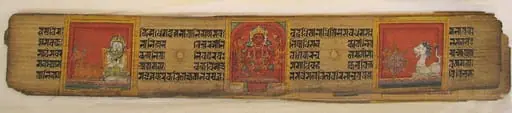
Untitled is an ink painting. It dates from 1149 and is held in the collection of the Metropolitan Museum of Art.
About this work
Subject & Meaning
The focus on the stupa rather than a narrative scene emphasizes the object's role as a focal point for meditation and veneration within the Buddhist tradition.
Created in 1149 in India, this anonymous work is a religious painting executed in ink and color on palm leaf. The composition centers on a stupa, a dome-shaped structure serving as a Buddhist reliquary, which stands as the primary subject of the piece. As a representation of Buddhism, the image functions within a sacred context, utilizing the stupa to symbolize the Buddha's presence and the path to enlightenment.
The artwork's iconography is defined by these religious elements, reflecting the devotional practices of its time and place. The focus on the stupa rather than a narrative scene emphasizes the object's role as a focal point for meditation and veneration within the Buddhist tradition.
Technique & Style
The work is executed in ink and color on palm leaf, a traditional South Asian support well suited to the elongated horizontal format typical of Buddhist devotional manuscripts. The combination of fluid ink line and applied color allowed the anonymous painter to render religious imagery, including a stupa and Buddhist iconography, with fine linear detail and saturated pigment. Classified within the Met's paintings holdings, the palm-leaf support and ink-and-color handling reflect established regional conventions for sacred imagery produced in India during the mid-twelfth century.
History & Provenance
The work is dated to 1149 and originates from India, executed in ink and color on palm leaf as a Buddhist religious painting depicting a stupa. It is held in the collection of the Metropolitan Museum of Art and is attributed to an anonymous painter. No further details regarding its commission, prior ownership chain, or intermediate provenance are documented in the available sources, which also do not provide a specific accession number or detailed exhibition history beyond its inclusion in the collection.
Overview
This untitled 12th-century artwork, rendered in ink and color on a palm leaf, depicts two pointed structures. These forms, characterized by stacked roofs and small flags, are preliminary sketches of Buddhist stupas. Originating from the Bihar or Bengal regions, the piece offers insight into the visual representation of these sacred relic mounds during its period of creation.
Context
Created in the 12th century, this drawing emerges from the artistic traditions of either Bihar or Bengal, regions historically significant for Buddhist art and scholarship. The use of palm leaf as a medium was widespread, facilitating the creation of both manuscripts and preliminary studies. This piece provides a glimpse into the visual culture and artistic methods prevalent in these areas during that era.

Artist & collection

- Untitled
 Untitled
 Prajnaparamita flanked by two bodhisattvas, folio 187 (recto), from a Manuscript of the Perfection of Wisdom in Eight Thousand Lines (Ashtasahasrika Prajnaparamita-sutra)
 Untitled
 Untitled
 Untitled
 Text, Folio 10 (verso), from a Manuscript of the Perfection of Wisdom in Eight Thousand Lines (Ashtasahasrika Prajnaparamita-sutra)
 Text, Folio 90 (verso), from a Manuscript of the Perfection of Wisdom in Eight Thousand Lines (Ashtasahasrika Prajnaparamita-sutra)
 Text, folio 43 (recto), from a Manuscript of the Perfection of Wisdom in Eight Thousand Lines (Ashtasahasrika Prajnaparamita-sutra)
 Text, Folio 146 (recto), from a Manuscript of the Perfection of Wisdom in Eight Thousand Lines (Ashtasahasrika Prajnaparamita-sutra)
 Text, Folio 47 (recto), from a Manuscript of the Perfection of Wisdom in Eight Thousand Lines (Ashtasahasrika Prajnaparamita-sutra)
 Text, folio 48 (recto), from a Manuscript of the Perfection of Wisdom in Eight Thousand Lines (Ashtasahasrika Prajnaparamita-sutra)