Artwork
Untitled
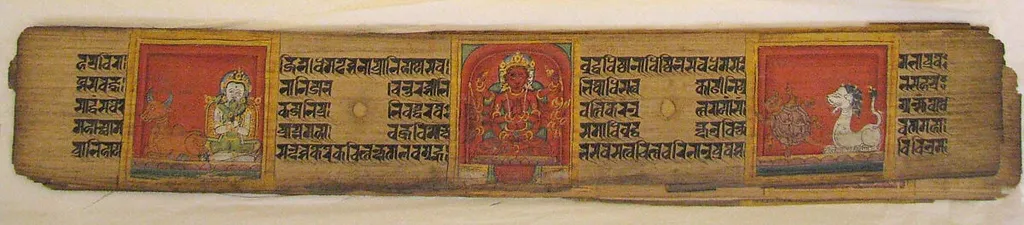
Untitled is an ink painting. It dates from 1349 and is held in the collection of the Metropolitan Museum of Art.
About this work
Subject & Meaning
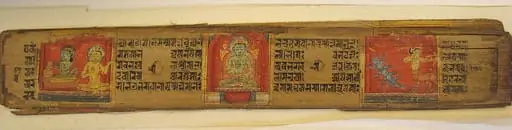
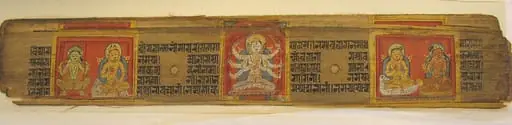
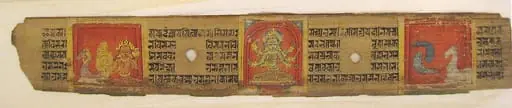
The specific identity of the deity is not detailed in the available records, but the work is firmly categorized as a depiction of Buddhist divinity.
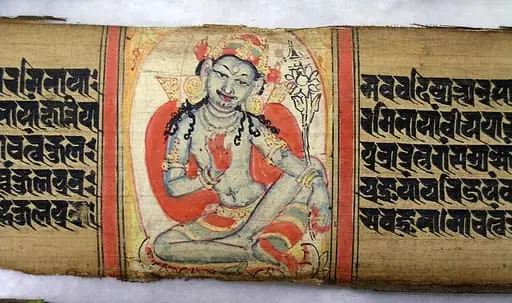
Created in Nepal in 1349, this religious painting on palm leaves depicts a Buddhist deity. The work functions as an object of devotion within the Buddhist tradition, utilizing ink and color to render the divine figure. As a piece of religious art, its primary significance lies in its representation of sacred Buddhism iconography, serving as a visual focus for spiritual practice rather than a narrative scene.
The specific identity of the deity is not detailed in the available records, but the work is firmly categorized as a depiction of Buddhist divinity.
Technique & Style
Created in 1349 in Nepal, this anonymous religious painting employs ink and color applied to a support of palm leaves. The work measures 5.4 units in height and 33.3 units in width, adhering to the compact format typical of palm-leaf manuscripts. Stylistically, the piece functions as a devotional image within the Buddhist tradition, depicting a deity through traditional painting techniques.
The medium of ink and pigment on organic palm leaf suggests a delicate handling process suited to the narrow, elongated support. As a work of religious art, its formal qualities prioritize iconographic clarity over naturalistic depth, characteristic of the period's devotional practices in the region.
History & Provenance
The work titled Untitled was produced in Nepal in 1349 by an anonymous painter who specialized in religious imagery. Executed in ink and color on palm leaves, the piece belongs to the Buddhist deity genre and was classified as a painting within the broader category of paintings. After its creation, the artwork entered the collection of the Metropolitan Museum of Art, where it remains on view today (Met 55.121.37.6).
Its provenance traces a direct path from the 14th‑century Nepalese workshop to the museum’s holdings, with no documented intermediate owners. The dating is anchored to the year 1349, confirmed by both stylistic analysis and the museum’s catalog entry.
The work is held in the collection of the Metropolitan Museum of Art, where it is identified by the accession number 55.121.37.6. Created in Nepal in 1349, this ink and color painting on palm leaves depicts Buddhist deities. While the provided records confirm its current institutional location and cataloging details, they do not contain specific information regarding past exhibitions or a detailed provenance history prior to its entry into the museum's holdings.
Context
The painting, dated 1349 and executed in ink and color on palm leaf, belongs to the Himalayan religious tradition of Nepal and is housed in the Metropolitan Museum of Art. Its depiction of a Buddhist deity situates it within the broader development of Himalayan Buddhist iconography during the 14th century, a period marked by increasing patronage of visual worship in the Kathmandu Valley. Scholars of Himalayan art have used stylistic analysis of such anonymous works to trace the diffusion of Nepalese artistic motifs into Tibetan and Indian contexts, emphasizing the role of trans‑regional pilgrimage networks in shaping religious imagery.
The work’s classification as a religious painting underscores its function within devotional practice rather than as a secular portrait.
Overview
This untitled painting, created approximately seven centuries ago in Nepal's Kathmandu Valley, utilizes ink and color on palm leaves. It depicts a multi-armed, blue-skinned deity, each hand grasping a distinct object. The artwork's small scale and construction suggest it was designed for portability and ease of storage, reflecting practices common for religious texts and imagery of the period.
Artist & collection

 Untitled
 Untitled
 Untitled
 Untitled
 Untitled
 Untitled
 Folio 37 from a Gandavyuha-sutra (Scripture of the Supreme Array): Sudhana and a pair of antelopes (recto); text (verso)
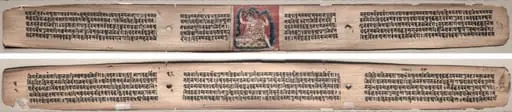 Folio 22 from a Gandavyuha-sutra (Scripture of the Supreme Array): Samantabhadra spinning clouds of things (recto); Text (verso)
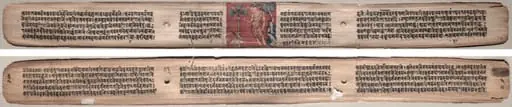 Folio 73 from a Gandavyuha-sutra (Scripture of the Supreme Array): Sudhana and an antelope (recto); text (verso)
 Untitled
 Untitled
- Untitled