Movement
Antiquarianism
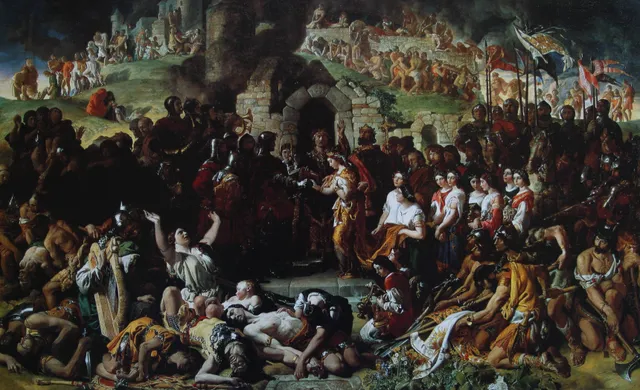
Antiquarianism is an art movement. The gallery holds 1 work in this movement. Browse Antiquarianism paintings, portraits, pictures and artworks from the world's public-domain museum collections.
Antiquarianism describes the long European tradition of studying and admiring the material remains of the past — relics, ruins, coins, manuscripts, costume, and monuments — and the body of art it shaped. Less a single style than a scholarly and aesthetic disposition, it took root in the Renaissance, when humanists began collecting and cataloguing classical remains, and expanded steadily from the fifteenth through the seventeenth centuries before reaching a peak of activity in the eighteenth. The Enlightenment gave it fresh purpose: as nations searched for a sense of historical identity, antiquaries set out to recover the past from physical evidence rather than legend. The spirit of the movement is captured in the motto of the English antiquary Sir Richard Colt Hoare — "We speak from facts, not theory."
The antiquarian's defining commitment was empirical accuracy, and this fed directly into the visual arts. Antiquarian scholarship created a demand for archaeological precision in painting and illustration, making the medieval and ancient worlds less a vague romantic backdrop than a reconstructable reality. Practitioners measured ruins, copied inscriptions, and recorded armour, dress, and architecture so that artists could render them faithfully. In Ireland, the antiquarian and painter George Petrie set a standard with his treatise The Ecclesiastical Architecture of Ireland (1845), whose illustrations were praised for a truthfulness deliberately opposed to the merely picturesque.
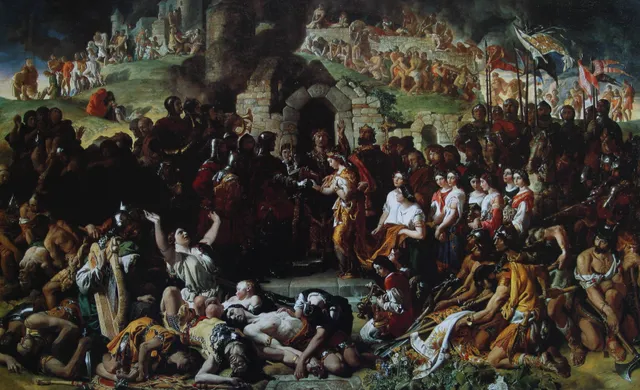
The impulse shaped the grand history painting of the nineteenth century, and Daniel Maclise (1806–1870) is among its most accomplished exponents. Maclise steeped himself in Irish annals and chronicles — Gerald of Wales's Expugnatio Hibernica, the medieval Song of Dermot and the Earl, and Geoffrey Keating's seventeenth-century history — and was known for his command of antiquarian artefacts, costume, and architectural detail. His monumental The Marriage of Strongbow and Aoife (c. 1854, National Gallery of Ireland), which imagines the 1170 union of the Norman Richard de Clare and the Leinster princess Aoife amid the burning of Waterford, marries painstaking research with charged national symbolism, even as critics noted that he let poetic imagination override strict accuracy.
Antiquarianism's legacy is foundational rather than peripheral. Its insistence on careful study of documents and objects helped inspire neoclassicism, the Gothic and medieval revivals, and the historicism of Victorian art, and it stood close to the Pre-Raphaelites' own taste for the archaic. By the close of the nineteenth century the movement had fragmented productively into the modern disciplines it had seeded — archaeology, art history, numismatics, philology, and palaeography — making the antiquary a direct ancestor of the modern historian and curator.
Works
Frequently asked questions
What is Antiquarianism?
Antiquarianism is an art movement. A scholarly and artistic fascination with the material remains of ancient civilizations, peaking in 18th-century Europe.
Where can I see Antiquarianism works?
Antiquarianism works in the collection are held by National Gallery of Ireland.