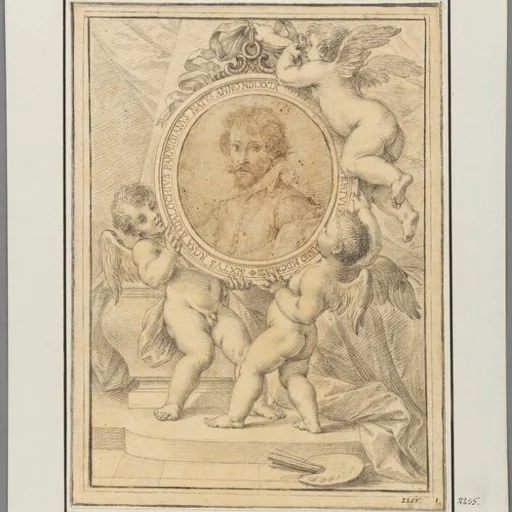
Movement
Bolognese School
Bolognese School is an art movement of the 1500–1700 period. The gallery holds 1 work in this movement, including works by Sisto Badalocchio. Browse Bolognese School paintings, portraits, pictures and artworks from the world's public-domain museum collections.
The Bolognese School denotes the tradition of painting that flourished in Bologna from the late sixteenth into the seventeenth century, when the city briefly rivalled Florence and Rome as a centre of Italian art. It crystallised around 1582 when three members of one family — Ludovico Carracci and his younger cousins, the brothers Agostino and Annibale — opened a studio-academy in Bologna. First called the Accademia dei Desiderosi and later renamed the Accademia degli Incamminati ("Academy of the Progressives"), it arose as a deliberate revolt against the artificiality and stylisation of late Mannerism, and aligned with the Counter-Reformation call, voiced at the Council of Trent, for religious images of clarity and emotional persuasion.
The Carracci reform rested on direct study: drawing from the living model, anatomy, natural science and classical sculpture, combined with the rich colour of Venetian and Lombard painting. The result was a manner that fused naturalistic observation with idealised, monumental form. The school's earthy, observational streak — seen in Annibale's genre pictures such as The Bean Eater and The Butcher's Shop — drew on Bolognese predecessors like Bartolomeo Passarotti (1529–1592), an older Mannerist whose lively heads and market scenes (our collection holds his Homer's Riddle) helped point the younger generation toward life.
Annibale Carracci became the school's most consequential figure. Called to Rome in 1595, he frescoed the vault of the Galleria in the Palazzo Farnese (c. 1597–1600) with the loves of the pagan gods, a cycle that became a new "academy" for younger painters and a cornerstone of Baroque classicism. From the Incamminati emerged a remarkable second generation: Guido Reni, Domenichino, Francesco Albani, Giovanni Lanfranco and, slightly later, Guercino, alongside lesser pupils such as Sisto Badalocchio of Parma, who worked under both Agostino and Annibale.
What began as a regional movement became the dominant force in seventeenth-century Italian painting. Its balance of naturalism and idealised design shaped the Roman Baroque and, through works like Reni's Aurora and Domenichino's Last Communion of St. Jerome, fed the classical current that would influence French painters such as Poussin and the academic tradition for two centuries.
Key artists
Works
Frequently asked questions
What is Bolognese School?
Bolognese School is an art movement. The painting tradition centered on Bologna from the late 16th through 18th centuries, anchored by the Carracci family's academy and its reform of Mannerism.
Who are the key Bolognese School artists?
Key Bolognese School artists in the collection include Sisto Badalocchio.
When did Bolognese School take place?
Bolognese School dates from 1500–1700.
Where can I see Bolognese School works?
Bolognese School works in the collection are held by Uffizi Gallery.