Movement
Celtic Revival
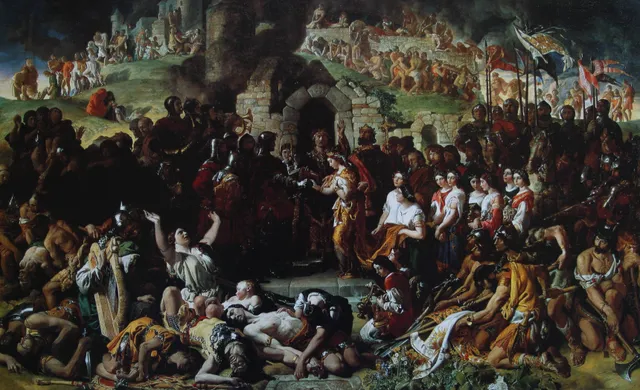
Celtic Revival is an art movement. The gallery holds 1 work in this movement. Browse Celtic Revival paintings, portraits, pictures and artworks from the world's public-domain museum collections.
The Celtic Revival was an interdisciplinary movement that arose in Ireland and Britain across the late nineteenth and early twentieth centuries, reaching its mature phase—sometimes called the Irish Renaissance—from the 1880s. It was driven by two convergent forces: the antiquarian and archaeological recovery of Iron Age and Early Medieval insular objects, and a sharpening sense of national identity. Against the backdrop of British rule, scholars, collectors, and artists looked to a pre-colonial past—its high crosses, illuminated manuscripts, and metalwork—as the foundation of a distinct Gaelic culture. The renewed interest in Ireland's heritage fed directly into the preservation of the Irish language and ran parallel to the literary movement led by W. B. Yeats and Lady Gregory.
Visually, the revival mined the vocabulary of insular art. Interlace and knotwork, spirals, zoomorphic ornament, the ringed Celtic cross, and reproductions of penannular brooches of the seventh to ninth centuries reappeared on jewellery, gravestones, book illumination, embroidery, and architectural detail. Much of this was less a single painterly style than a decorative idiom, frequently combined with dreamlike Symbolist subject matter drawn from myth and saga, and prized for its handcrafted, vernacular character.
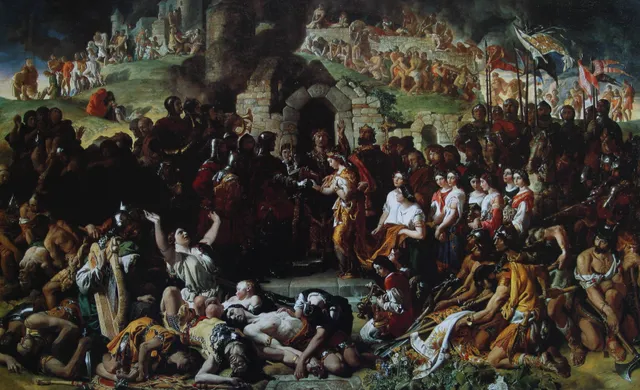
In Scotland, John Duncan (1866–1945) became the movement's foremost painter, producing mythological canvases such as *Tristan and Iseult* (1912), *St Bride* (1913), and *The Riders of the Sidhe*. The Irish-born Phoebe Anna Traquair (1852–1936) worked across murals, enamel, and embroidery—her embroidered cycle *The Progress of a Soul* among her finest achievements—while the Manx designer Archibald Knox supplied Liberty & Co. with the celebrated Cymric silver and Tudric pewter ranges. An important precursor is Daniel Maclise's monumental *The Marriage of Strongbow and Aoife* (1854, oil on canvas, National Gallery of Ireland), which depicts the 1170 Norman marriage with a broken Celtic harp and a shattered high cross underfoot, mourning the eclipse of Gaelic Ireland.
The Celtic Revival overlapped substantially with the Arts and Crafts movement and Art Nouveau, whose flowing organic line owed much to early Celtic ornament; it shared their reaction against industrialisation and their championing of traditional craft. Its legacy endures in Irish national symbolism, graphic and jewellery design, and the wider modern fascination with Celtic visual culture.
Works
Frequently asked questions
What is Celtic Revival?
Celtic Revival is an art movement. A 19th- and early-20th-century cultural movement that revived interest in the art, mythology, and ornamental traditions of the ancient Celtic peoples.
Where can I see Celtic Revival works?
Celtic Revival works in the collection are held by National Gallery of Ireland.