Movement
Fijnschilder
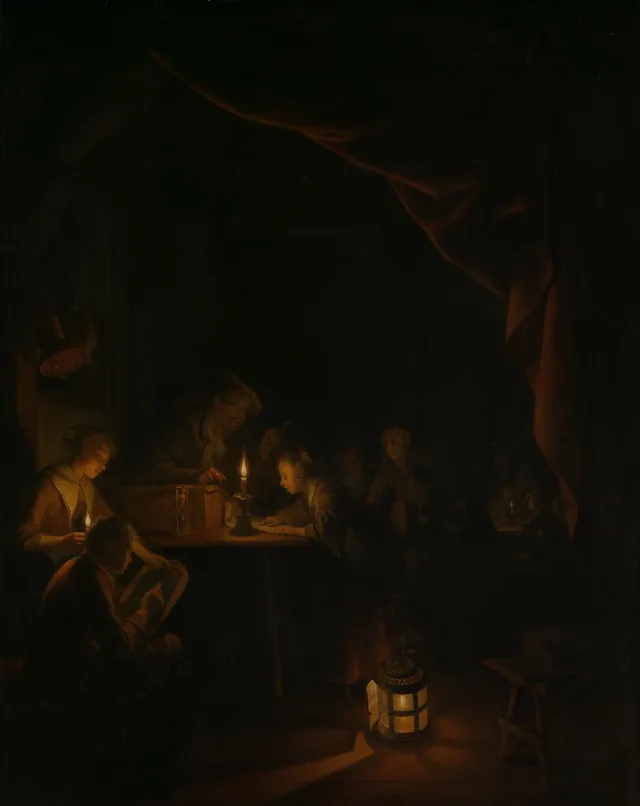
Fijnschilder is an art movement of the 1630–1670 period. The gallery holds 1 work in this movement, including works by Gerrit Dou. Browse Fijnschilder paintings, portraits, pictures and artworks from the world's public-domain museum collections.
The Fijnschilders — Dutch for "fine painters" — were a tightly knit school of Dutch Golden Age artists who flourished in the university town of Leiden from roughly 1630 to 1710. Their progenitor was Gerrit Dou (1613–1675), a glazier's son who on 14 February 1628 became Rembrandt's first pupil, training in the young master's Leiden studio until Rembrandt departed for Amsterdam in 1631. Where Rembrandt and Frans Hals moved toward broad, visible brushwork, Dou pursued the opposite ideal: a meticulous reconstruction of the visible world rendered on a miniature scale. He founded a local manner of painting that would dominate Leiden's reputation for the better part of a century and command some of the highest prices of the age.
The Fijnschilder style is defined by its almost superhuman finish. Working on small oak panels, these painters built up enamel-smooth surfaces in which individual brushstrokes vanish entirely, achieving a polish often likened to glass. They were virtuosos of differentiated texture — velvet and brocade, human skin, glass, polished copper and glazed earthenware are each rendered so convincingly that the materials seem tangible. Favourite subjects included intimate genre scenes of domestic and everyday life, candlelit nocturnes exploiting strong chiaroscuro, and trompe-l'œil "niche" compositions in which figures lean from an arched stone window.
Dou trained the next generation directly. His most celebrated pupils were Frans van Mieris the Elder (1635–1681), whom he called "the prince of all my pupils," and Gabriël Metsu; the lineage continued through Frans's son Willem van Mieris, Godfried Schalcken — noted for his candlelit pieces — Quirijn van Brekelenkam, Pieter Cornelisz van Slingelandt, and, into the eighteenth century, the highly polished Adriaen van der Werff. Canonical works include Dou's *The Night School* (c. 1660–1665), a luminous candlelit classroom; his *The Young Mother* (Mauritshuis); and Van Mieris's *The Duet* (1658).
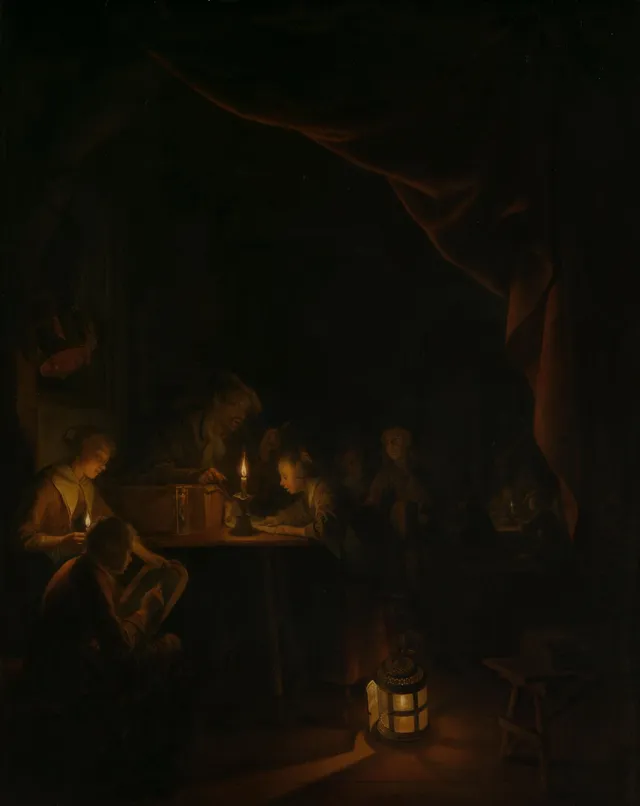
In their own day the Fijnschilders were prized above almost all rivals: Dou's patron Johan de Bye exhibited twenty-nine of his paintings in Leiden in 1665, and collectors paid sums that eclipsed those fetched by Rembrandt and Vermeer. Rooted in the detailed precision of early Netherlandish masters such as Jan van Eyck, the school's refined, jewel-like manner shaped Dutch genre and "elegant" painting deep into the eighteenth century. This museum holds Dou's *De avondschool* (The Evening School), an exemplary nocturnal scene by the movement's founder.
Key artists
Works
Frequently asked questions
What is Fijnschilder?
Fijnschilder is an art movement. The Leiden 'fine painters' of the Dutch Golden Age, led by Gerrit Dou.
Who are the key Fijnschilder artists?
Key Fijnschilder artists in the collection include Gerrit Dou.
When did Fijnschilder take place?
Fijnschilder dates from 1630–1670.
Where can I see Fijnschilder works?
Fijnschilder works in the collection are held by Rijksmuseum.