Movement
Dutch School
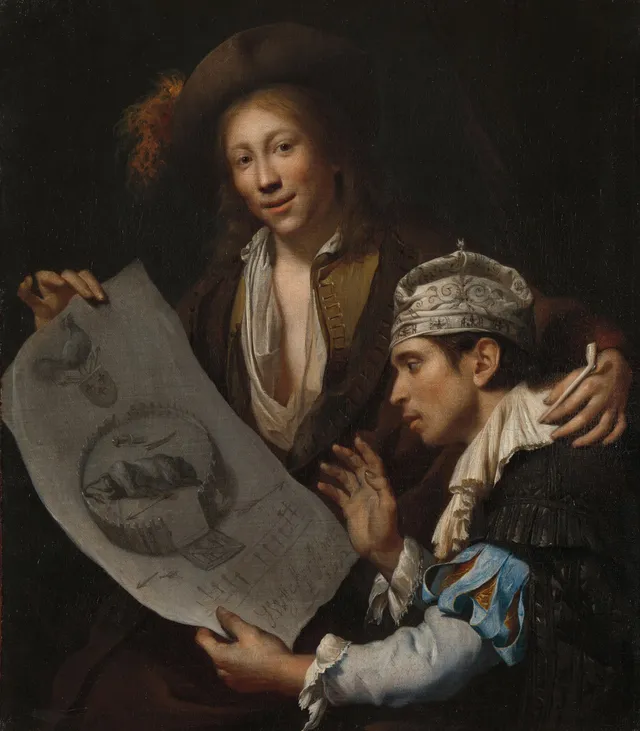
Dutch School is an art movement. The gallery holds 1 work in this movement. Browse Dutch School paintings, portraits, pictures and artworks from the world's public-domain museum collections.
"Dutch School" is a label that art history has attached to two distinct traditions. In music it names the Franco-Flemish, or Netherlandish, School — the polyphonic vocal style that dominated European composition across the fifteenth and sixteenth centuries through masters such as Johannes Ockeghem and Josquin des Prez. In the visual arts, however, the term far more commonly designates the painters of the seventeenth-century Dutch Republic, the so-called Dutch Golden Age, and it is this school that fills museum galleries today.
That painting school rose with the nation itself. The northern provinces' long revolt against Habsburg Spain, formally won at the Peace of Münster in 1648, produced an independent, Calvinist, mercantile republic of extraordinary wealth. With no royal court and a Reformed Church that shunned religious imagery, demand shifted from grand altarpieces to modest pictures bought by a broad middle class for the home. The core of the period runs from the late 1620s to the French invasion of 1672.
Though contemporary with the European Baroque, Dutch painting largely rejected its idealization and love of splendour, extending instead the meticulous realism inherited from Early Netherlandish masters. Painters specialized narrowly, and whole new secular genres flourished — portraiture, scenes of everyday life, landscape, seascape and still life — observed with near-scientific attention to light, texture and surface.
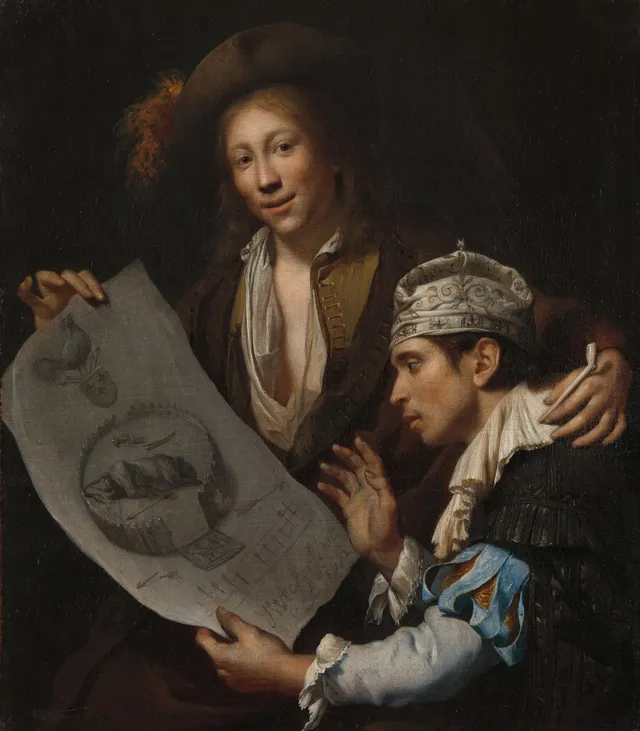
Rembrandt van Rijn stands at the summit, his theatrical chiaroscuro animating works such as The Night Watch; Johannes Vermeer distilled domestic quiet into luminous interiors, while Frans Hals and Judith Leyster brought bravura energy to portrait and genre painting. The catalogue's Allegory on the French Invasion of 1672, by the Utrecht painter Johannes van Wijckersloot (c. 1625–1687), belongs to the school's political vein: it depicts the Garden of Holland with its lion defeated and weapons shattered as a triumphant French cockerel crows overhead — an emblem of the Rampjaar, or "disaster year," when Louis XIV's armies overran the Republic.
That invasion, halted only by the deliberate flooding of the Hollandic Water Line, is conventionally taken to mark the Golden Age's close. Yet its art proved durable: Dutch realism and genre painting reshaped European taste and anticipated the naturalism of the nineteenth century, from the Barbizon painters to Vincent van Gogh, who revered Rembrandt and Hals as forebears.
Works
Frequently asked questions
What is Dutch School?
Dutch School is an art movement. A term sometimes applied to the broader range of Dutch painting beyond the Golden Age, including regional and academic traditions through the 19th century.
Where can I see Dutch School works?
Dutch School works in the collection are held by Rijksmuseum.