Movement
Neo Pompeian
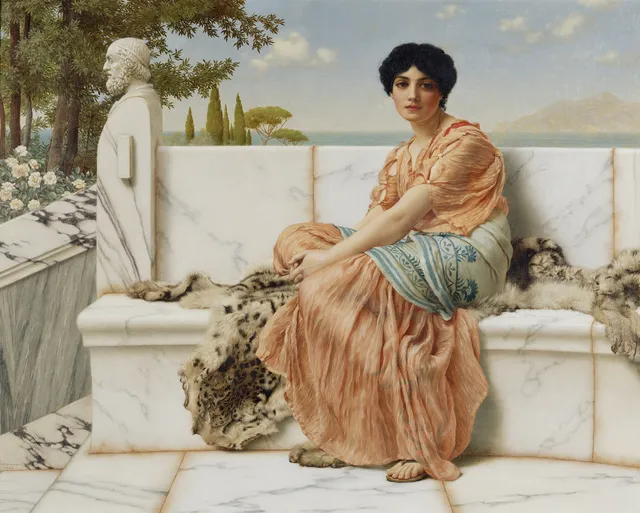
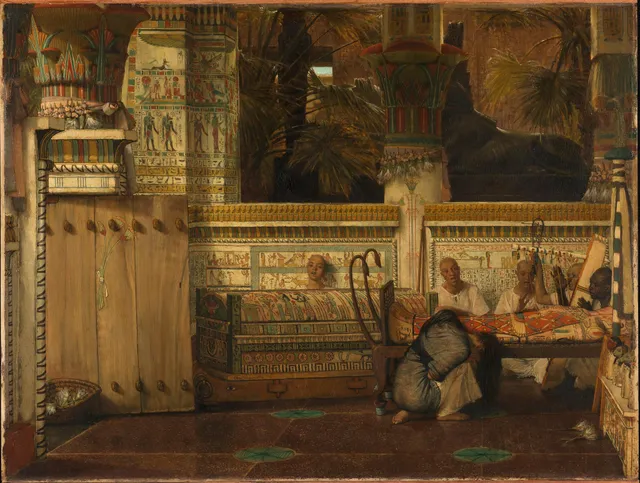
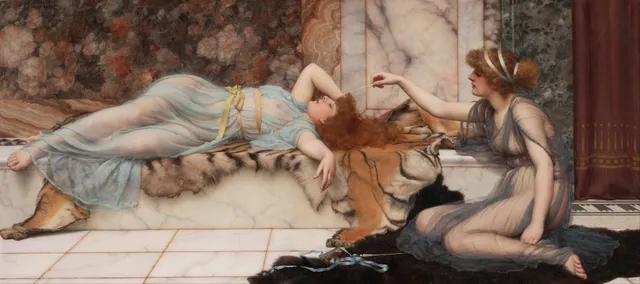
Neo Pompeian is an art movement dating from 1860. The gallery holds 3 works in this movement, including works by John William Godward. Browse Neo Pompeian paintings, portraits, pictures and artworks from the world's public-domain museum collections.
Neo-Pompeian is the strand of nineteenth-century classicism that drew its imagery, palette, and decorative vocabulary directly from the buried Roman cities of Herculaneum and Pompeii, rediscovered through excavations begun in 1738 and 1748. As prints of their frescoes, mosaics, and household objects circulated across Europe, antiquity ceased to be an abstraction of marble white and became vivid, domestic, and colourful. Chief among the lessons was colour itself: the deep iron-oxide and cinnabar grounds of the murals gave their name to "Pompeian red," which nineteenth-century museums, villas, and palaces adopted for their walls in emulation of the great Roman houses.
The taste matured under the Second Empire (1852–1870). In France a group of young Parisian painters known as the Néo-Grecs—nicknamed les Pompéistes, or "Pompeii-painters"—gathered around Jean-Léon Gérôme after his sensational Salon debut with The Cock Fight (1846, Musée d'Orsay), turning antique scenes toward intimate, everyday life. The fashion spilled into the decorative arts: between 1855 and 1860 the architect Alfred-Normand built the celebrated Maison Pompéienne for Prince Napoléon-Jérôme Bonaparte on the avenue Montaigne, its warm red-and-black interiors modelled on the Villa of Diomedes and inaugurated before Napoleon III in 1860 (demolished 1891).
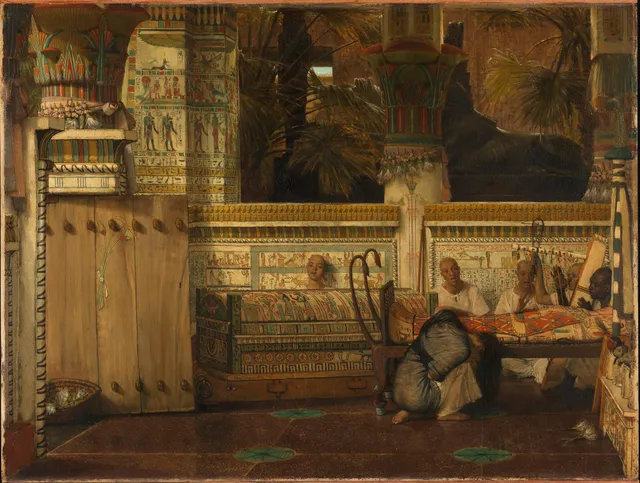
In Britain the impulse produced its most enduring pictures. Sir Lawrence Alma-Tadema (1836–1912), Dutch by birth, visited Pompeii in 1863 and thereafter built a career on archaeologically exact scenes of Roman leisure—languid figures among gleaming marble, silver, and Mediterranean light, as in The Roses of Heliogabalus (1888). His protégé John William Godward (1861–1922) refined the manner into studies of a single woman in idealised antique settings, an explicitly "Pompeian" style seen in A Pompeian Lady (1904). Our collection holds Godward's Mischief and Repose and Reverie, alongside Alma-Tadema's earlier De Egyptische weduwe.
Neo-Pompeian work shares borders with Neoclassicism and the Victorian "Olympians" such as Frederic Leighton and Edward Poynter, but is distinguished by its archaeological literalism and warm, frescoed palette. Long dismissed after Alma-Tadema's death, it has been reappraised since the 1960s as a defining expression of nineteenth-century historicism.
Key artists
Works
Groups & collectives
Frequently asked questions
What is Neo Pompeian?
Neo Pompeian is an art movement. A 19th-century revival inspired by the rediscovered wall paintings of Pompeii and Herculaneum.
Who are the key Neo Pompeian artists?
Key Neo Pompeian artists in the collection include John William Godward.
When did Neo Pompeian take place?
Neo Pompeian dates from around 1860.
Where can I see Neo Pompeian works?
Neo Pompeian works in the collection are held by J. Paul Getty Museum and Rijksmuseum.