Movement
School of Fontainebleau
School of Fontainebleau is an art movement of the 1530–1610 period. The gallery holds 1 work in this movement, including works by Niccolò dell'Abbate, Francesco Primaticcio and Antoine Caron. Browse School of Fontainebleau paintings, portraits, pictures and artworks from the world's public-domain museum collections.
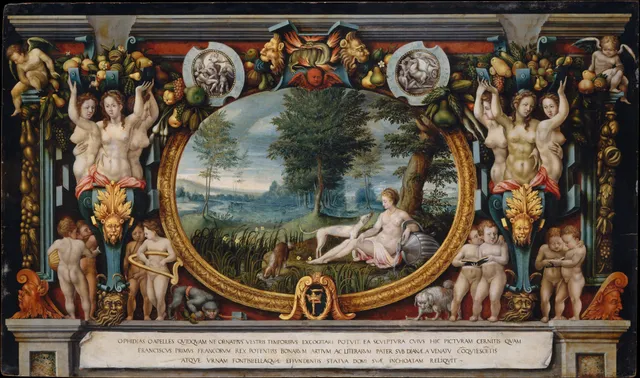
The School of Fontainebleau names the constellation of Italian and French artists whose work centred on the Château de Fontainebleau, the rural palace southeast of Paris that King Francis I began transforming into a sumptuous royal residence in 1528. Seeking to import the prestige of the Italian Renaissance, the king lured the Florentine painter Rosso Fiorentino (1494–1540) to France around 1530, followed in 1532 by the Bolognese Francesco Primaticcio (1504–70). Their arrival, set against the wider migration of artists after the 1527 Sack of Rome, transplanted Italian Mannerism onto French soil and gave the French court a distinctive new visual language for roughly the next eighty years.
The "first school" (c.1530–60) is defined above all by its decorative ensembles, where painted panels were framed by stucco figures, garlands, and the rolled, leather-like ornament known as strapwork that Rosso pioneered. The celebrated Gallery of Francis I marries fresco, sculpted relief, grotesques, putti, and an elaborate, often cryptic programme of mythological allegory. Figures are rendered in the Mannerist idiom Primaticcio made canonical for the era: elongated limbs, small heads, long necks, and sinuous, artificial poses, frequently charged with a refined eroticism. Benvenuto Cellini's bronze relief The Nymph of Fontainebleau (c.1543) — a long-limbed reclining nude with a stag, held in this collection — epitomises that elegant, courtly sensuality.
The movement's leading hands also include Niccolò dell'Abbate (c.1509–71), the Modenese painter of poetic mythological landscapes summoned by Henry II in 1552. Anonymous easel paintings such as the famous Diana the Huntress, and works by French contemporaries like Jean Cousin and the Valois-court painter Antoine Caron, extended the style beyond the palace walls.
Under Henry IV a "second school" (c.1590–1610) revived the tradition through Toussaint Dubreuil, the Flemish-born Ambroise Dubois, and Martin Fréminet, who sustained its crowded compositions and undulating forms into the early seventeenth century. Together the two schools established Mannerism as France's dominant courtly mode, shaped the development of French painting, printmaking, and decorative arts, and left a refined classicising elegance that would feed into the grand decorative schemes of the following century.
Key artists

Works
Frequently asked questions
What is School of Fontainebleau?
School of Fontainebleau is an art movement. The cosmopolitan art produced at the French royal court at Fontainebleau from the 1530s to the early 17th century, created mainly by Italian and Flemish artists imported by Francis I.
Who are the key School of Fontainebleau artists?
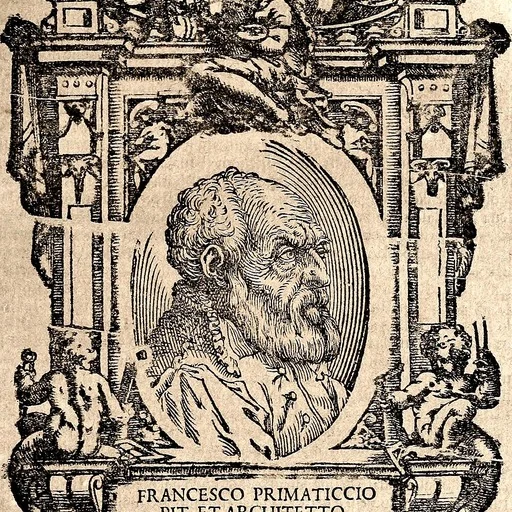
Key School of Fontainebleau artists in the collection include Niccolò dell'Abbate, Francesco Primaticcio and Antoine Caron.
When did School of Fontainebleau take place?
School of Fontainebleau dates from 1530–1610.
Where can I see School of Fontainebleau works?
School of Fontainebleau works in the collection are held by Metropolitan Museum of Art.