Stand in front of a wall hung with Camille Pissarro landscapes and you watch one painter answer the same question in four or five different handwritings. A Caribbean harbor scene with the dry clarity of a colonial draftsman hangs beside a soft grey Pontoise valley that could almost pass for Corot. A few feet on, a riverbank dissolves into broken touches of pure pigment laid down with a system, dot by dot, as if the artist had decided that feeling was not enough and the picture needed a theory. Then a wet Paris boulevard seen from a high window, all motion and weather. The question that critics kept putting to him, and that he never stopped putting to himself, was blunt: what kind of painter are you, exactly?
My argument is that Pissarro's refusal to settle on one answer was not indecision but his actual method, and that it is the reason he, more than Monet or Degas, became the connective tissue of an entire generation. He kept re-asking the question because each answer revealed what the previous one had hidden. He was the oldest of the Impressionists and the only one who showed at all eight of their group exhibitions, the steady hinge the movement swung on, yet he is also the painter who, at nearly sixty, walked away from the very style he had helped invent to try something stricter. A survey would call that a career in phases. I would call it a single sustained experiment, run by a man temperamentally incapable of believing he had finished learning to see.
The man who kept changing his mind
The biographical facts already read like a set of distinct answers. He was born in 1830 in Charlotte Amalie, on the island of Saint Thomas in what was then the Danish West Indies, the son of a Sephardic-Jewish merchant family, and he came to art by way of a shipping ledger he had no intention of keeping (Wikipedia). He reached Paris in 1855 and studied with Camille Corot, whose silvery, tonal landscapes taught him that a field could be built out of close-valued greys rather than bright local color (The J. Paul Getty Museum). He helped organize the first Impressionist show in 1874. He adopted the pointillism of the much younger Georges Seurat from the mid-1880s, held to it for roughly three hard years, then largely abandoned it. He died in 1903, his eyesight failing, painting cities from behind glass because the dust of the open road had become too much for his eyes.
John Rewald, who edited Pissarro's letters, called him the dean of the Impressionist painters, partly on grounds of age and partly on something harder to name, a gravity the others deferred to. The Tate puts the structural fact plainly: he is the only artist to have shown work at every one of the eight Paris Impressionist exhibitions between 1874 and 1886 (Tate). Monet skipped shows. Renoir drifted toward the official Salon. Pissarro stayed, and that staying is usually told as loyalty. I read it differently. He stayed because the exhibitions were his laboratory, the place where he could test one answer against the next in public and watch which held up.
First answer: the island
Before there was an Impressionist Pissarro there was a colonial one. Look at Two Women Chatting by the Sea, St. Thomas, painted in his twenties before he had fully committed to France. Two figures stand near the water with baskets, caught in the ordinary act the title names, talking. The drawing is firm and the light is hard, the light of a place where the sun does not negotiate. There is none of the later dissolve here. The women have weight, their headwraps and skirts are read as solid masses, and the ground beneath them is described rather than suggested. What is already present, and what he would carry for fifty years, is the subject: working people doing unremarkable things in a landscape that belongs to them. He did not start with the cathedral or the dancer. He started with two women and a basket by the sea, and he never really left them.
This is worth pausing on because it sets the terms for everything after. The National Gallery of Art describes him as a father of Impressionism who became a mentor to younger painters, and that paternal role grew directly out of his subject matter (National Gallery of Art). While others painted leisure, the regatta and the café and the box at the opera, Pissarro painted labor: harvests, market women, cabbage fields, the muddy commerce of a provincial town. His politics were anarchist and sincere, and you can see the conviction in the choice of who gets to fill the canvas.
Second answer: Pontoise and the grey
Settle next on Landscape at Les Pâtis, Pontoise. Pontoise, northwest of Paris, was Pissarro's territory in the 1860s and 1870s, the place where he worked out the second answer to the question. The Corot lesson is visible in the restraint of the palette, the way the greens are pulled toward grey and brown so that no single note shouts. But the handling has loosened. The paint sits up on the surface, the brush leaves its own record, and the structure of the land, the rise of a slope, the screen of trees, the patch of cultivated ground, is what organizes the picture rather than any anecdote. He is learning to make the touch itself carry the meaning.
Pontoise also matters because of who came to stand beside him there. The young Paul Cézanne worked next to Pissarro in these years and later said, in effect, that Pissarro had been a father to him. Paul Gauguin came under his wing too, learning to handle a brush from him before sailing off toward symbolism and the tropics. This is the mentor at work, and the mentorship was never a one-way transmission of doctrine. Pissarro taught structure and absorbed audacity in return. It is part of why his own answers kept shifting. He was always standing next to someone whose questions were not his.
That openness to the painter at the next easel is the bridge to his strangest turn. A man who had already revised himself twice, from the island draftsman to the Pontoise tonalist, had no instinct to defend his gains. So when a new method arrived through the studios in the mid-1880s, promising a firmer footing than the lucky weather of plein-air work, Pissarro did not dismiss it as the young men's fashion. He treated it the way he treated every prior answer, as a claim to be tested with his own hands rather than argued about in the café. The result was the most radical mid-career reversal any of the original Impressionists attempted.
Third answer: the dot
Then, in his mid-fifties, Pissarro did the thing that still startles. He met Seurat and Paul Signac, looked hard at their method of building a picture from small separate touches of unmixed color meant to fuse in the viewer's eye, and decided the Impressionism he had spent a decade perfecting was too loose, too dependent on the lucky accident of a good day's weather. He gave the years from roughly 1885 to 1888 to the slow, laborious technique that came to be called pointillism (Wikipedia). It was the critic Félix Fénéon who, at the eighth and final Impressionist exhibition in 1886, coined the term Neo-Impressionism to describe the work of Seurat, Signac, and both Camille and his son Lucien Pissarro (The Metropolitan Museum of Art). The dean of the Impressionists had quietly walked his own movement to its edge and stepped over it.
You can feel the strain of the experiment in the work of those years, and you can feel the relief when it ends. The pointillist system promised permanence and a kind of optical truth, but it cost him spontaneity, the thing he had loved most. He said as much in the long, candid correspondence with his son Lucien that Rewald later collected and published (Internet Archive). By 1890 he had loosened the discipline, keeping what the divided touch had taught him about the vibration of adjacent colors while letting the wrist move freely again. He had asked whether a more scientific painting was a better painting, run the test honestly, and returned a verdict against his own younger enthusiasm.
The garden and the fan: where the answers meet
Two smaller works show the experiment metabolized rather than abandoned. The Artist's Garden at Eragny comes from the country house at Eragny-sur-Epte where he spent his last two decades. The garden is rendered with a touch that remembers the dot without being enslaved by it, flecks of warm and cool laid close so the foliage shimmers, but loosened back into something a hand made in an afternoon rather than a laboratory built over weeks. The subject is humble, a patch of cultivated ground belonging to the painter himself, and the picture is the quiet reconciliation of his second and third answers. The structure of Pontoise and the broken color of the pointillists, holding hands at last.
The Fan Mount: The Cabbage Gatherers is the sleeper of the group and tells you something a wall of oils would not. Painted in gouache on the curved field of a folding fan, in a format borrowed from the Japanese prints the whole circle was studying, it shows field workers bent to the cabbages. The shape forces decisions. The horizon arcs, the figures distribute along the fan's sweep, and Pissarro turns the constraint into composition. Here is the anarchist's subject, agricultural labor, treated with the decorative refinement of a luxury object, and the contradiction is the point. He never let the politics curdle into ugliness or the beauty float free of work.
Works discussed in this article
Last answer: the city from a window
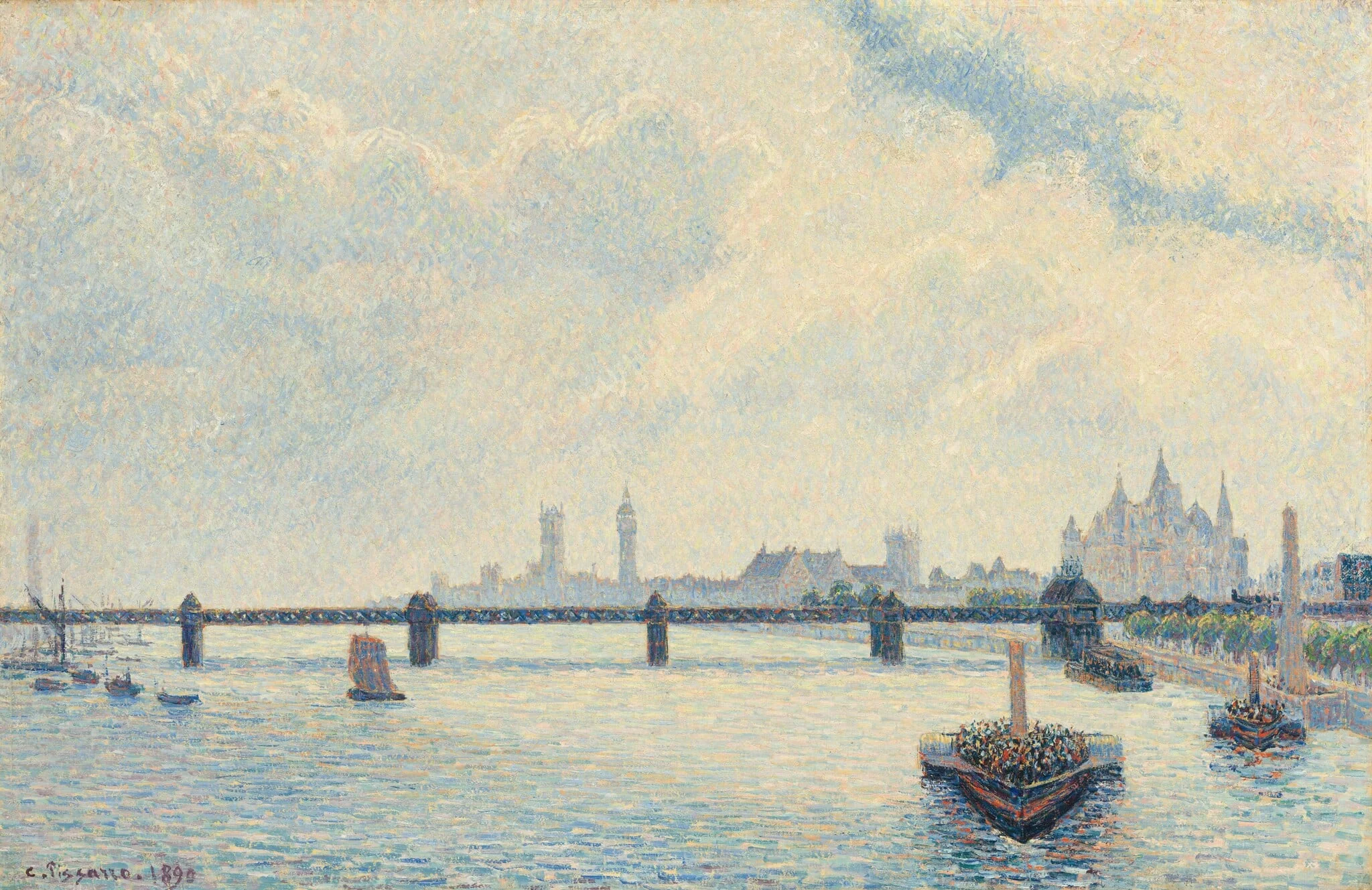
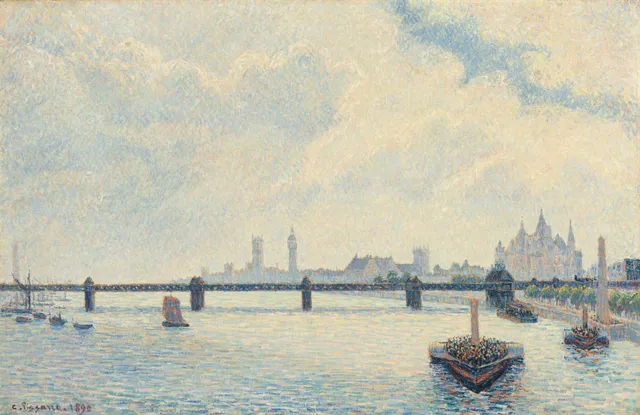
The final answer arrived when his body forced it. A chronic eye infection made working outdoors painful, so in the 1890s Pissarro took rooms above the great public spaces of Paris, Rouen, and London and painted what he could see through the glass. The result is the series work of his last decade, and it is some of the strongest painting of his life. Look closely at Charing Cross Bridge, London. The composition is built on a long horizontal, the railway bridge laid flat across the middle distance, cutting the Thames into a band of working water below and a high bank of weather-thick sky above. A train's smoke smudges sideways and merges with the river haze so you cannot say where the engine ends and the London air begins. The water is dragged in broken horizontal strokes that catch a dull gleam. Along the near embankment the traffic is summarized, a few vertical accents standing for figures and carriages, never described, only enough to register that the city is in motion. The whole picture is held together by atmosphere, the soft particulate light that he had spent forty years learning to set down.
Its companion in temperament is The Louvre, Afternoon, Rainy Weather, one of the Paris window-pictures. From his high vantage the wet pavement becomes a mirror, the carriages and umbrellas reduced to dark commas sliding across a silvered ground, the palace beyond softened by rain into a single grey mass. This is the man who began with two solidly drawn women on a hard-lit beach now painting a whole city as a single shifting weather event. He has come the entire distance from description to sensation, and yet the subject is still the same. People, going about their work, in a place. The answer changed completely. The question never did.
What the archive shows
Our own holdings make the breadth of these answers measurable. Artifact World Gallery keeps 269 works under Pissarro's name, spread across 44 separate collections, with dates running across the better part of a century down to his death in 1903. That venue spread is the telling number. A painter who belonged to a single style and a single city tends to pool in two or three museums. Pissarro scatters, because there is no one Pissarro to collect. The Caribbean draftsman, the Pontoise tonalist, the cabbage-field anarchist, the convert to the dot, and the old man at the rainy window each found different buyers and different homes, and the archive preserves the argument of his life as a distribution rather than a signature look.
The mentor in the middle
If the question is what kind of painter Pissarro was, the most useful answer may be the one that points away from his own canvases. He was the painter other painters trusted. Cézanne credited him directly. Paul Gauguin learned his craft at Pissarro's side before breaking toward something the older man found baffling. The generation that followed, the Nabis intimists like Édouard Vuillard and the symbolist dreamer Odilon Redon, inherited a Paris art world that Pissarro's exhibitions had pried open. Even painters from outside the French quarrel, the Swedish virtuoso Anders Zorn or the transatlantic society portraitist John Singer Sargent, worked in a market whose appetite for loose, light-filled, modern handling the Impressionist shows had built. Pissarro was the one who never stopped attending, and a movement needs that more than it needs a genius.
There is a temptation to rank his phases, to call the high Impressionist years the real Pissarro and the rest preface and epilogue. I think that misreads him. The pointillist detour was not a mistake he recovered from. It was the proof of his central trait, which was that he would rather risk a style he had mastered than coast on it. The late city series is not a sad coda forced by failing eyes. It is the most resolved work he made, the place where forty years of asking finally produced a picture that needed no further answer.
So: what kind of painter was Camille Pissarro? The honest reply is that he was the kind who treated the question as permanent. He answered it in colonial light and in Corot's greys, in the broken touch of Impressionism and the rigid dot of its successor, and finally in the soft grey weather of a city seen through a window he could no longer leave. The next time you pass a wall of his work and feel that you are looking at several painters, trust the feeling. You are. He built each of them on purpose, and he is still the only one who showed up for all eight rounds.
Sources & further reading
- Camille Pissarro — Tate
- Camille Pissarro — Wikipedia
- Neo-Impressionism — The Metropolitan Museum of Art, Heilbrunn Timeline of Art History
- Camille Pissarro, French, 1830-1903 — The J. Paul Getty Museum
- Camille Pissarro — National Gallery of Art
- Letters to His Son Lucien — Internet Archive
- Camille Pissarro — Smarthistory