Artwork
Two Women Chatting by the Sea, St. Thomas
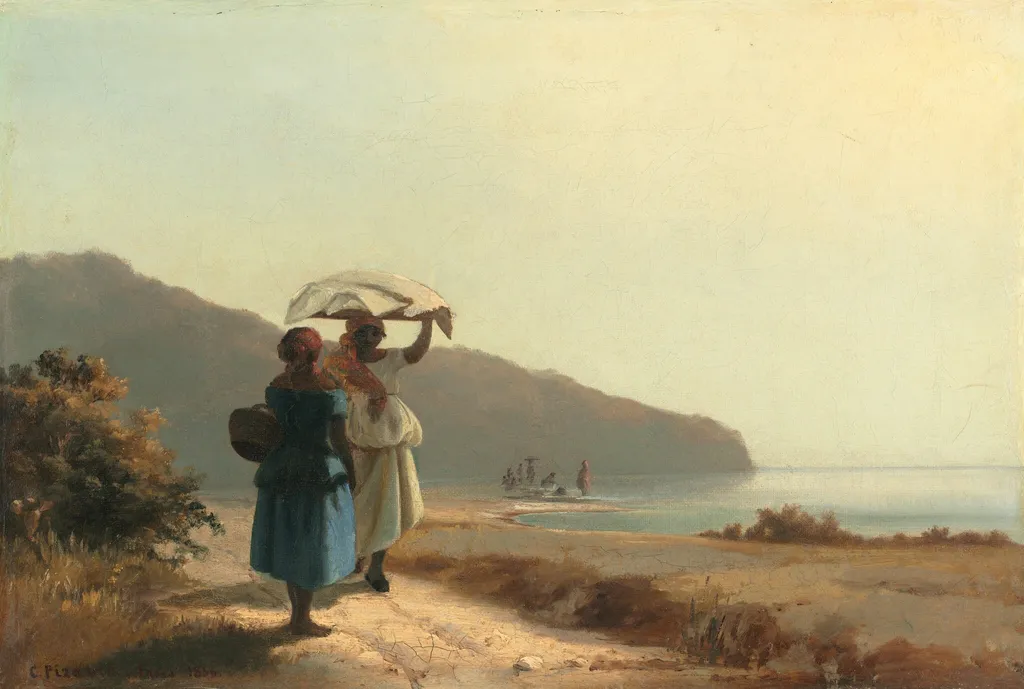
Two Women Chatting by the Sea, St. Thomas is an oil painting by the Impressionist artist Camille Pissarro. It dates from 1856 and is held in the collection of the National Gallery of Art.
- Inscription
- Inscribed:lower left: C.Pizarro . Paris 1856.
About this work
Above the shore of Charlotte Amalie, two Afro-Caribbean women pause to talk, one balancing a basket on her head.
Above the shore of Charlotte Amalie, two Afro-Caribbean women pause to talk, one balancing a basket on her head. Camille Pissarro painted his native St. Thomas in 1856, a year after leaving the Danish West Indies for Paris, working from memory and earlier sketches. The small canvas blends tropical light with the plein-air manner he took from the Barbizon School, an early sign of the attention to ordinary labor and atmosphere that ran through his career.
Subject & Meaning
The painting depicts two Afro-Caribbean women conversing on a beach path along the coast of Saint Thomas, the artist's native island. One woman faces the viewer, balancing a large basket, likely containing laundry, on her head for shade, wearing a white gathered dress and colorful headscarf. Her companion, seen from behind, wears a vibrant blue dress and brownish-red head covering, also carrying a basket.
The figures embody tranquility and everyday labor, with their relaxed exchange suggesting harmony and quiet dignity. Painted in Paris from memory or sketches, the work carries "Latin American flair" that connects to Caribbean artistic traditions. The sparse landscape, calm sea reflecting sunlight, distant figures perhaps fishing or washing clothes, and minimal vegetation, keeps focus on the women as central subjects.
Scholar Wolf Eiermann notes this early work already demonstrates Pissarro's characteristic approach to figures with serenity, joy, and inner harmony, while working women remained a lifelong motif in his oeuvre.
Technique & Style
Two Women Chatting by the Sea, St. Thomas is an oil on canvas measuring 27.7 by 41 cm in a horizontal format. Pissarro signed the work at the lower left as "C.Pizarro. Paris 1856," using a spelling of his name he retained until 1859.
The composition places two figures on a beach path that recedes diagonally from the lower center toward a hillside in the background, with the hill's edge cutting across the picture plane. The sea is rendered as a calm, smooth surface reflecting sunlight, while vegetation and landscape are suggested sparingly with broad, simplified planes. Both figures cast shadows toward the front left, anchoring them within a sunlit, otherwise nearly empty coastal setting.
The clear focus on the two women conveys a sense of stillness and harmony that anticipates characteristics of Pissarro's later work.
History & Provenance
Camille Pissarro painted this work in Paris in 1856, early in his career after moving from his native Saint Thomas. It was likely created in the studio of Anton Melbye on the Rue Notre-Dame de Lorette, which Pissarro shared. The painting was in the collection of Danish painter and paint manufacturer Gunnar A. Sadolin (1874–1955) by 1939, as recorded in Pissarro's catalogue raisonné.
In December 1965, it was sold at Sotheby's, London (lot 146), then handled by P. & D. Colnaghi & Co. before being acquired by American collector Paul Mellon of Upperville, Virginia, the same year. Mellon donated the painting to the National Gallery of Art, Washington, D.C., in 1985, where it remains.
Two Women Chatting by the Sea, St. Thomas has been held by the National Gallery of Art in Washington, D.C., since 1985, when Paul Mellon and his wife donated it as part of their collection. Prior to that, the painting had entered the Mellons' holdings in 1965, acquired through P. & D. Colnaghi & Co. from a Sotheby's sale in London on 1 December 1965 (lot 146). Earlier provenance traces to the Danish painter and paint manufacturer Gunnar A. Sadolin (1874–1955) of Dragør, Denmark, who owned the work by 1939, when it was catalogued in the Sadolin collection in Pissarro/Venturi 1939 (no. 5).
The painting has been featured in several exhibitions, including The European Vision of America at the National Gallery of Art, Cleveland Museum of Art, and Galeries nationales du Grand Palais (1976–1977); the Virginia Museum of Fine Arts in 1979; Camille Pissarro: Impressionist Innovator at the Israel Museum and the Jewish Museum (1995); the Staatsgalerie Stuttgart in 2000; and Pissarro's People at the Clark Art Institute and the Legion of Honor (2011–2012).
Context
Painted in Paris in 1856, this early canvas belongs to a group of nine signed "tropical" works Pissarro produced from memory or sketches of his native Saint Thomas after settling in France. Scholars note the paradox that Pissarro continued depicting Caribbean subjects while simultaneously turning to French landscapes. Wolf Eiermann observes that the water reflections in this series show the influence of the Melbye brothers' seascapes, yet already reveal Pissarro's characteristic treatment of figures with "rest, joy of life and inner harmony."
Christopher Lloyd emphasized the Melbyes' role in introducing Pissarro to European artistic currents, while noting parallels between this composition and works by Oswald Achenbach. Eiermann also identifies a "Latin American flair" that places the chatting women within a tradition of Antillean painters like Agostino Brunias. The motif of working women remained central throughout Pissarro's career.
Legacy
Pissarro's early Caribbean subjects, including Two Women Chatting by the Sea, St. Thomas, have been retrospectively positioned as foundational to his later oeuvre. Wolf Eiermann of the Stuttgart Staatsgalerie, writing around the 1999 German retrospective, identified in the 1856 tropical series the calm, joyful, and harmonious treatment of figures that would characterize Pissarro's mature work, while also noting that working women remained a central motif in paintings produced decades later. Christopher Lloyd emphasized in 1981 that the Melbye brothers' influence on the young Pissarro, visible in this canvas, equipped him with a full command of European pictorial currents by the time he arrived in Paris.
Joachim Pissarro described the artist's continued use of Saint Thomas imagery in Paris as paradoxical, and Eiermann situated the scene within a tradition of Antillean painters such as Agostino Brunias. The painting has subsequently traveled through major Pissarro surveys, including the 1995 Impressionist Innovator exhibition, the 2000 Stuttgart retrospective, and the 2011–2012 Pissarro's People show, cementing its place in the scholarly assessment of the artist's formative years.
Overview
Camille Pissarro's "Two Women Chatting by the Sea, St. Thomas," painted in 1856, is an oil on canvas depicting a quiet moment on his native Caribbean island. Created in Paris shortly after his relocation, the small-scale work draws on his memories and sketches of St. Thomas. It captures the unique effects of tropical light and foreshadows his later engagement with everyday life and atmospheric color, blending local Caribbean elements with the emerging Barbizon aesthetic.
Own this work as a print
Artist & collection


- Coast scene with a vessel aground
 Italianate River Landscape
 Italiaans rivierlandschap
 Seaside
 Aften ved Middelhavet. I baggrunden Marseille og øen If
 Praia com índios e veleiro (atribuído)
 Ships Off the Coast of Zealand. Morning
 Ships Off the Coast of Zealand. Morning
 Lake Scene
 The Lagunes of Venice
 Fishing port at dawn (Morning)
 Fishermen and their Families on the Shore of the Bay of Naples