Artwork
Fan Mount: The Cabbage Gatherers
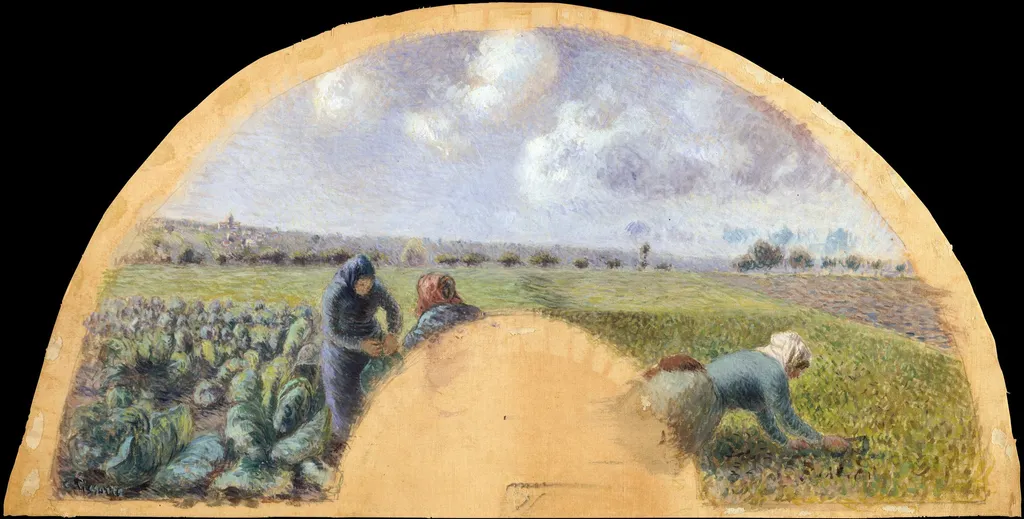
Fan Mount: The Cabbage Gatherers is an unspecified painting by the Impressionist artist Camille Pissarro. It dates from 1890 and is held in the collection of the Metropolitan Museum of Art.
About this work
Peasant women in bright kerchiefs bend over rows of cabbages in the fields near Pontoise, painted in gouache on silk at Edgar Degas's urging.
Peasant women in bright kerchiefs bend over rows of cabbages in the fields near Pontoise, painted in gouache on silk at Edgar Degas's urging. Camille Pissarro made this fan mount around 1878–79, choosing rural labor where his friend favored urban entertainers. Louisine Elder, later Mrs. H. O. Havemeyer, bought it through Mary Cassatt, one of Pissarro's first sales to an American. The Metropolitan Museum of Art acquired it in 1994.
Overview
Camille Pissarro's "The Cabbage Gatherers" is a fan mount painted around 1878–79, depicting rural life near Pontoise. Executed in gouache on silk, its curved, elongated format was designed for a handheld fan. This work represents Pissarro's engagement with a decorative art form, influenced by Edgar Degas, and was notably among the first of his pieces to enter an American collection. It is now part of the Metropolitan Museum of Art's holdings.
Subject & Meaning
In "The Cabbage Gatherers," Pissarro portrays peasant women engaged in agricultural labor in the fields surrounding Pontoise. Dressed in vibrant kerchiefs, they are shown bending over rows of cabbages, reflecting the artist's consistent interest in rural life and the dignity of manual work. This choice of subject diverged from the urban entertainment scenes favored by his contemporary, Edgar Degas, for similar fan projects.
Technique & Style
Rendered in gouache on silk, this fan mount showcases Pissarro's adaptation of his Impressionist sensibilities to a decorative format. The opaque watercolors allowed for a bright, direct depiction of the scene, while the silk provided a delicate surface. Its distinctive six-and-a-half-by-twenty-and-a-half-inch dimensions conform to the traditional shape of a folding fan, integrating art with functional design.
History & Provenance
The Cabbage Gatherers holds significance as an early acquisition by an American collector. Louisine Elder, who later became a prominent patron of Impressionism as Mrs. H. O. Havemeyer, purchased the piece in the late 1870s, reportedly facilitated by artist Mary Cassatt. This acquisition marked the genesis of what would become a substantial collection of Impressionist art.
After remaining in private hands for over a century, the Metropolitan Museum of Art acquired the fan mount in 1994 through the Leonora Brenauer Bequest.
Context
The creation of fan mounts like "The Cabbage Gatherers" was spurred by Edgar Degas in the late 1870s, who envisioned an entire room dedicated to such works at the 1879 Impressionist exhibition. While Degas often depicted scenes of Parisian leisure, Pissarro consistently gravitated towards the everyday realities of the French countryside, using the fan format to explore his preferred themes of rural labor and landscape.
Artist & collection