Artwork
The Louvre, Afternoon, Rainy Weather
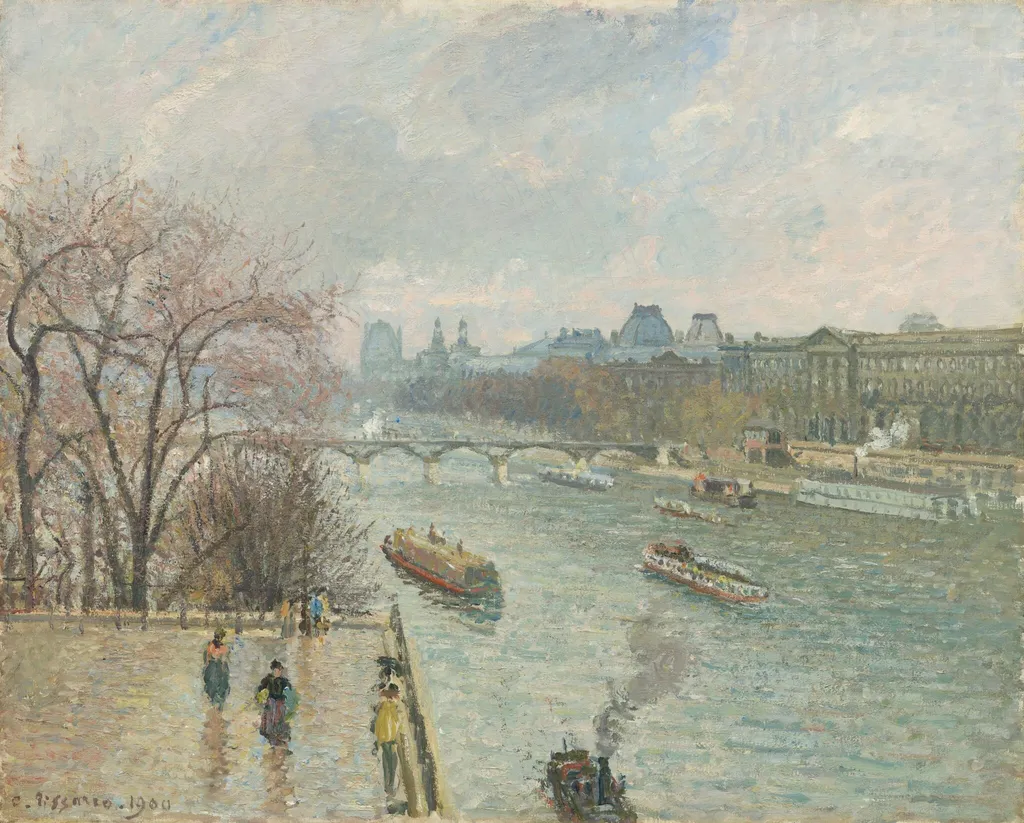
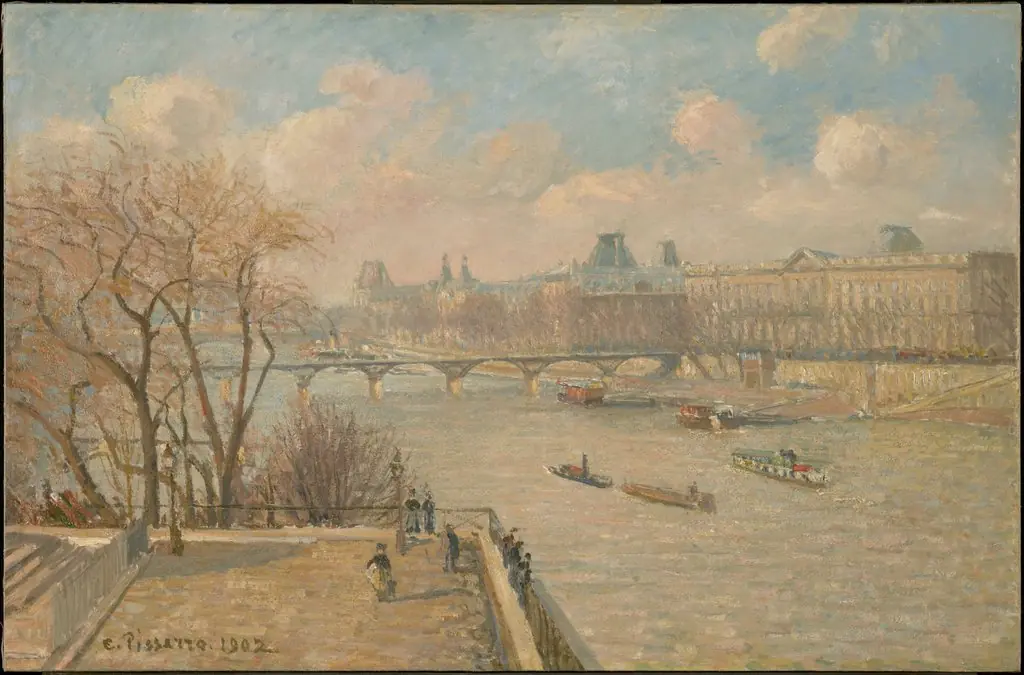
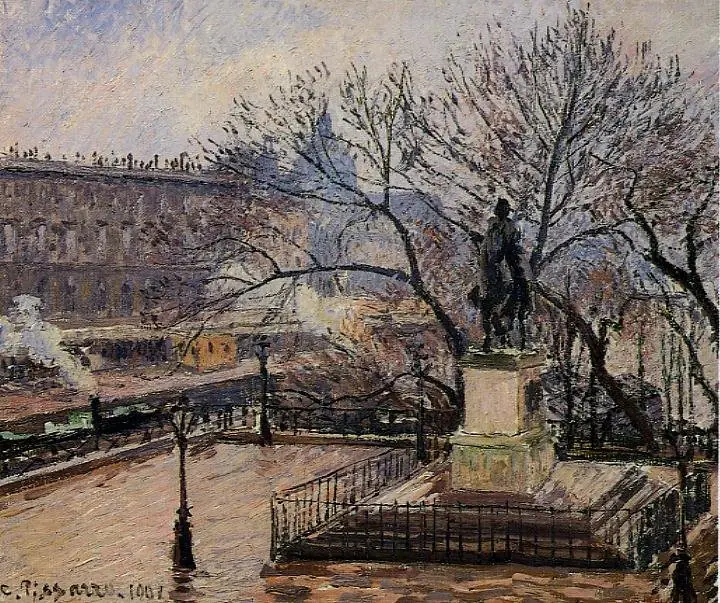
The Louvre, Afternoon, Rainy Weather is an oil painting by the Impressionist artist Camille Pissarro. It dates from 1900 and is held in the collection of the National Gallery of Art.
- Inscription
- Inscribed:lower left: C. Pissarro. 1900
About this work
Raindrops still glisten on the Place du Pont-Neuf as Camille Pissarro paints the Louvre's riverfront across the Seine in 1900, the view from his new apartment on the Île de la Cité. Boats steam toward the bridge while gray water reflects a passing storm. Sold through Durand-Ruel, the canvas later crossed the Atlantic and entered the National Gallery of Art in 2014 with the Corcoran Collection.
History & Provenance
Its first recorded transaction occurred on 17 May 1901, when it was purchased directly from Camille Pissarro by the Paris–New York dealers Durand-Ruel.
The painting was executed in 1900. Its first recorded transaction occurred on 17 May 1901, when it was purchased directly from Camille Pissarro by the Paris–New York dealers Durand-Ruel. Later that year, on 8 October 1901, Julius Oehme of New York bought it from Durand-Ruel.
By 1905 the work belonged to Edward C. Walker (d. 1915) and his wife Mary Griffin Walker (1855–1937) of Willistead Manor, Ontario, and Washington, D.C.. Upon Mary Walker's death on 4 May 1937, the painting was bequeathed to the Corcoran Gallery of Art in Washington. In 2014 the Corcoran's collection, including this painting, was acquired by the National Gallery of Art, where it now resides. No commission is documented; the work was sold after its creation.
The painting is held in the collection of the National Gallery of Art in Washington, D.C., where it entered in 2014 after being acquired from the Corcoran Gallery of Art. Previously, it was bequeathed to the Corcoran in 1937 by Mary Griffin Walker, the widow of Edward C. Walker, who had owned the work since at least 1905. The painting was exhibited that year at the Detroit Museum of Art as part of a loan from the private collection of E. Chandler Walker.
Its accession number at the National Gallery of Art is not specified in the available sources, but the provenance documents a clear chain from the artist through the dealers Durand-Ruel and Julius Oehme before entering the Walker collection.
Overview
Pissarro painted The Louvre, Afternoon, Rainy Weather in 1900, capturing a Parisian cityscape from his apartment on the Île de la Cité. The oil on canvas depicts the Louvre's riverfront facade across the Seine, with the Place du Pont-Neuf and the statue of Henri IV in the foreground. The scene is set just after a rainstorm, evidenced by the glistening wet pavement and agitated river surface.
This work belongs to a significant series where the artist explored the same urban vista under diverse atmospheric conditions.
Subject & Meaning
The painting presents a view from Pissarro's residence, looking across the Seine toward the historic Louvre. In the immediate foreground, a section of the Place du Pont-Neuf is visible, featuring the equestrian monument to Henri IV. The recent passage of a rainstorm is central to the atmosphere, rendering the street surfaces reflective and the river's waters turbulent.
The composition employs subtle diagonal lines, guiding the eye from the foreground square towards the distant museum and incorporating the movement of boats on the river.
Technique & Style
Pissarro's late Impressionist approach is evident in the painting's surface. The artist rendered the wet pavement with numerous small strokes, combining coral, yellow, lavender, pink, white, and brick red to create a shimmering orange effect. The Seine is depicted in a range of grays, from nearly white to dark slate, punctuated by delicate streaks of deep blue and pale orange. This meticulous application of color and broken brushwork conveys the transient effects of light and weather.
Context
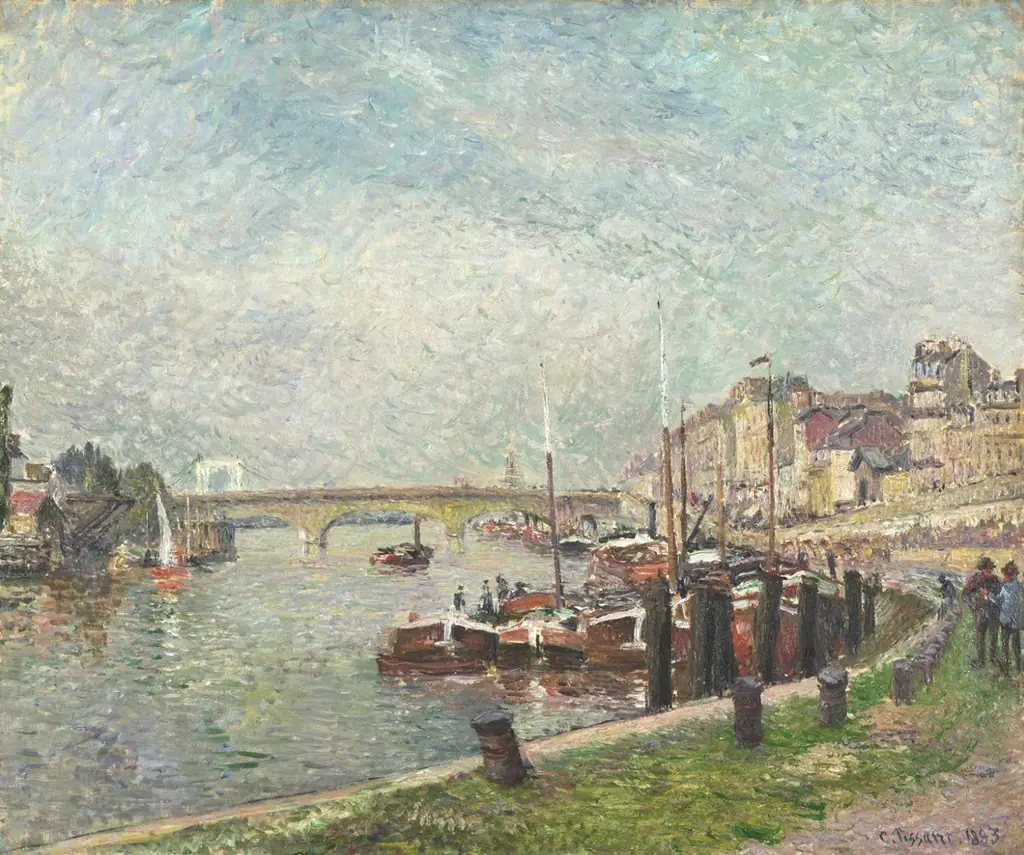
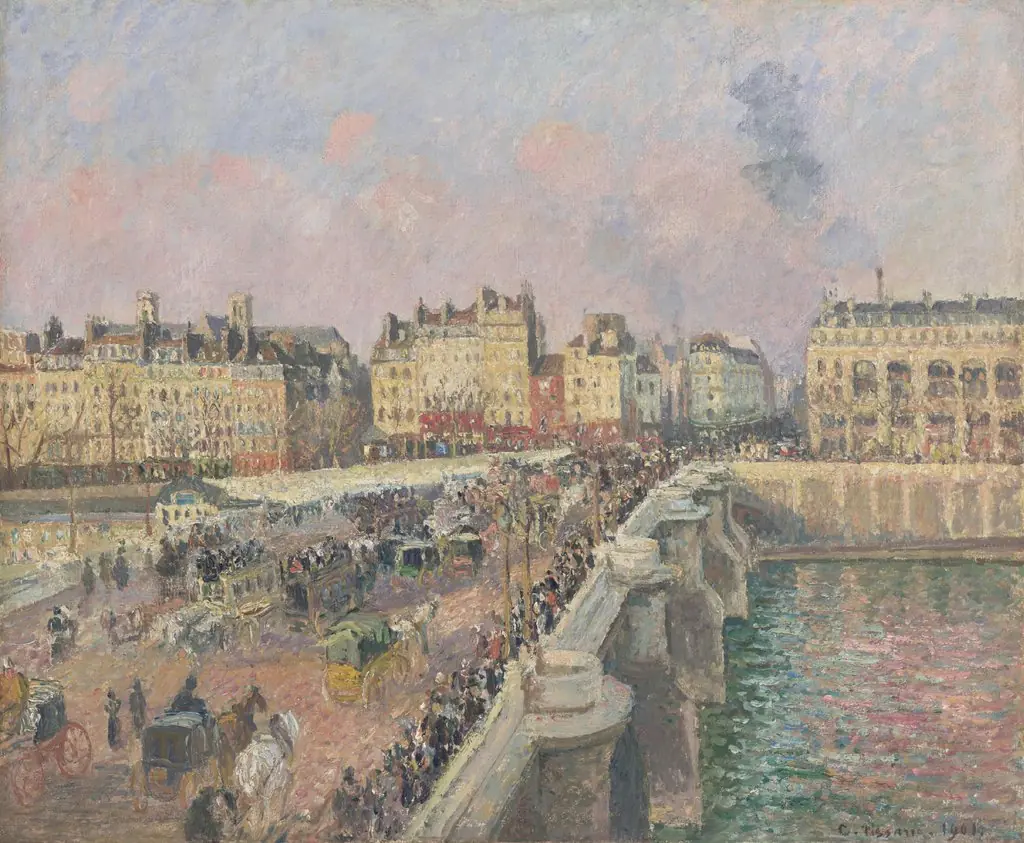
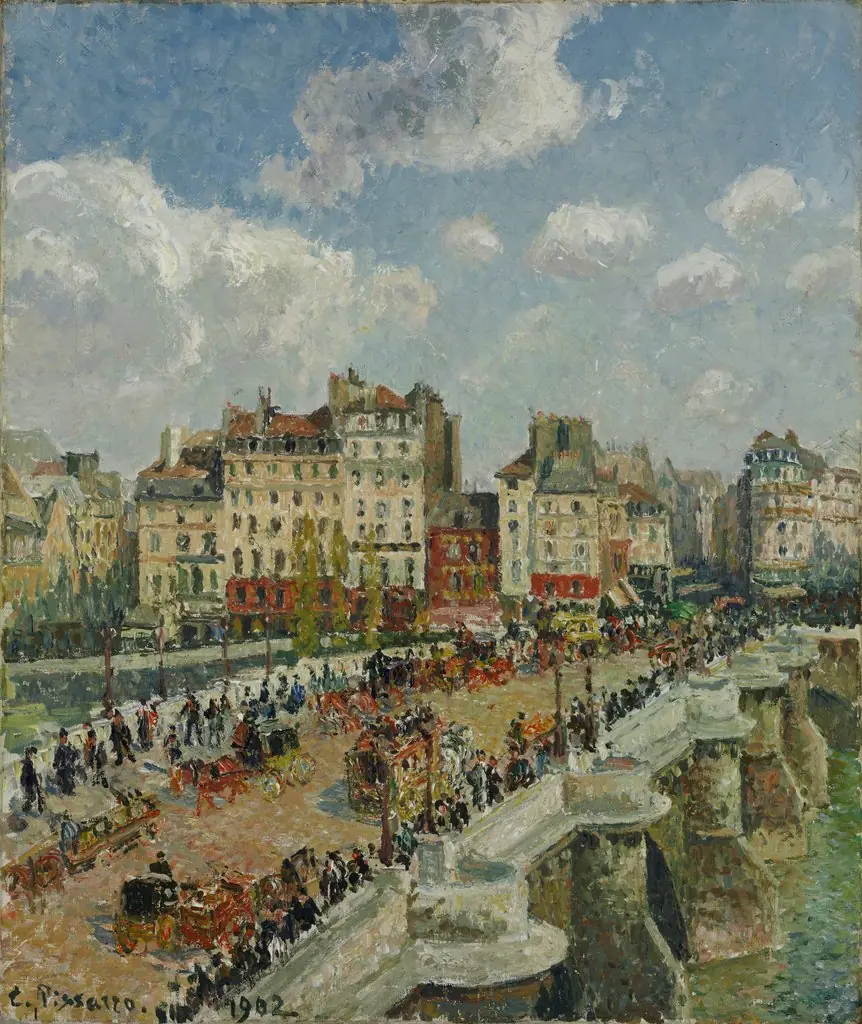
This painting is part of a notable series Pissarro undertook during his final years, focusing on the urban landscape of Paris. From his apartment on the Île de la Cité, he repeatedly observed and documented the same view of the Seine and the Louvre. By revisiting this specific vista under varying weather conditions, times of day, and levels of river traffic, Pissarro systematically explored the shifting light and atmosphere of the modern city, a characteristic theme of his late career.
Own this work as a print
Artist & collection