The corpus files Édouard Manet and his modern eye under the heading "father of modern art," and the heading does him a quiet disservice. It pictures a man who walked out of the museum and slammed the door behind him. Manet did the opposite. He kept his key, went back in after hours, and rearranged the furniture so that Titian and Velázquez suddenly looked like they were describing 1863. His whole career is a running quarrel with the painters already hanging on the wall, conducted in their own language and aimed at their own audience, the official Paris Salon. He did not want a new building. He wanted the old one to admit what it was actually showing.
Here is the argument this essay defends, and it is narrow on purpose. The movement that hardened first into Impressionism and then into modern art did not begin by rejecting tradition. It began with Manet turning to face tradition directly, borrowing its compositions pose for pose, and then removing the two things that had kept those compositions respectable: the deep illusionistic space that let a viewer step politely into the scene, and the mythological or religious pretext that excused whatever the scene contained. Take those away and a reclining goddess becomes a naked woman looking back at you across a dealer's price. That, far more than any sunlit haystack, is where the new painting starts. The Metropolitan Museum's essay on the artist is willing to call him the father of modernism for precisely this reason, and the title is earned not by invention but by a kind of disciplined insubordination toward everything he had been taught to admire.
The well-mannered rebel
Manet was born in Paris in January 1832, the son of a senior official in the Ministry of Justice, according to the standard biographical record, which already tells you he was no garret bohemian. He trained for roughly six years under Thomas Couture, a Salon success of the previous generation, and he wanted Salon success of his own. That fact is worth holding onto through everything that follows: the man who outraged official taste spent his entire life submitting work to it and smarting when it was refused. In 1861, at twenty-nine, he won the Salon's honorable mention for The Spanish Singer, a guitar player rendered with a frankness that the older judges could still file under skill rather than provocation. Within two years the same hand, doing more of the same thing, was being treated as an assault on decency. Nothing in his method had collapsed. The audience had simply caught up to what the method implied.
The hinge year was 1863. The Salon jury rejected so many canvases that the Emperor authorized a parallel exhibition, the Salon des Refusés, and there Manet hung Le Déjeuner sur l'herbe. The scandal was not the nudity; the Salon walls groaned with nudes every season. The scandal was that this nude was a recognizably contemporary woman, seated at a real picnic beside two clothed men in modern Parisian dress, regarding the viewer with no shame and no allegorical cover story. And the grouping was lifted, almost like a diagram, from a Renaissance authority. Smarthistory traces the three central figures to a Marcantonio Raimondi engraving after Raphael's Judgment of Paris, with a further debt to a Louvre canvas then attributed to Titian. Manet was not improvising a fresh outrage. He was quoting scripture and changing a single word, and the word he changed was "then" to "now."
The following year he pressed harder. Olympia, painted in 1863 and shown at the Salon in 1865, took the posture of Titian's Venus of Urbino and replaced the compliant goddess with a Parisian courtesan who meets the eye the way a creditor does. The reaction turned physical. The record holds that the hostility ran so high that only the precautions of the Salon administration kept the canvas from being punctured and torn, a detail preserved in the standard account of the affair. A crowd does not lunge at a painting it finds merely clumsy. It attacks a painting that has insulted something it believed it owned.
A Spanish education taken off the wall
Manet's quarrel had a strong accent, and the accent was Spanish. Long before he ever traveled to Madrid he had studied Velázquez and Goya in the Louvre and in reproductive prints, and the early 1860s produced a sustained run of Spanish-subject pictures that are, underneath the costumes, arguments about how a single figure ought to sit on a canvas. He was not collecting picturesque detail. He was after a way of building a body that the Spaniards had perfected and the French academy had let atrophy, the figure isolated against a near-empty ground, weighed and placed rather than embedded in a story. Our holdings are dense with them. The Matador Saluting, Mademoiselle V. . . in the Costume of an Espada, and the Young man in Mayo costume all use the dress of the bullfight as a pretext for the thing Manet genuinely cared about: a solid figure planted against a shallow, nearly shadowless ground, built up in broad zones of tone rather than the slow sculptural modeling Couture had drilled into him. The bullfighter's black-and-rose costume is, conveniently, the same problem he had inherited from the Spaniards, a body that has to register as weight and as flat pattern at the same instant. In the Espada the woman holds a muleta and a sword in a stance no real bullfighter would risk, and Manet plainly does not care; the pose is borrowed, the costume is theatrical, and the only sincerity in the picture is the paint.
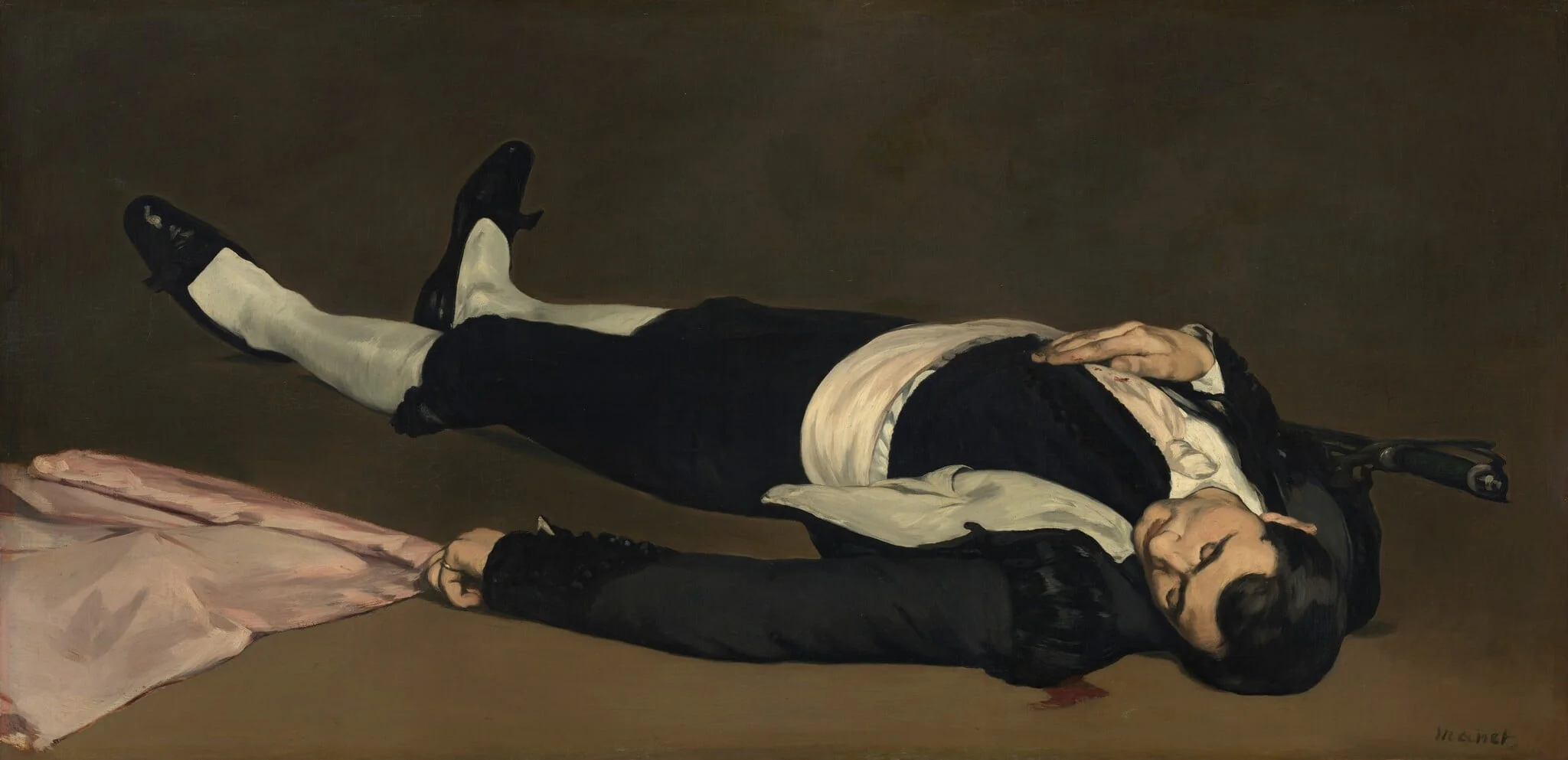
Look at The Dead Toreador. A single man lies on his back on a bare floor, his feet turned toward us, the whole body laid out parallel to the bottom edge so that we read it first as a flat dark shape and only afterward as a corpse. He wears a short jacket and black slippers, and the white shirt-front catches the only strong light in the picture, a long diagonal of linen that drags the eye from the slack hand up to the tilted head. The black of the jacket is not modeled into folds so much as poured, a single dense field that the white collar cuts against like a blade. Around him there is almost nothing, a bare grey-brown floor, and off to one side the pale glint of a dropped sword. Manet has cut the bullring away completely. There is no bull, no crowd, no arena, no anecdote about how the man came to die. The floor tilts up toward us steeply enough that the figure seems pressed flat against the surface of the canvas rather than settled into a room you could walk through. He took a subject that begged for melodrama and declined to provide any of it. What is left is the plain fact of a dead body and the austere beauty of black against white, which is exactly the Spanish lesson he was after, Velázquez and the old painters of dead Christs and dead saints, drained of the church and handed over as pure paint.
The flat picture, and why it offended
It helps to be concrete about what people were reacting to, because "flatness" can sound like jargon. Couture and the academy taught a picture as a window. Light enters from a believable source, falls across forms in graded half-tones, and the eye is led back through staged planes into a deep, breathable space. Manet kept refusing the middle of that recipe. He lit his figures almost from the front, so the modeling that should round a cheek or a forearm into the page collapses, and what would have been a soft transition becomes a sharp border between a lit area and a shadowed one. Edges snap. Backgrounds go neutral and close. The paint declares itself as paint, laid on in confident slabs rather than blended into invisibility. A figure that an academic would have coaxed into rounded relief instead reads as a cutout, brilliantly lit and abruptly bounded. To a Salon eye this looked like incompetence or insult, a refusal of the very craft that distinguished an artist from a sign-painter. To the younger men watching, it read as permission. The picture had stopped pretending to be a hole in the wall and started admitting it was a marked surface, and once a generation accepts that, every later experiment becomes thinkable.
Religion stripped of its incense
In 1864 Manet sent a religious painting to the Salon, and it unsettled people for the same structural reason the Spanish pictures had. The Dead Christ with Angels shows the body of Christ propped half-upright, held by two angels, the side wound visible, the flesh heavy and grey. The staging is devout. The handling is not. Manet paints the dead god as a dead man, the weight pulling down through the slumped shoulders, the soles of the feet grubby, the light raking across a torso that carries the same matter-of-fact density as the toreador's shirt. He keeps the iconography that centuries of altarpieces had made automatic and he lets the incense evaporate out of it. The argument is the one he keeps making in different rooms. The old picture stays on the wall; the old consolation quietly leaves. A viewer who came for transcendence was instead shown a body, and the offense lay in how plainly the body was painted.
The quarrel turns to modern life
The Spanish enthusiasm did not last, and by the middle of the decade Manet was aiming the same method at the rooms and streets of his own city. Young Lady in 1866 is the hinge between the two halves of his career. A woman stands nearly full-length in a loose pink dressing gown, a small parrot perched beside her, a posy of violets in her fingers, a half-peeled orange at her feet. The objects sit there as facts, not as a code to be decrypted, even though every one of them would once have carried a moral about the five senses. The title pins her to a year rather than to a myth. There is no story, no allegory of the senses dressed up to license the picture. There is a contemporary woman, painted close to life-size, returning the viewer's gaze with the same level steadiness Olympia had used a year earlier. The flatness is intact, the broad fields of tone, the refusal of deep recession. Only the subject has migrated. The museum has been left behind and the boulevard has walked in, and the woman is allowed to be exactly herself rather than a stand-in for Spring or Vanity or Sense.
Works discussed in this article
This was the moment the younger painters were watching closely. Manet became the reluctant center of a circle that drew in Auguste Renoir along with the open-air landscapists Eugène Boudin and Johan Barthold Jongkind, men who would carry his frankness outdoors and let it dissolve into weather and light. He took as much as he gave. The caricaturist Honoré Daumier had already proven that modern life could be the whole subject of a serious picture, while the fashionable Alfred Stevens and the grave muralist Pierre Puvis de Chavannes marked the two poles, polished salon commerce on one side and timeless classicism on the other, between which Manet pointedly refused to settle.
When that younger group mounted its first independent exhibition in Paris in 1874, hostile critics seized on Monet's Impression, Sunrise and turned the title into a jeer, and the name Impressionism stuck to the whole enterprise. Manet never once exhibited with them. He went on submitting to the official Salon to the end, still arguing inside the institution rather than founding a rival church. That stubbornness is the most revealing thing about him. The men who looked most like his heirs walked away from the establishment, and he stayed to keep fighting it on its own ground, painting the bars and gardens of modern Paris until his death in the spring of 1883, his stature as a founder of modern art arriving only after he was in the ground.
What the argument left on the wall
Our own shelves register the scale of the output and its restlessness. Artifact World Gallery keeps 230 works under Manet's name, gathered from 37 separate venues and spanning roughly 1847 to 1882, which is to say from his earliest student copies to the year before he died. Set that spread against the popular memory of the man and a useful tension opens up. A painter remembered for three or four notorious scandals in fact worked steadily for some thirty-five years, in oil and pastel and print, for an official body that mostly turned him away. The venue count matters as much as the work count. The supposed enemy of the establishment is now distributed across thirty-seven of its museums, his canvases hung with the same reverence once reserved for the very Old Masters he had been accused of mocking. The institution lost the argument and then absorbed the man who won it. There is no neater proof that the quarrel was always a family quarrel.
Émile Zola understood the stakes earlier than the salon critics did, publishing a long and combative defense of the painter that he later gathered into his volume Mes haines. Zola grasped that Manet was holding painting to a stricter standard of honesty rather than tearing painting down, and that the apparent rudeness of the brushwork was a moral position as much as a technical one. The argument Manet started did not end with him. Every painter who came afterward had to decide what to do with the museum now that one man had demonstrated you could love it and disobey it in the same stroke of the brush. Walk forward through the next sixty years of European painting, from the dissolving light of the Impressionists to the broken planes that followed, and you are walking through the long consequences of that single decision.
Sources & further reading
- Édouard Manet (1832-1883) — The Metropolitan Museum of Art
- Manet, Le Déjeuner sur l'herbe (Luncheon on the Grass) — Smarthistory
- Édouard Manet — Wikipedia
- Impressionism (art term) — Tate
- Édouard Manet — National Gallery of Art
- Mes haines: Édouard Manet, étude biographique et critique — Internet Archive (Émile Zola)