Artwork
The Dead Christ with Angels
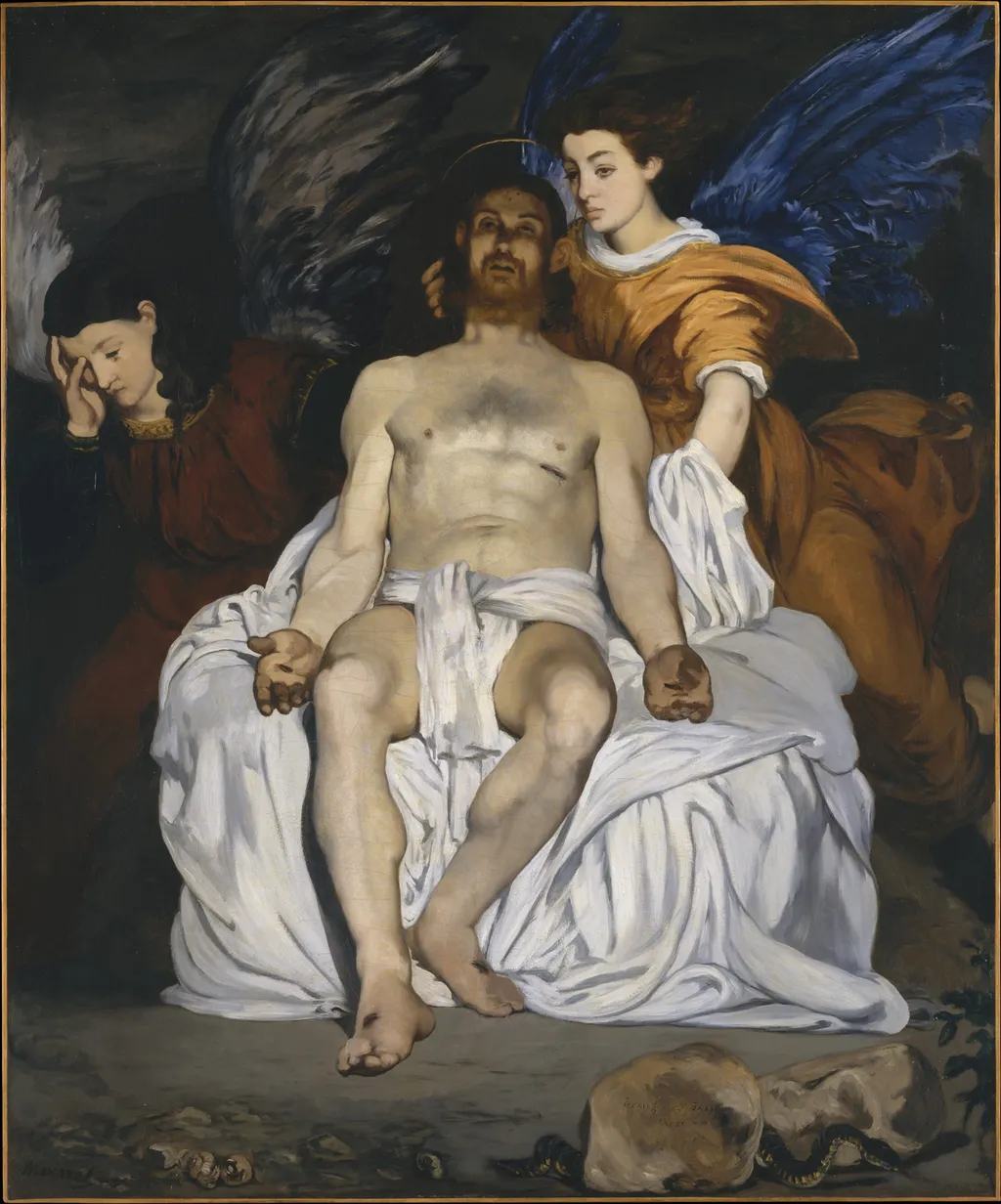
The Dead Christ with Angels is an oil painting by the Academic Art artist Édouard Manet. It dates from 1864 and is held in the collection of the Metropolitan Museum of Art.
About this work
In 1864, Édouard Manet sent the Paris Salon a religious subject he had rarely attempted: a dead Christ between two angels in blazing red and orange robes. A stone cites the Gospel of John, yet Manet kept Christ in the tomb the Bible says was empty and placed the spear wound on the wrong side, drawing critics' attacks on its cadaverous realism. The Met acquired it in 1929.
Subject & Meaning
The angels wear bright red and orange instead of white, heightening drama, and the spear wound is incorrectly placed on the left side, an acknowledged error.
The painting depicts the Lamentation of Christ (John 20:12), but Manet subverts the biblical narrative by showing Christ's dead body present and supported by an angel rather than missing from the tomb. The angels wear bright red and orange instead of white, heightening drama, and the spear wound is incorrectly placed on the left side, an acknowledged error. A stone inscription cites John 20:12.
Likely influenced by Ernest Renan's Vie de Jésus (1863), which denied the Resurrection, Manet emphasizes Christ's mortality: the angels grieve rather than announce triumph. The realistic, unidealized corpse was seen as provocative and even blasphemous, shifting the meaning from sacred sacrifice to a human death, thus questioning traditional iconography by focusing on mourning over resurrection.
Technique & Style
Executed in oil on canvas (179.4 × 149.9 cm), the painting exhibits Manet's characteristic spontaneity. Drapes are rendered with thick, loose touches, while modeling is achieved by dragging black lines through wet colour, producing a sense of simplicity. Elsewhere, broad brushstrokes contrast with more precise areas, and blurring in Christ's hands and feet suggests movement.
The composition is built on deliberate discordances: the angels' bright red-orange wings clash with the neutral background, their placing is asymmetrical, and the cloth alternates between realistic folds and abstract handling. Manet's unorthodox choice of showing the lance wound on the left side of Christ's body further disturbed critics, who also attacked the realistic, grey-pink flesh tones as dirty or corpse-like. Despite these innovations, the handling remains rooted in traditions of Spanish and Italian old masters, particularly in the monumentality of the dead Christ.
History & Provenance
Édouard Manet painted The Dead Christ with Angels in oil on canvas in 1864, intending it for that year's Paris Salon. The work was among Manet's few religious subjects, possibly chosen to counter negative reactions to his earlier modern-themed paintings. After submitting the painting, Manet realized the spear wound was on the wrong side; Charles Baudelaire advised correction, but the artist lacked time to amend it.
The painting entered the art market in January 1872, when Manet sold it to dealer Durand-Ruel for 3,000 francs. It subsequently passed through private collections before returning to Durand-Ruel in 1877 (for 7,000 francs) and again in June 1881. On 7 February 1903, Durand-Ruel sold it to Henry Osborne Havemeyer and his wife Louisine Waldron Elder for $17,000. Louisine bequeathed the painting to the Metropolitan Museum of Art in 1929, where it remains.
The Dead Christ with Angels is held at the Metropolitan Museum of Art in New York, where it entered the collection in 1929 as a bequest from Louisine Havemeyer. The painting was first exhibited at the Salon of 1864 in Paris. Its provenance traces through several private collections: Manet sold the work to the dealer Durand-Ruel in 1872 for 3,000 francs; after subsequent sales, it was acquired by Henry Osborne Havemeyer and his wife Louisine in 1903 for $17,000, before being bequeathed to the Met.
Context
Manet seldom painted religious subjects, and this work was seen as a departure from his focus on modern life (3,5). Critics at the 1864 Salon reacted harshly, deriding the realistic depiction of Christ's corpse as dirty or even blasphemous (4,5,6). Théophile Gautier criticized the 'sordid' tones (5).
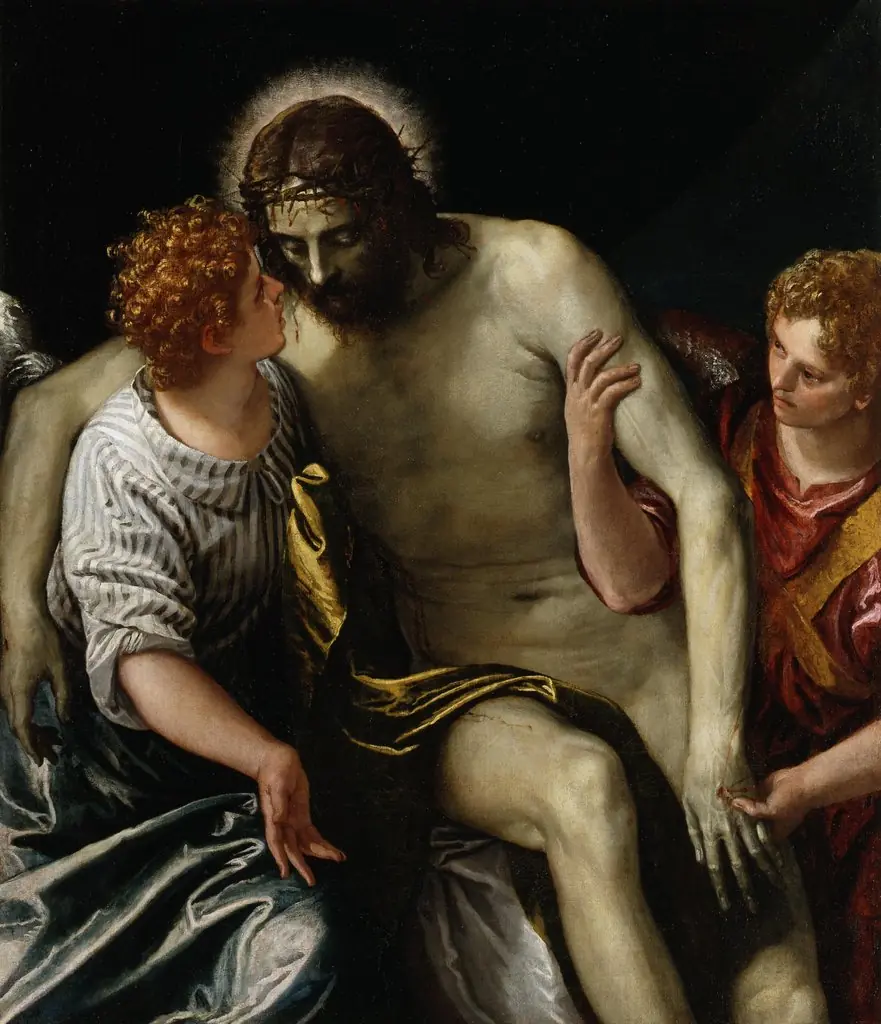
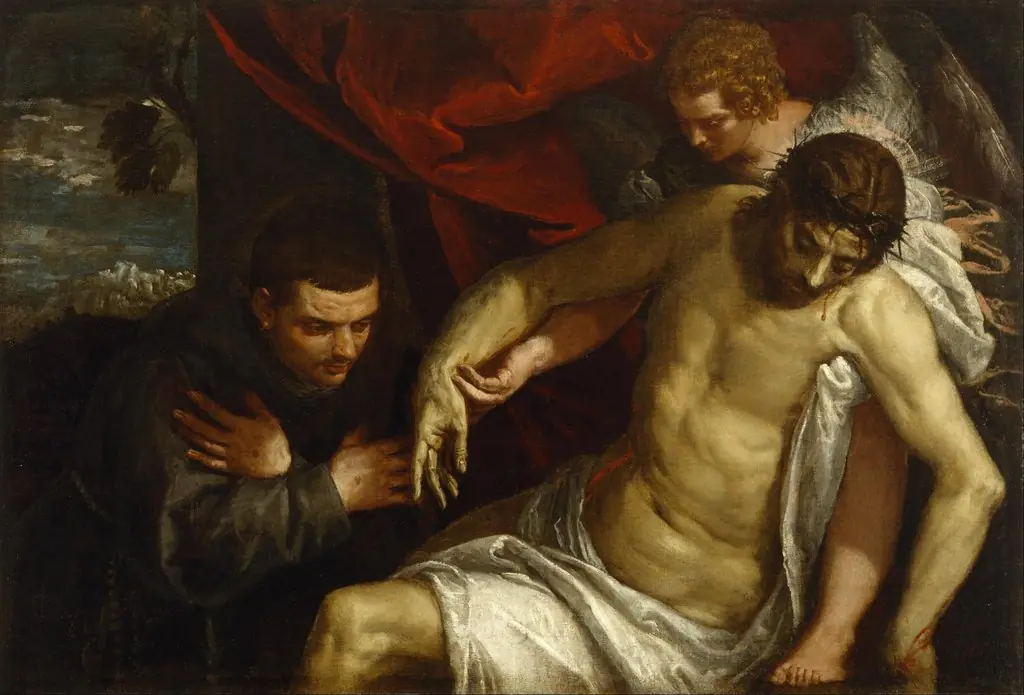
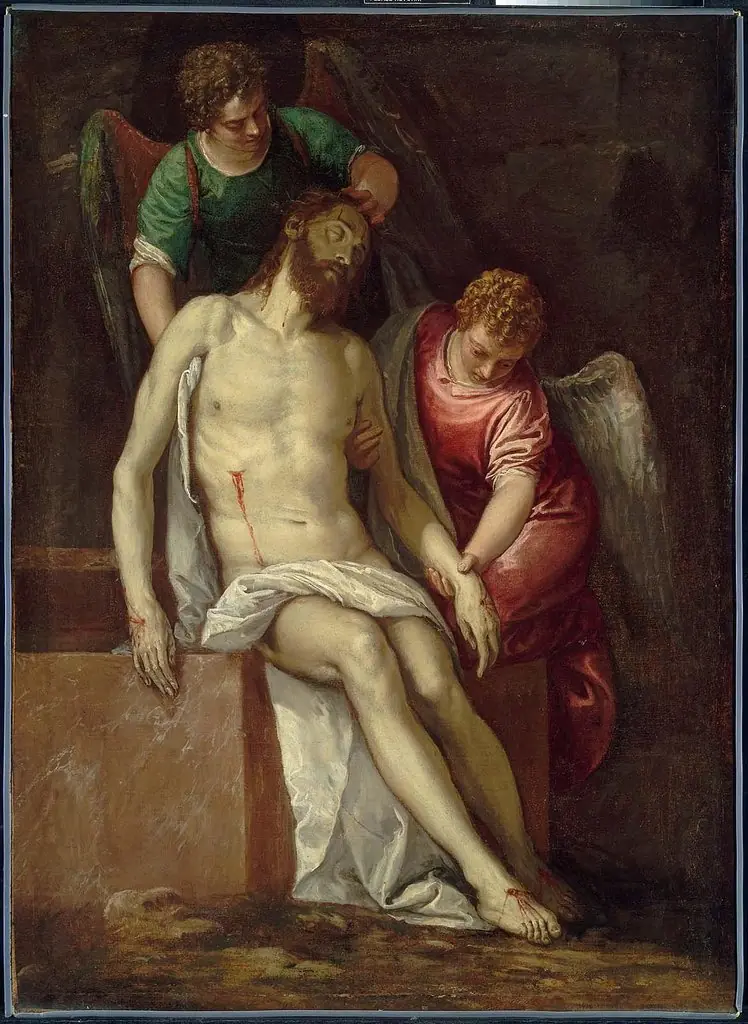
Scholarly interpretation often connects the painting to Ernest Renan's Vie de Jésus (1863), which denied Christ's resurrection and emphasized his humanity; the grieving angels support this reading (3,4,5,6). Manet also positioned the work against Courbet's realist theories, though Courbet himself mocked it (4,6). Art historians note its debt to Old Masters such as Mantegna, Veronese, and Tintoretto (5,6).
The work thus holds a unique place in Manet's oeuvre as a provocative religious piece that engaged with contemporary theological and artistic debates (3,4).
Legacy
The Dead Christ with Angels has accrued a notable legacy as a controversial yet historically significant work. Upon its debut at the Salon of 1864, the painting drew sharp criticism, which ultimately reinforced Manet's public image as a painter challenging social conventions. Its perceived connection to Ernest Renan’s then-contentious Vie de Jésus (1863) further fueled debate.
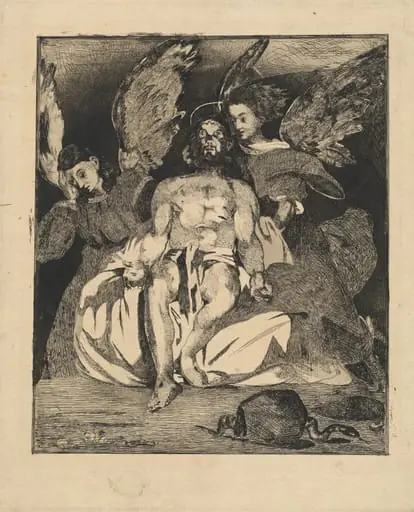
Manet revisited the composition in an etching executed around 1866–67. After passing through several private collections via the dealer Durand-Ruel, the painting entered the Metropolitan Museum of Art in 1929 as part of the Havemeyer bequest. It has since been featured in numerous exhibitions across Europe and the United States.
Modern scholarship often interprets the work not as a provocational gesture but as a sophisticated homage to Renaissance painters such as Tintoretto and Veronese.
Overview
Édouard Manet's 1864 oil painting, The Dead Christ with Angels, presents a departure from his typical contemporary themes. This work depicts a scene from the Gospel of John, showing Christ's body attended by two angels within the tomb. Notably, Manet chose to portray Christ's body still present, diverging from the biblical narrative of an empty tomb. The canvas is now held in the collection of the Metropolitan Museum of Art.
Own this work as a print
Artist & collection
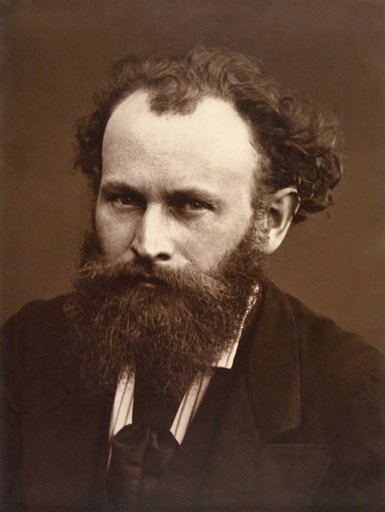
Artist
Édouard Manet was a French modernist painter. He was one of the first 19th-century artists to paint modern life, as well as a pivotal figure in the transition from Realism to Impressionism.