Dutch genre painting in the 1650s was carrying on a family quarrel, and Johannes Vermeer is the painter who staged the quarrel most plainly. The generation before him, the candlelit Utrecht Caravaggisti and the early painters of merry companies and bordellos, treated the scene of everyday life as theater: a wide grin, a raised glass, a procuress leaning into the bargain, the moral spelled out so no buyer could miss it. Vermeer's argument with that inheritance is the thesis this essay defends. He took the same domestic stage, the same single woman at a window, and drained it of anecdote until nothing was left but light, weight, and a held breath. The everyday stopped performing for the viewer and began, instead, to ignore him.
That is the claim worth carrying work by work: Vermeer's quiet is not temperament, it is a position. He inherited a manner that shouted and answered it with a manner that withholds. Where his predecessors used a picture to tell you what to think about a woman with a wine glass, Vermeer used paint to make you unsure, and then made the uncertainty the whole subject. Look at Woman Holding a Balance or the Woman with a Water Jug, and you are watching a movement argue with its own past in real time, brushstroke by brushstroke.
The argument hung on the back wall
The cleanest evidence that Vermeer knew exactly whom he was arguing with is that he sometimes painted his opponent into the room. The Utrecht school of Dirck van Baburen specialized in close-cropped scenes of negotiation and appetite, lit by a hard raking light borrowed at second hand from Caravaggio in Rome. A Baburen-type brothel piece, all bared teeth and outstretched palm, turns up on the back wall behind one of Vermeer's seated music-makers. The older picture is loud, frontal, and legible. The Vermeer woman in front of it is none of those things. The juxtaposition is the essay he refused to write in words. He put the predecessor up like a quotation and then declined to agree with it.
Genre painting, as the Tate defines it, simply means scenes of everyday life, and by the time Vermeer reached it the category was already crowded with conventions. There was a grammar of gesture: the proffered coin meant venality, the lute meant seduction, the open window meant a wandering mind. Vermeer kept the props and cut the grammar. A lute in his hands no longer announces anything. In Woman with a Lute, the player tunes her instrument and gazes off toward the window light, and the picture refuses to tell us whether she waits for a lover or simply listens for a string to come true. The vocabulary survives; the sermon is gone.
What the predecessors wanted, and what Vermeer wanted instead
It helps to be fair to the side Vermeer was arguing against. The earlier genre painters were not crude. They wanted legibility, narrative, and a viewer who left the picture knowing something. Their light served the story: it picked out the cheating hand, the exchanged glance, the spilled drink. The scene existed so the anecdote could happen. Vermeer's reversal is total. In his mature interiors the story serves the light. Whatever the woman is doing, pouring, weighing, reading, tuning, is mostly a reason to hold her still under a north window while the daylight does its slow work across plaster, linen, and skin. The event is an excuse. The illumination is the event.
You can date the shift inside Vermeer's own career. His A Girl Asleep still carries the residue of the older mode: a woman dozing over wine, a half-open door, a composition that seems to promise a moralizing reading about idleness or drink. X-rays famously found a man and a dog painted out of the doorway behind her, the kind of narrative hook his predecessors would have kept. Vermeer scraped the anecdote away and left an ambiguity. By the time he paints the women of the 1660s, the doorway is sealed, the second figure is gone, and the only thing crossing the threshold is light. The argument is something he had with himself before he had it with the previous generation.
Close looking: The Milkmaid
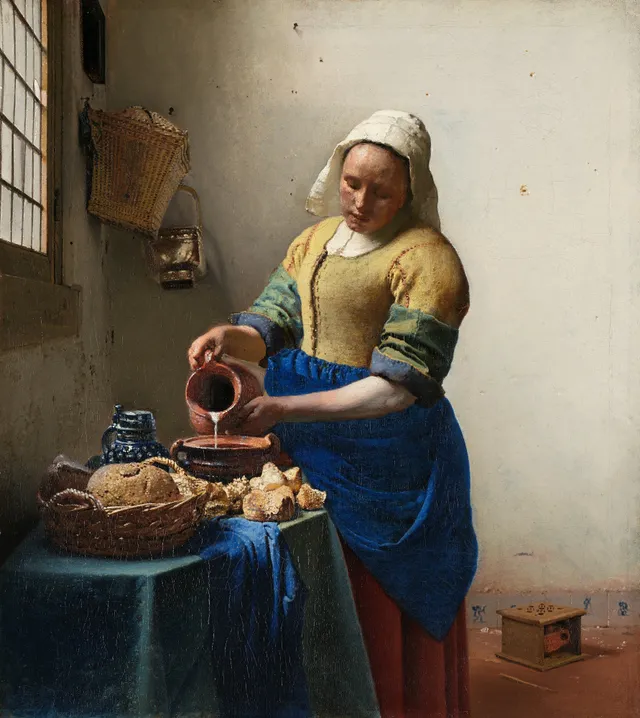
Stand close to The Milkmaid. A maidservant pours milk, wholly absorbed in her work, as the Rijksmuseum puts it. An earlier painter would have used a kitchen maid as a type, a comic or erotic stock figure, often winking at the viewer. Vermeer gives her the gravity of a saint. The light comes from a window at the left whose lower pane is cracked, and it lands on the bread on the table as small, separate beads of paint, each crumb a built-up dab that catches the day. The blue of her apron is laid in thick against the warm ochre wall, and the white wall behind her is not blank: it carries a scatter of old nail holes and a single nail still in place, with its little shadow. Down at the floor sits a foot warmer, a domestic detail the older tradition would have read as a symbol of female desire.
Notice what Vermeer does with all that loaded furniture. He neither confirms the symbol nor denies it. He simply makes the milk more interesting than the meaning. The thread of it, falling from the lip of the jug, is the most concentrated thing in the picture, painted so the eye snags on the pour and stays. A predecessor would have wanted you to read the room. Vermeer wants you to watch it. The maid does not look up. She will never look up. That refusal to acknowledge the viewer is the whole break with the merry-company manner, and it is delivered not by argument but by a woman pouring milk and meaning it.
Stillness as a thesis: Woman Holding a Balance
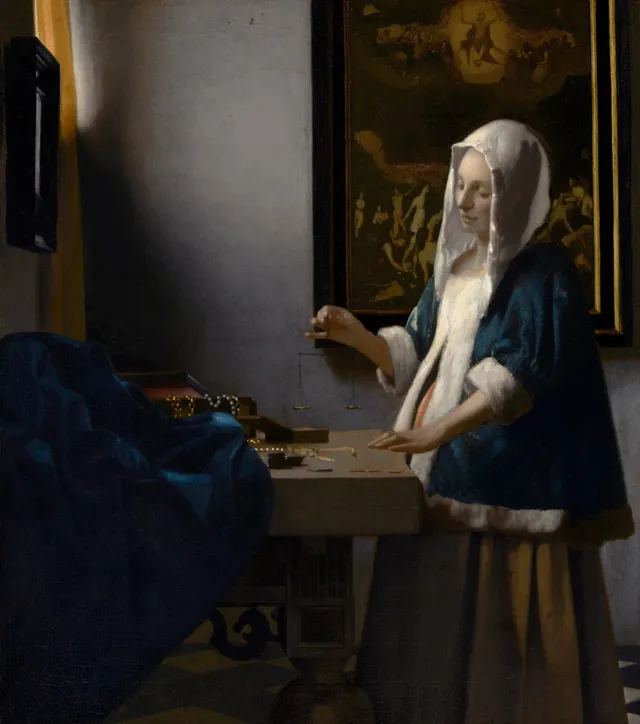
The most concentrated version of the argument is the Woman Holding a Balance in Washington, dated around 1664 by the National Gallery of Art. A woman stands at a table strewn with pearls and a chain of gold, holding a small balance between her fingers. On the wall behind her hangs a painting of the Last Judgment, Christ presiding over the weighing of souls. Here is the predecessor's whole machinery of meaning, laid out in a single frame: the gold that tempts, the scales that judge, the sacred picture that moralizes. An Utrecht painter would have closed the case. Vanity, vice, repentance, the lesson delivered.
Vermeer leaves the balance empty. Look at the pans: nothing in them. She is not weighing the pearls. She holds the scales level and looks down into them with an expression that is calm to the point of being unreadable, lit by a soft fall of light from the upper left that catches the white fur trim of her jacket and the rim of the empty pans. The Last Judgment looms, but it is dimmed, pushed into shadow, robbed of its thunder. The woman occupies the exact center of the composition where, in the picture behind her, Christ would sit in judgment. Vermeer sets a human stillness against a divine verdict and refuses to say which one wins. The older painting on the wall insists; the painted woman declines to be instructed. The whole quarrel of the movement is in that gap between the loud picture and the quiet one, six inches of plaster apart.
The scale of what survives shapes how we can even make this case. Artifact World Gallery holds 24 Vermeer works spread across 11 venues, all by the single hand, clustered in the roughly two decades between 1650 and 1670. That is already most of the painter. According to the Metropolitan Museum's Heilbrunn essay by Walter Liedtke, Vermeer produced perhaps about forty-five pictures in his life, of which only thirty-six are known today, and he remained largely obscure until the end of the nineteenth century. The Met's account makes the corpus number land harder. The argument this man had with his predecessors was carried out in a body of work small enough to fit on a few gallery walls, and every surviving canvas had to do real work in the case.
The same argument, heard by other ears
Vermeer was not arguing alone, and the contemporaries who heard the quarrel answered it in their own dialects. Gabriel Metsu kept far more of the narrative than Vermeer would allow. His interiors of letter-readers and sick visits still want to tell you a small story, and they tell it beautifully, with a warmth Vermeer rarely permits himself. Metsu is the painter who reformed the older anecdote rather than abolishing it. Set him beside Vermeer and you see two ways of answering the same inherited loudness: one softens the story, the other deletes it.
Closer to home in Delft, Carel Fabritius had already begun loosening the dark, dramatic manner of Rembrandt's circle toward a cooler, daylit clarity, setting figures against light walls instead of swallowing them in shadow. Fabritius died young and left few pictures, but the direction he was pointing, toward open light and a stilled scene, is the road Vermeer took the furthest. Older Delft hands like Leonaert Bramer, a painter of small nocturnal histories who is recorded among Vermeer's early connections, belonged to the very generation being argued with: theatrical, story-driven, fond of the torch-lit moment. The local lineage was right there to push against.
Works discussed in this article
The Woman with a Water Jug shows how complete the victory had become. A woman stands between a window she is opening and a basin she is lifting, one hand on each, and the picture freezes her at the instant before either action resolves. Nothing happens. Nothing needs to. The leaded glass scatters the morning into cool diamonds across the wall, the brass of the basin throws a faint warm reflection up onto her fingers, and the blue and white of her headdress answers the blue of the tablecloth across the room. A predecessor would have given her a reason: a visitor at the door, a letter on the table, a glance toward someone offstage. Vermeer gives her a window and a basin and the light between them, and that turns out to be enough to build a painting that holds the eye longer than any anecdote could.
Where the silence breaks: the Allegory
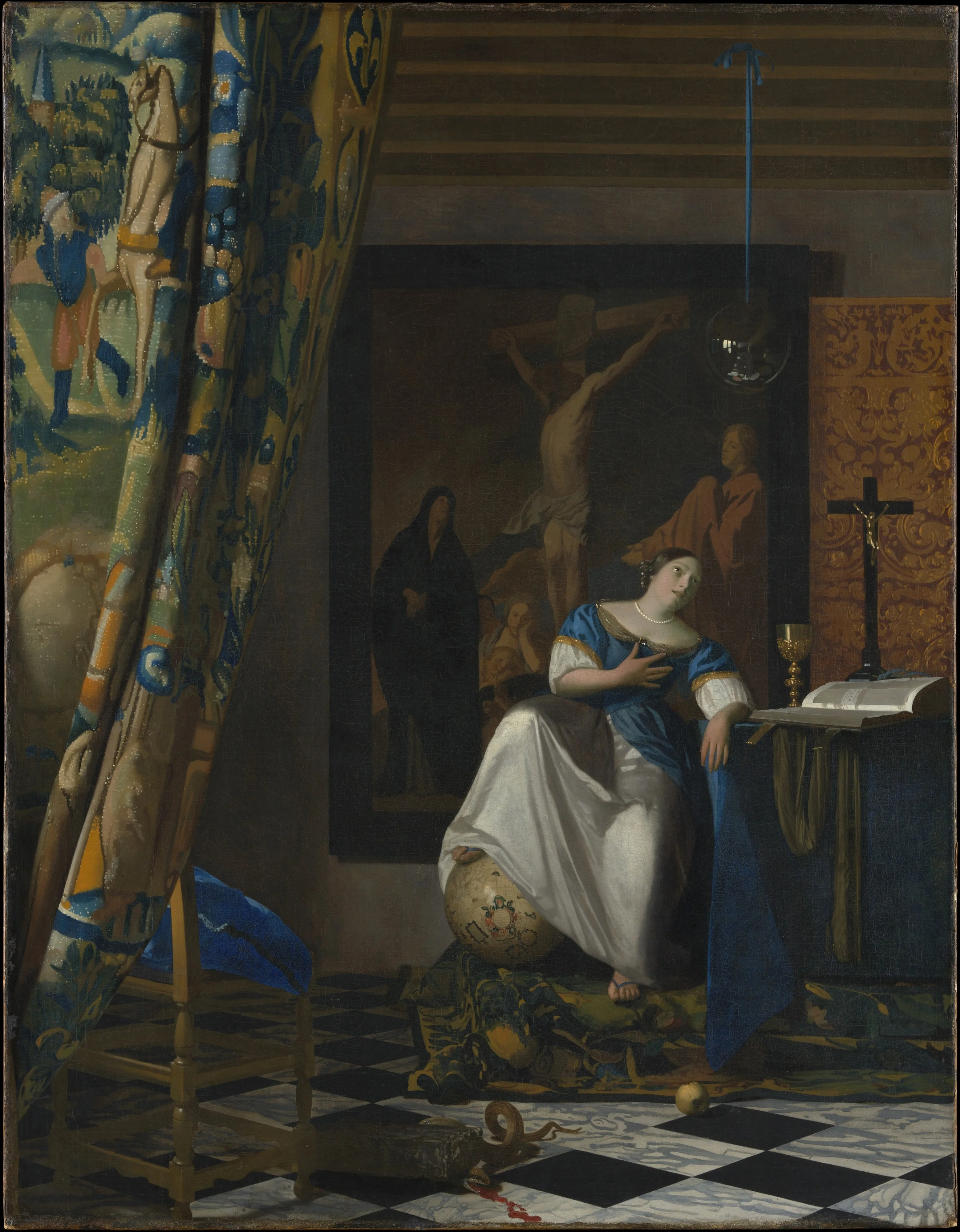
An honest case has to show where the thesis strains, and it strains in the Allegory of the Catholic Faith. Here Vermeer reaches for exactly the loud, legible symbolism he spent his career quieting. A woman personifying Faith sits with her foot on a globe and her hand on her heart, a glass sphere hanging above her, a serpent crushed beneath a cornerstone, a chalice and a great painting of the Crucifixion behind. Every object is keyed to a meaning, in the manner of the printed emblem books of the day. The picture announces. It instructs. It is, in its program, a return to the very mode of his predecessors.
And yet the hand betrays the program. The glass sphere overhead, reflecting the room in a small warped world, is painted with the same patient attention to light that animates the milk and the water jug. The drapery is observed, not merely emblematic. The argument leaks back in. Even when Vermeer accepts a commission to moralize at full volume, his eye keeps drifting to the way daylight curves around glass. The Allegory proves the rule by nearly breaking it: the symbolic apparatus is borrowed, but the looking is unmistakably his, and the looking is what we remember.
Why he vanished, and what came back instead
The strangest part of the story is that the argument was barely heard for two centuries. Vermeer painted slowly, sold locally, and sank into obscurity after his death, his name attached to a thin catalogue that confused him with other hands. The nineteenth-century revival rebuilt his reputation almost from scratch, and that rebuilding had consequences. A reputation assembled late and from few pictures is a reputation with gaps, and gaps invite fraud. The Dutch forger Han van Meegeren exploited exactly this, fabricating religious scenes and passing them off as lost early Vermeers, a hoax that for a time fooled the experts and is documented in detail in Jonathan Lopez's account of the affair.
There is a grim irony in the fakes. Van Meegeren did not imitate the silent women at their windows, the work that actually carries Vermeer's argument. He painted heavy, sermonizing biblical scenes, closer in spirit to the loud predecessors than to anything Vermeer fought for. The forgeries succeeded for a while because the public image of Vermeer was still being formed and could absorb almost anything. They failed in the end because the real Vermeer is, finally, hard to counterfeit. You can fake a subject. The quality of held light across a plaster wall resists the forger's hand. The thesis survives even its imitators: take away the stillness and the looking, and what is left is exactly the noise Vermeer had set out to refuse.
Set the empty balance beside the back-wall brothel scene one last time. The movement that produced Vermeer began by telling viewers what to feel and ended, in his hands, by trusting them to feel it unprompted in a room where nothing is explained. He won the argument so completely that we now mistake his answer for the natural state of painting. The next time a quiet interior strikes you as obvious, remember that someone had to argue a whole tradition into silence to make it look that way, weighing nothing in an empty pan and letting the light decide.
Sources & further reading
- Johannes Vermeer (1632-1675) — The Metropolitan Museum of Art, Heilbrunn Timeline of Art History
- The Milkmaid (Het melkmeisje) — Rijksmuseum, Amsterdam
- Woman Holding a Balance — National Gallery of Art, Washington
- Genre painting (art term) — Tate
- Johannes Vermeer, Girl with a Pearl Earring — Smarthistory
- Girl with a Pearl Earring — Wikipedia
- The Man Who Made Vermeers: Unvarnishing the Legend of Master Forger Han van Meegeren — Internet Archive
- Duveen Brothers records: van Meegeren 'Emmaus,' fake Vermeer — Getty Research Institute